The Quest to Prove the Existence of a New Type of Quantum Particle that could be created in exotic materials
https://www.wired.com/story/paraparticles-would-be-a-third-kingdom-of-quantum-particle/

The Quest to Prove the Existence of a New Type of Quantum Particle that could be created in exotic materials
https://www.wired.com/story/paraparticles-would-be-a-third-kingdom-of-quantum-particle/
1 Comment
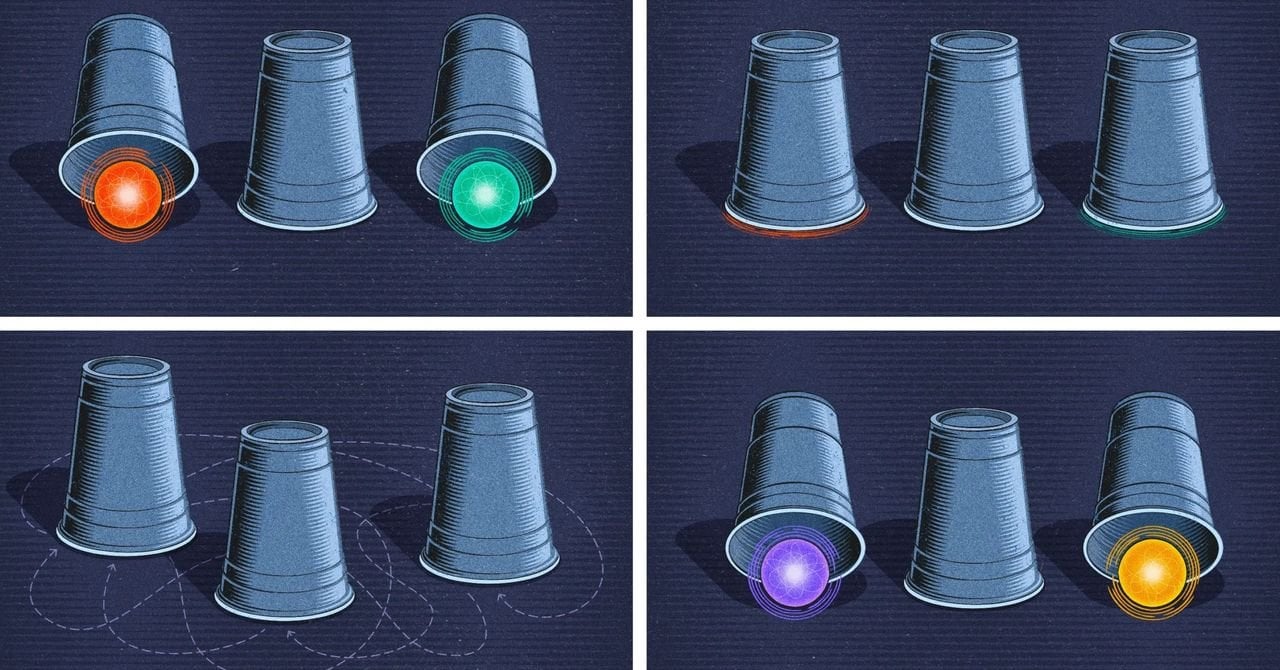
> All known elementary particles fall into one of two categories, and the two behave almost as opposites. There are the particles that make up matter, called fermions, and the particles that impart the fundamental forces, called bosons. The defining characteristic of fermions is that if you switch the positions of two fermions, their quantum state gains a minus sign. Bosons have no such restriction. Groups of bosons will happily all do exactly the same thing.
> It’s not obvious that fermions and bosons should be the only two options. That’s in part due to a fundamental feature of quantum theory: To calculate the probability of measuring a particle in any particular state, you have to take the mathematical description of that state and multiply it by itself.
> In theory, quantum particles can also have hidden internal states, **mathematical structures not seen in direct measurements, which also go away when squared.** A third, more general category of particle, known as a **paraparticle**, could arise from this internal state changing in a myriad of ways while the particles swap places.
> This means there’s a potential for new states of matter. Where bosons can pack an endless number of particles into the same state, and fermions can’t share a state at all, paraparticles end up somewhere in the middle. They are able to pack just a few particles into the same state, before getting crowded and forcing others into new states. Exactly how many can be crammed together depends on the details of the paraparticle—the theoretical framework allows for endless options.
> If paraparticles exist, they’ll most likely be emergent particles, called quasiparticles, that show up as **energetic vibrations in certain quantum materials.** “We might get new models of exotic phases, which were difficult to understand before, that you can now solve easily using paraparticles,” said Meng Cheng, a physicist at Yale University
> Bryce Gadway, an experimental physicist at Pennsylvania State University who sometimes collaborates with Hazzard, is optimistic that paraparticles will be realized in the lab in the next few years. These experiments would use **Rydberg atoms**, which are energized atoms with electrons that roam very far from their nuclei. This separation of the positive and negative charge makes Rydberg atoms especially sensitive to electric fields. You can build quantum computers out of interacting Rydberg atoms. They are also the **perfect candidates for creating paraparticles.**