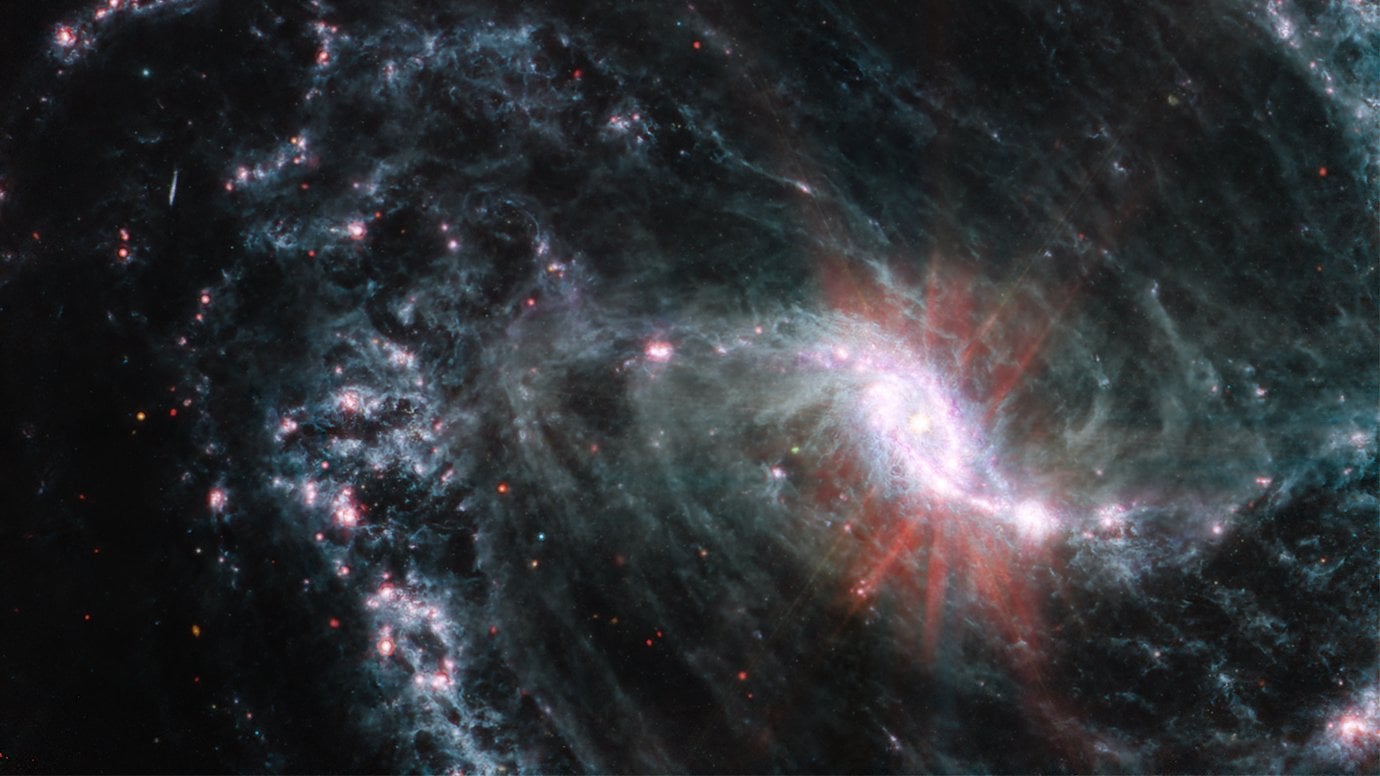
James Webb Space Telescope finds no evidence of tension in Hubble Constant, new evidence is suggesting that our Standard Model of the universe is holding up
https://news.uchicago.edu/story/new-measure-universes-expansion-suggests-resolution-conflict

James Webb Space Telescope finds no evidence of tension in Hubble Constant, new evidence is suggesting that our Standard Model of the universe is holding up
https://news.uchicago.edu/story/new-measure-universes-expansion-suggests-resolution-conflict
5 Comments
Finally a normal article from respectful source there
Will be interesting to see the discussion on the difference between analysis by the Chicago-Carnegie team with Friedmann et al Vs the CATS group with Scolnic and Riess et al
> Freedman’s latest calculation, which incorporates data from both the Hubble Telescope and the James Webb Space Telescope, finds a value of 70.4 kilometers per second per megaparsec, plus or minus 3%.
That brings her value into statistical agreement with recent measurements from the cosmic microwave background, which is 67.4, plus or minus 0.7%.
67.4 x 1.007 = 67.8718
70.4 x 0.97 = 68.288
<insert orangutan meme> Where statistical agreement?
I mean, our standard model amounts to “gravity doesn’t work terribly well at the galactic scale, it’s like there’s more matter than we can see. It doesn’t work very well at very large scales either, something is pushing everything apart.” We’ve given those things names, but we’re no closer to knowing what they are.
With that caveat in place, yes, the model is holding up. We still think gravity doesn’t work very well as a model at galactic scales (or there’s a big pile of matter present that we can’t detect in any other way) and we still think something is pushing everything apart.
Astronomer here! This is one of those big debates in science that is fundamental, but it’s unclear how it’ll shake out. The TL; DR question here is a basic question in cosmology- how fast is the universe expanding?
Astronomers measure this rate with a parameter called the [Hubble constant](https://news.uchicago.edu/explainer/hubble-constant-explained) (called H0 at our current time), and it’s not like we have a simple way of measuring it at great distances- we have some, to be sure, but all have some error in the calculated method and the question is how well you understand that error. And it turns out *some* methods do not agree with each other to a large amount- specifically, if you look at our local universe, the Hubble constant is a notably higher value than what you get from the earliest radiation in the universe, called the Cosmic Microwave Background. This is called the “Hubble Tension,” and is one of the big outstanding questions of astrophysics.
Now there are two big groups who are working on this in our local universe (and smaller ones to be fair), one led by Adam Reiss who won the Nobel Prize for first discovering the accelerating expansion of the universe (ie, dark energy), and his group keeps insisting they see if the Hubble constant has changed over time. On the other hand we have the folks behind this linked release, led by Wendy Freedman at Chicago, who is less insistent. In fact, her group has begun arguing that if you do the analysis of JWST and Hubble data their way, there *is* no Hubble tension- it disappears! But then the Reiss geouo thinks they’re just doing it wrong- for example, they wrote [this paper](https://arxiv.org/abs/2408.11770) in response to the analysis before this one from this same group led by Freedman, arguing things like their sample size isn’t big enough.
I frankly don’t operate in this field enough to definitively say who is right- but I *do* enjoy a good scientific debate, as we all should! Whatever the answer ultimately is- is the expansion of the universe constant, or changing over time- it’s a tough question and we don’t have the answer yet for sure.