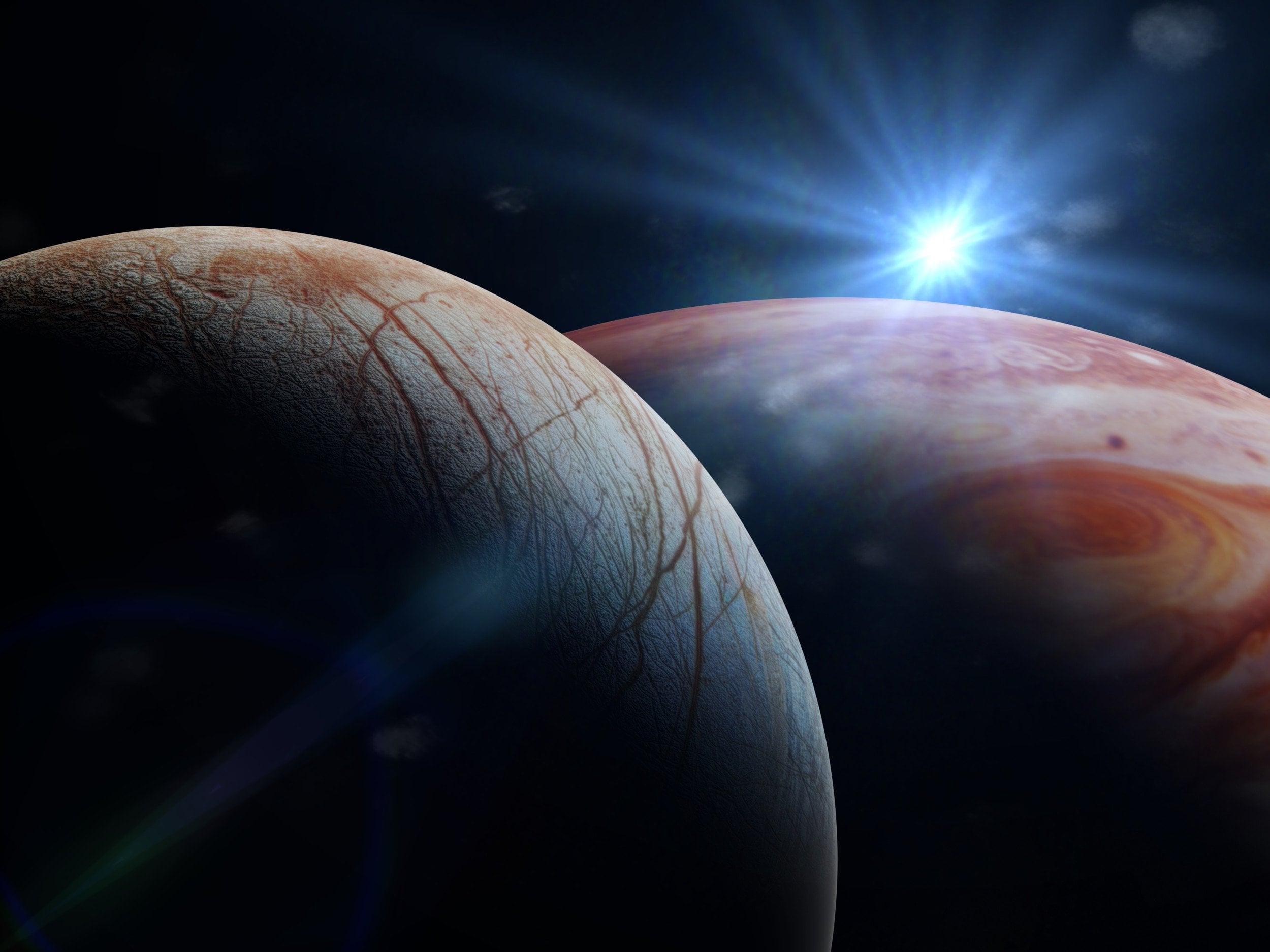
Mysterious surface changes on Jupiter’s moon point to something deep below
https://www.newsweek.com/jupiter-moon-europa-webb-ocean-amorphous-water-ice-2078542

Mysterious surface changes on Jupiter’s moon point to something deep below
https://www.newsweek.com/jupiter-moon-europa-webb-ocean-amorphous-water-ice-2078542
7 Comments
By Ian Randall — Deputy Science Editor |
The icy surface of Jupiter’s moon Europa appears to be constantly changing, new data from the James Webb Space Telescope has revealed.
This phenomena, the team explained, is heightened in so-called “chaos regions” where surface features like cracks, plains and ridges end up jumbled and ensnared together.
“We think that the surface is fairly porous and warm enough in some areas to allow the ice to recrystallize rapidly,” said paper author and geologist Richard Cartwright of Johns Hopkins University in a statement.
Read more: [https://www.newsweek.com/jupiter-moon-europa-webb-ocean-amorphous-water-ice-2078542](https://www.newsweek.com/jupiter-moon-europa-webb-ocean-amorphous-water-ice-2078542)
Title reads like a Stellaris point of interest. Love it
Send a lander with various ways to bore through the ice. Each with a tether, microphone, video and sensors to detect whatever is most important. It could sit there for years slowly melting, boring and possibly taking video while submerged. Make it shark proof just in case.
James Webb telescope is really the greatest achievement of our species to date.
Hope it continues to push our understanding of the universe further.
Junk article clickbait word bingo: MYSTERIOUS!
As long as it’s not Janus. That would be a problem.
This isn’t even close to new information and the author should be ashamed to present it as such.
The ocean beneath Europa’s surface has been known about for so long that Arthur C. Clark [wrote a novel featuring it in 1985](https://en.m.wikipedia.org/wiki/2010:_Odyssey_Two#:~:text=2010%3A%20Odyssey%20Two%20is%20a,the%20film%20version%20of%202001.).
Edit: not 1985, it was in 1982