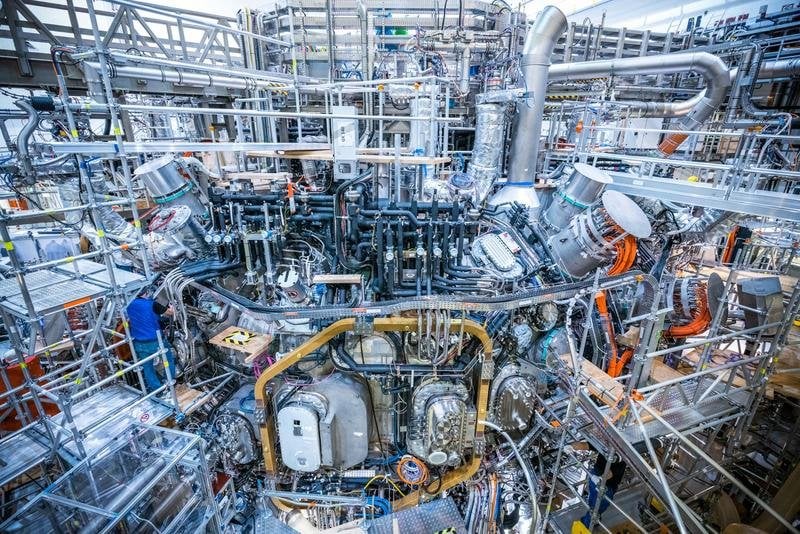
Wendelstein 7-X sets new performance records in fusion research
https://nachrichten.idw-online.de/2025/06/03/wendelstein-7-x-sets-new-performance-records-in-fusion-research

Wendelstein 7-X sets new performance records in fusion research
https://nachrichten.idw-online.de/2025/06/03/wendelstein-7-x-sets-new-performance-records-in-fusion-research
2 Comments
Submission Statement:
On May 22, 2024, the Wendelstein 7-X (W7-X), operated by the Max Planck Institute for Plasma Physics in Greifswald, Germany, completed its latest experimental cycle, achieving major milestones in nuclear fusion research. W7-X is the world’s largest and most advanced stellarator, a type of nuclear fusion device that utilizes complex magnetic fields to confine extremely hot plasma. Its goal is to prove that stellarators can achieve the performance required for future fusion power plants, potentially offering a highly stable and efficient alternative to the better-known tokamak devices.
The most significant accomplishment from this campaign was the attainment of a new world record for the “triple product” in fusion physics—an essential benchmark that combines plasma density, temperature, and energy confinement time (known as the Lawson criterion). During a 43-second plasma discharge, W7-X achieved a triple product value surpassing those set by leading tokamaks (such as JET in the UK and JT60U in Japan) for similar or longer pulse durations. While tokamaks have historically achieved higher triple product values during very short pulses, W7-X now holds the record for sustained performance—an essential necessity for any future power plant.
A major breakthrough contributing to this success was the integration of a cutting-edge pellet injector system developed by Oak Ridge National Laboratory in the USA. This unique system injects a continuous stream of small, frozen hydrogen pellets into the plasma, effectively allowing the W7-X plasma to be refueled and maintained over much longer periods, and in the core of the plasma, where the fuel is needed. During the record-setting experiment, approximately 90 such hydrogen pellets were injected, while the plasma was simultaneously heated with powerful microwave systems—a technique crucial for reaching the necessary temperatures for fusion. This achievement was made possible by extensive collaboration, including contributions from European partners in diagnostics and plasma heating design.
Beyond the triple product, the W7-X campaign also set new records in total energy turnover and in achieving high plasma pressures relative to the confining magnetic field. Energy turnover reached 1.8 gigajoules over 360 seconds, exceeding similar results from large Asian tokamaks, and plasma pressure relative to magnetic pressure hit 3%—an important step toward the 4–5% required for commercial fusion reactors.
These results collectively mark a significant validation of the stellarator concept and demonstrate practical steps toward establishing a reliable, continuous fusion power source. Importantly, the ongoing international collaboration between European and American research institutions has been key to these advancements, reflecting the complexity and scale of modern fusion research. Overall, the W7-X’s performance in sustained fusion-relevant conditions highlights its promise as a cornerstone for future fusion power plants, driving efforts to achieve a positive energy balance and practical fusion energy generation.
Dunno if this thing is actually good but it looks impressive. Good sci-fi stuff.