Here’s some additional information about the data that I share in the post.
**Project types**
There are 959 carbon capture projects in the CCUS projects database.
They belong to one of six project types:
1. Capture (401)
2. Full chain (172)
3. Storage (157)
4. Transport & Storage (107)
5. Transport (64)
6. Capture for use (58)
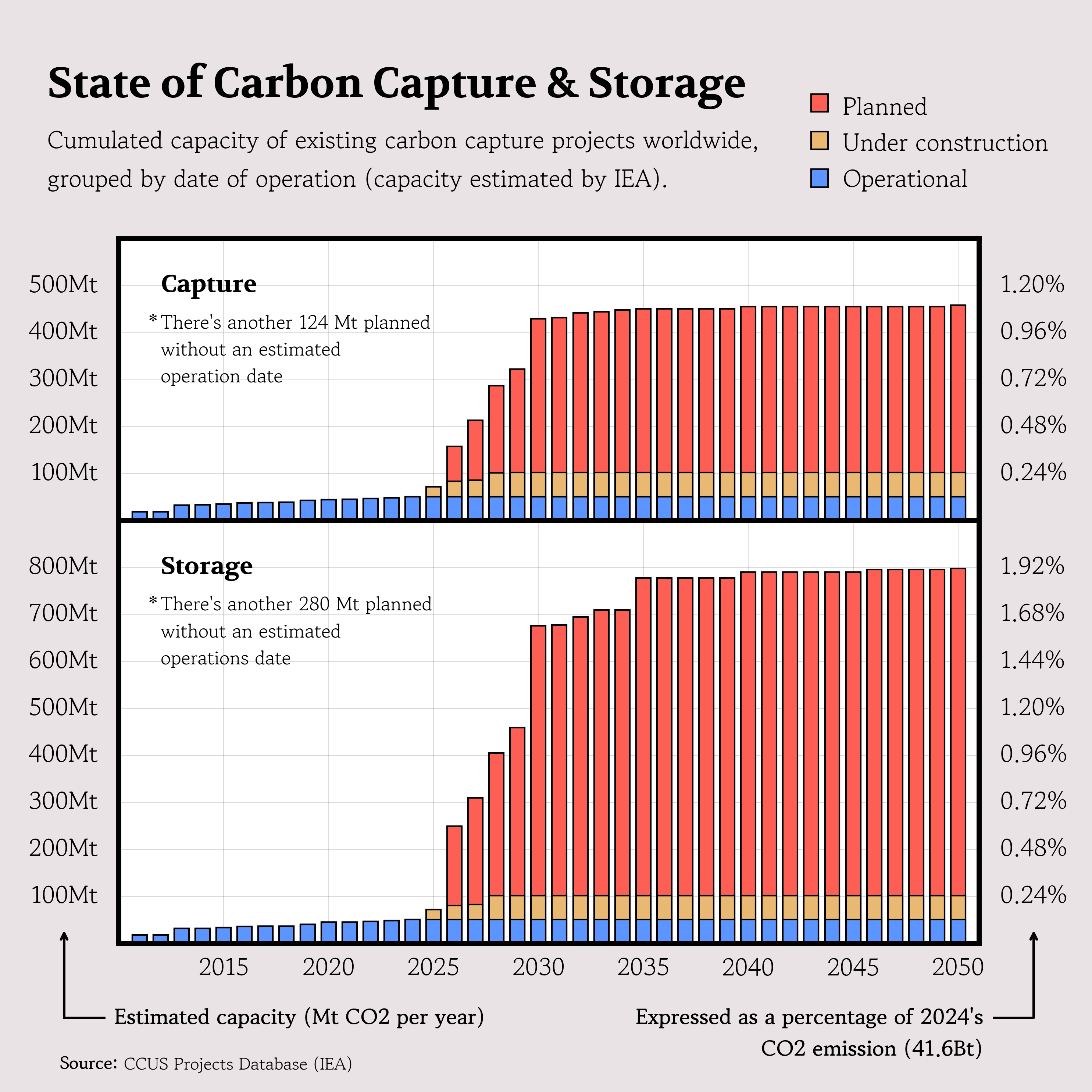
In the chart, capture is the sum of estimated capacity for projects with type “Capture”, “Full chain”, or “Capture for use”.
Storage shows the sum of projects with type “Transport & Storage”, “Storage“, and “Full chain“.
Transport project doesn’t include any capture or storage.
**Sectors for carbon capture**
There are projects for capturing up to 582 Mt of carbon per year and they capture carbon from one of the following industries.
* Power and heat (30.4%)
* Hydrogen or ammonia (19.6%)
* Natural gas processing (14.4%)
* Other fuel transformation (10.8%)
* Cement (7.4%)
* Biofuels (6.7%)
* Chemicals (3.9%)
* Iron and steel (2.4%)
* Direct air capture (2%)
* Other industries (2.4%)
**Conclusion**
Current carbon capture projects can handle around 1% of current CO2 emissions. That’s not enough to change the trajectory of climate change.
Looking at project that are operational or under construction, that number becomes as low as 0.24%.
Let’s hope for some promising progress leading the way for the development of more ambitious projects soon.
remorej on
You should create one where the top of the scale is the total CO2 emission.
233C on
Are those “I build a coal power plant, but look, I capture ‘most’ of my CO2” (ie still an overall net emission), or Direct Air Capture (ie “I take CO2 that is already there and remove it, resulting in an overall net decrease”)? And in the latter, does it take into account the origin of the power need?
Ryyyyyaaaaan on
Somehow I bet the graph looked the same 10 years ago. All planned, never completed.
zezzene on
Wow crazy how much effort we are going to put in, tomorrow
Plenty_Quail_9645 on
Carbon capture looking like it’s still stuck in the “nice try” phase, but gotta start somewhere.
Jsstt on
Wait, so according to this chart, we’re already capturing 0.1% of the current global output? That is about five orders of magnitude higher than I expected. It also means that if we scale up by a factor of 1000, we’re at a break-even point. And given that, as far as I know, carbon capture isn’t that high on everyone’s to-do list, it seems weirdly achievable to reach that point if countries start seriously investing. And *that* makes me question the original figure of 0.1% because I don’t believe that for a second, lol.
geek66 on
IT DOES NOT SCALE
The same effort and dollars spent to move away from fossil fuels would have 100x impact.
As a very long term – moonshot – type research, no problem. But every start-up trying to legitimize CCS in the near term is a money grabbing boondoggle
Mr-Blah on
It needs another color to represent the planned capture capacity that was supposed to be operational, to really highlight their lies.
crunk on
This whole thing is a grift right ?
I mean, it never seemed like a good idea, and lots of them use more energy than they put in – pure greenwashing.
Aleph_NULL__ on
sure, but if we’re going off “likelihood of burning” a forest is orders of magnitude higher risk than a house or a CLT building. A healthy timber industry is possible, and probably the most pragmatic carbon sequestration we have today
GreenKangaroo3 on
Isn’t that a… Ridiculously low amount?
Does that make a difference at all?
jbano on
Only the HUGE land owners will cash huge carbon storage checks that will prevent them from harvesting for 30 years. And then the federal program will go belly up after 2 years and half of the initial money clears the checking account then the contracts will be voided and the HUGE land owners will walk with the cash and the ability to do what they want with the land in just a couple years. This has happened time and time again with these fraudulent carbon sequestration projects.
downrightmike on
Carbon capture is a bait and switch, completely useless while more carbon is pumped into the atmosphere day after day
alainreid on
How can there be construction every year and not have “Operational” increase?
KnotSoSalty on
Sigh…
The problem is that carbon capture is really really energy intensive. Like doubling our total energy production might put a dent it in.
This goes the fundamental assumption that solar/wind will fix our climate problems. Those technologies struggle to just replace our current energy needs when we probably need to triple production.
NickForBR on
And it’s all total bullshit. There is no reality where carbon capture makes any sense. It’s a fake “solution” by oil companies to act like they’re solving a problem. Look up the Gorgon Project in Australia – turns out pumping millions of pounds of carbon into the ground causes seismic activity and gets less efficient over time!
It’s not net positive – it’s net stupid.
Alis451 on
fun fact: building wood framed houses is technically a form of carbon sequestering. 2 birds, 1 stone!

![[OC] The Current State of Carbon Capture & Storage Projects](https://www.byteseu.com/wp-content/uploads/2025/06/43zpl6jbax4f1-1536x1536.png "[OC] The Current State of Carbon Capture & Storage Projects")
19 Comments
The lumber industry alone captures 2,000 Mt of carbon per year, dwarfing all of these numbers.
I created this chart for my my newsletter [Data Squares](https://datasquares.substack.com/)
Here’s some additional information about the data that I share in the post.
**Project types**
There are 959 carbon capture projects in the CCUS projects database.
They belong to one of six project types:
1. Capture (401)
2. Full chain (172)
3. Storage (157)
4. Transport & Storage (107)
5. Transport (64)
6. Capture for use (58)
In the chart, capture is the sum of estimated capacity for projects with type “Capture”, “Full chain”, or “Capture for use”.
Storage shows the sum of projects with type “Transport & Storage”, “Storage“, and “Full chain“.
Transport project doesn’t include any capture or storage.
**Sectors for carbon capture**
There are projects for capturing up to 582 Mt of carbon per year and they capture carbon from one of the following industries.
* Power and heat (30.4%)
* Hydrogen or ammonia (19.6%)
* Natural gas processing (14.4%)
* Other fuel transformation (10.8%)
* Cement (7.4%)
* Biofuels (6.7%)
* Chemicals (3.9%)
* Iron and steel (2.4%)
* Direct air capture (2%)
* Other industries (2.4%)
**Conclusion**
Current carbon capture projects can handle around 1% of current CO2 emissions. That’s not enough to change the trajectory of climate change.
Looking at project that are operational or under construction, that number becomes as low as 0.24%.
Let’s hope for some promising progress leading the way for the development of more ambitious projects soon.
You should create one where the top of the scale is the total CO2 emission.
Are those “I build a coal power plant, but look, I capture ‘most’ of my CO2” (ie still an overall net emission), or Direct Air Capture (ie “I take CO2 that is already there and remove it, resulting in an overall net decrease”)? And in the latter, does it take into account the origin of the power need?
Somehow I bet the graph looked the same 10 years ago. All planned, never completed.
Wow crazy how much effort we are going to put in, tomorrow
Carbon capture looking like it’s still stuck in the “nice try” phase, but gotta start somewhere.
Wait, so according to this chart, we’re already capturing 0.1% of the current global output? That is about five orders of magnitude higher than I expected. It also means that if we scale up by a factor of 1000, we’re at a break-even point. And given that, as far as I know, carbon capture isn’t that high on everyone’s to-do list, it seems weirdly achievable to reach that point if countries start seriously investing. And *that* makes me question the original figure of 0.1% because I don’t believe that for a second, lol.
IT DOES NOT SCALE
The same effort and dollars spent to move away from fossil fuels would have 100x impact.
As a very long term – moonshot – type research, no problem. But every start-up trying to legitimize CCS in the near term is a money grabbing boondoggle
It needs another color to represent the planned capture capacity that was supposed to be operational, to really highlight their lies.
This whole thing is a grift right ?
I mean, it never seemed like a good idea, and lots of them use more energy than they put in – pure greenwashing.
sure, but if we’re going off “likelihood of burning” a forest is orders of magnitude higher risk than a house or a CLT building. A healthy timber industry is possible, and probably the most pragmatic carbon sequestration we have today
Isn’t that a… Ridiculously low amount?
Does that make a difference at all?
Only the HUGE land owners will cash huge carbon storage checks that will prevent them from harvesting for 30 years. And then the federal program will go belly up after 2 years and half of the initial money clears the checking account then the contracts will be voided and the HUGE land owners will walk with the cash and the ability to do what they want with the land in just a couple years. This has happened time and time again with these fraudulent carbon sequestration projects.
Carbon capture is a bait and switch, completely useless while more carbon is pumped into the atmosphere day after day
How can there be construction every year and not have “Operational” increase?
Sigh…
The problem is that carbon capture is really really energy intensive. Like doubling our total energy production might put a dent it in.
This goes the fundamental assumption that solar/wind will fix our climate problems. Those technologies struggle to just replace our current energy needs when we probably need to triple production.
And it’s all total bullshit. There is no reality where carbon capture makes any sense. It’s a fake “solution” by oil companies to act like they’re solving a problem. Look up the Gorgon Project in Australia – turns out pumping millions of pounds of carbon into the ground causes seismic activity and gets less efficient over time!
It’s not net positive – it’s net stupid.
fun fact: building wood framed houses is technically a form of carbon sequestering. 2 birds, 1 stone!