Martian crash test passed: Black fungus survives the harshest conditions of the extraterrestrial environment
https://universemagazine.com/en/martian-crash-test-passed-black-fungus-survives-the-harshest-conditions-of-the-extraterrestrial-environment/

Martian crash test passed: Black fungus survives the harshest conditions of the extraterrestrial environment
https://universemagazine.com/en/martian-crash-test-passed-black-fungus-survives-the-harshest-conditions-of-the-extraterrestrial-environment/
5 Comments
> An international group of biologists and astrobiologists has published the results of their research in npj Microgravity, which changes our understanding of the limits of life on Earth. The authors examined how the extremophile black fungus Rhinocladiella similis behaves when exposed to two key factors on Mars: **high doses of UV-C radiation and magnesium perchlorates**, salts that are found in large quantities in Martian soil.
> Scientists exposed the fungus to a “cocktail” of Martian salt and strong ultraviolet light — conditions in which most microbes die. However, Rhinocladiella similis **survived at a rate of nearly 80%**, while the Martian fungus lost half of its cells. Even in a very salty solution, similar to possible Martian conditions, the black fungus grew calmly.
> Using proteomics and metabolomics, scientists have discovered that the fungus transforms into a yeast form, increasing the production of antioxidant enzymes and protective melanin pigments. This “molecular shield” neutralizes active forms of oxygen and stabilizes cell membranes in a saline environment. This shield neutralizes harmful oxygen “garbage” and **strengthens cell walls, making it resistant to salt and radiation.**
> The study once again demonstrates that life on Earth already possesses the tools necessary to conquer the harshest niches of the Red Planet. It seems that humanity’s struggle for survival on Mars may gain an unexpected fungal ally.
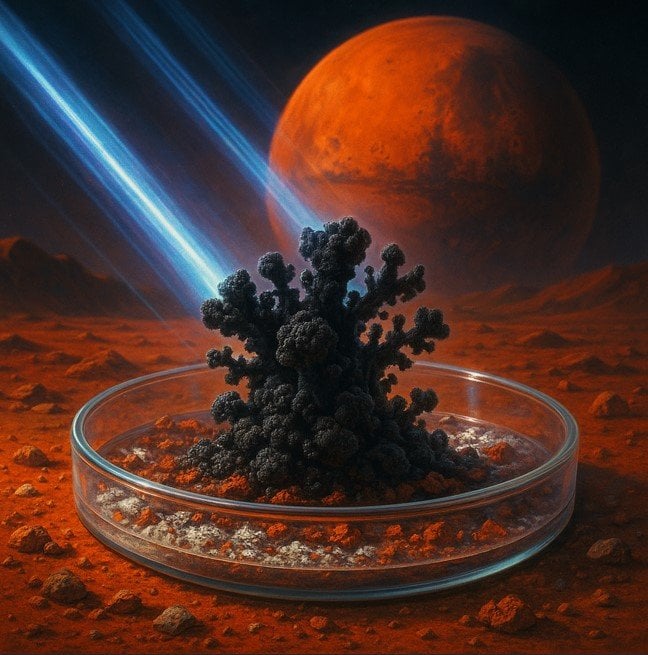
Illustration for the article is DALLE slop labeled as “artist’s interpretation.”
Actual study: https://pmc.ncbi.nlm.nih.gov/articles/PMC12095635/
I can’t imagine this actually being useful information
Pretty cool. If I’m understanding the article correctly there are a few potential benefits.
First searching for biosignatures of life elsewhere.
Second as one potential candidate for geo-engineering. The layer they talk about changes the environment to an extent helping other organisms to live easier, along with itself. One piece of the puzzle to potential terraforming, even if it’s within a biosphere like structure that uses natural martian soil.
We’re along way for any kind of terraforming imo but still, a step.