I’m sure this would be very interesting if I knew anything about music.
MuffinMan157 on
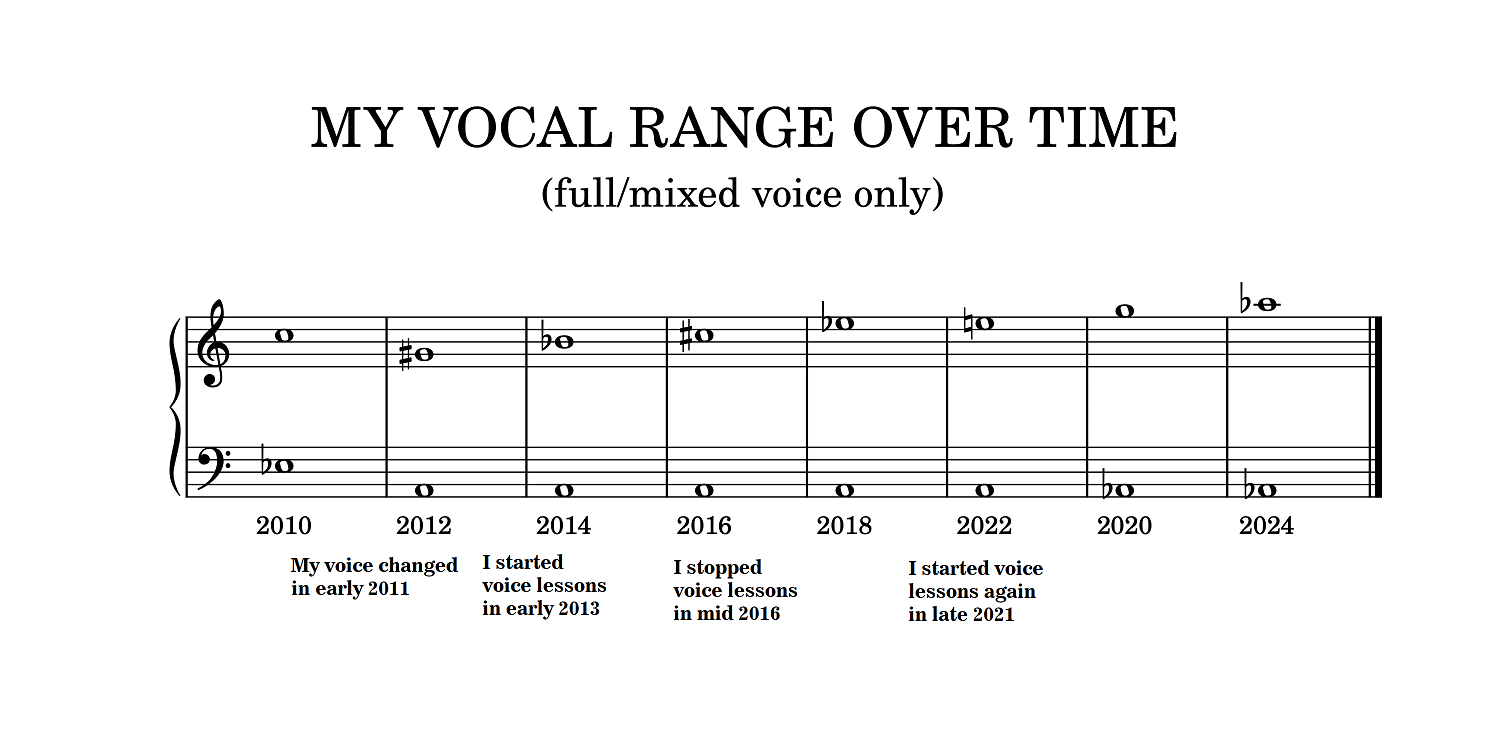
I’m assuming 2022 and 2020 are flipped?
fomorian on
That’s a fantastic way to visualize it! I’m inspired to create something similar. I started choral singing about 2 years ago, and my vocal range has improved a lot but I find myself really struggling with my upper range namely c4 is where my voice likes to crack, for basses thats supposed to be doable in chest voice apparently, so I don’t know what I’m doing wrong
Voxmanns on
Congratulations! That’s a great improvement in range, and I am sure the quality and timbre of the notes has improved significantly as well. Good stuff!
MerryxPippin on
What a refreshing viz to see in the sub…. unusual, yet elegant!
I agree that you need more scaffolding for people who can’t read music. Maybe something indicating the half step count of your range for 2010 and 2024?
grudginglyadmitted on
Great visualization.
I just read The Visual Display of Quantitative Information (*interesting if you ever want to create graphics, but also fantastic even if you just like looking at good graphics*) and while most graphics, even here on r/dataisbeautiful don’t meet the author’s standard, every once in a while there’ll be a really brilliant, creative, or elegant graphic that makes me think of the examples/good graphics in that book. This is one.
I just find this really elegant. Each measure cleverly still shows time, and it very naturally invites comparison measure/year to measure/year. There’s no more wasted data-ink than tried-and-true sheet music.
Do you have experience creating graphics/data displays or is this your first one? Bc if the former I want to see more and if the latter, you have a great natural sense of elegant graphical design.
PreparedStatement on
Based on the low end of your range, I’d guess you’re a First Tenor. If so, I’m willing to bet a hefty chunk of that top octave is falsetto. As a second tenor, I’m lucky to hit G4 before I have to go falsetto. (Not disparaging falsetto, it certainly has its place.)
funf_ on
I’m not super familiar with vocal training, but why does your lower range only drop a half step over a decade? Is it more difficult to train your lower register to go lower or do you just not need to access that range in your performances? Some combination of the two?

![[OC] My vocal range over time](https://www.byteseu.com/wp-content/uploads/2025/06/fjpy48w8ue7f1-1024x520.png "[OC] My vocal range over time")
8 Comments
I’m sure this would be very interesting if I knew anything about music.
I’m assuming 2022 and 2020 are flipped?
That’s a fantastic way to visualize it! I’m inspired to create something similar. I started choral singing about 2 years ago, and my vocal range has improved a lot but I find myself really struggling with my upper range namely c4 is where my voice likes to crack, for basses thats supposed to be doable in chest voice apparently, so I don’t know what I’m doing wrong
Congratulations! That’s a great improvement in range, and I am sure the quality and timbre of the notes has improved significantly as well. Good stuff!
What a refreshing viz to see in the sub…. unusual, yet elegant!
I agree that you need more scaffolding for people who can’t read music. Maybe something indicating the half step count of your range for 2010 and 2024?
Great visualization.
I just read The Visual Display of Quantitative Information (*interesting if you ever want to create graphics, but also fantastic even if you just like looking at good graphics*) and while most graphics, even here on r/dataisbeautiful don’t meet the author’s standard, every once in a while there’ll be a really brilliant, creative, or elegant graphic that makes me think of the examples/good graphics in that book. This is one.
I just find this really elegant. Each measure cleverly still shows time, and it very naturally invites comparison measure/year to measure/year. There’s no more wasted data-ink than tried-and-true sheet music.
Do you have experience creating graphics/data displays or is this your first one? Bc if the former I want to see more and if the latter, you have a great natural sense of elegant graphical design.
Based on the low end of your range, I’d guess you’re a First Tenor. If so, I’m willing to bet a hefty chunk of that top octave is falsetto. As a second tenor, I’m lucky to hit G4 before I have to go falsetto. (Not disparaging falsetto, it certainly has its place.)
I’m not super familiar with vocal training, but why does your lower range only drop a half step over a decade? Is it more difficult to train your lower register to go lower or do you just not need to access that range in your performances? Some combination of the two?