
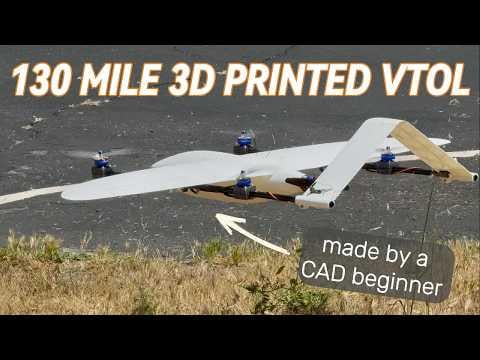
Ukraine's recent Spiderweb operation pointed to how decisive drones can be in modern warfare. Now here's another indication. With commonly available materials they can be built by amateurs.
20th century mass-warfare was defined by a nation's industrial might. But it seems you don't need that to build drones. They're following another 21st century trend – working from home. In traditional warfare, bombing industrial centers got results – what will it mean with drones when there doesn't have to be a 'center' – as they can be made anywhere and everywhere?
I made a 3D printed VTOL that can fly 130 miles (as a CAD beginner)
An Australian in California built a 210 km-range drone in 90 days using off-the-shelf parts, a 3D printer, and no prior experience—showing how accessible drone warfare has become.
byu/lughnasadh inFuturology
4 Comments
Bruce Simpson (a New Zealand blogger, RC enthusiast, all round loon, and [thorn in the side of his local council](https://www.youtube.com/watch?v=xGV_l-7s428)) designed [an ‘off the shelf parts’ cruise missile back in 2002](https://aardvark.co.nz/pjet/cruise.shtml) and built it for <$5000 a year later. He also got in a deal of trouble for it. [And offers to work for Iran.](https://www.abc.net.au/news/2003-12-06/diy-cruise-missile-attracts-defence-offers/101248)
Building a drone: very accessible.
Drone warfare: way less accessible.
You don’t do drone warfare with 1 drone. You do it with thousands or tens of thousands.
Any mildly competent nation should have the capacity to assemble 10k drones, but basically only china has the capacity to build the batteries and the motors.
So the type of drone warfare we see in Ukraine has really only become accessible as long as China doesn’t care to stop it.
Considering how important of a role drones turned out to play in the Ukraine war, this should really motivate countries to do something about it, but so far I haven’t seen a lot of development in that direction.
No one is building a drone from scratch. No one is taking lithium and making their own batteries. Or smelting their own copper to make wire for the motors. Good luck making microchips in your kitchen. That is all done in factories/foundries etc – which can all be bombed.
The final step might be doable at home – but will be 100 times faster in a well equipped factory. The Adam Smith pin maker example still holds true.
My 2c.
He didn’t actually build the drone, he just put the parts together. It’s not like those drone parts grow on trees. He didn’t make the microchips, the motors, or the 3D printer. It’s like saying you’ll be fine after an apocalypse because you can cook, but forgetting the grocery store won’t be there to hand you the ingredients.