In Western Europe nobody can afford to buy a home any more anyway, old, shitty one-family homes with tragic energy values in the suburbs go for >1 million €, and politicians and some academics alike are pushing to convince people renting is the new standard, and nobody should want to own a home any more. This trend makes me vomit.
Lez0fire on
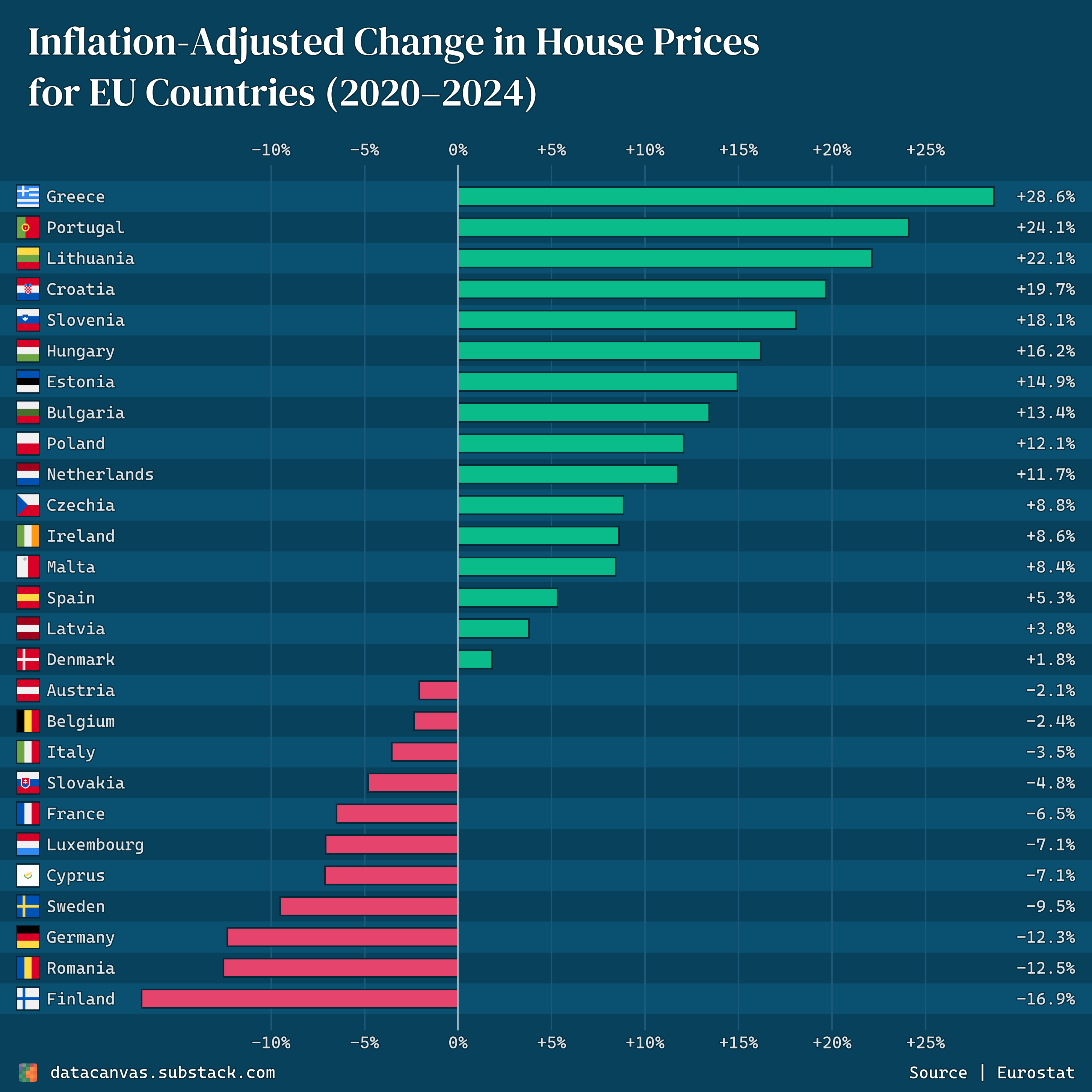
Spain’s number is fake af. Yeah, maybe if you add empty Spain, but the places where people actually want to live have increased prices between 50% and 100% in 5 years.
Xerphiel on
Nice chart, I’m always sad the UK isn’t in these, thanks Brexit!
[deleted] on
[deleted]
DOE_ZELF_NORMAAL on
There are countries where prices are dropping? How?
__Rick_Sanchez__ on
Romanian numbers certainly feel incorrect. Average inflation in that period was ~8%. Real estate prices went up by at least 15% on average per year.
TheDungen on
Nice but that’s just change, how much is the housing prices (compared to a local median salary of course)? Percentual changes only mean something if we know what they are a percentage off.
Edit2: It’s really not. Chruchill was right statistics have made lying redunant.
Edit3: The OP one is change from 2015, so ok maybe not quite as useless as change from last year.
whooo_me on
I wonder how useful these figures are, without also tracking/comparing the level of sales.
For instance, if few people can afford to buy a home, the average price could actually shoot up? Sounds crazy, but the people most ‘vulnerable’ are at the bottom of the market. If they feel the pinch, they stop buying. So you could end up with a greatly reduced market in size, but consisting entirely of high/mid earners/purchasers.
Higher average house prices, because the bottom end of the market has dropped off entirely.
DanDin87 on
Very misleading and wrong data. In any livable city in Italy prices have increased exponentially, it’s been big news all over the country. Of course if you average them with prices in abandoned villages on the mountains the median price will decrease…

![[OC] Inflation-Adjusted Change in House Prices for EU Countries (2020–2024)](https://www.byteseu.com/wp-content/uploads/2025/06/vmh0477rqt7f1-1536x1536.png "[OC] Inflation-Adjusted Change in House Prices for EU Countries (2020–2024)")
9 Comments
In Western Europe nobody can afford to buy a home any more anyway, old, shitty one-family homes with tragic energy values in the suburbs go for >1 million €, and politicians and some academics alike are pushing to convince people renting is the new standard, and nobody should want to own a home any more. This trend makes me vomit.
Spain’s number is fake af. Yeah, maybe if you add empty Spain, but the places where people actually want to live have increased prices between 50% and 100% in 5 years.
Nice chart, I’m always sad the UK isn’t in these, thanks Brexit!
[deleted]
There are countries where prices are dropping? How?
Romanian numbers certainly feel incorrect. Average inflation in that period was ~8%. Real estate prices went up by at least 15% on average per year.
Nice but that’s just change, how much is the housing prices (compared to a local median salary of course)? Percentual changes only mean something if we know what they are a percentage off.
Edit: Now [this](https://ec.europa.eu/eurostat/databrowser/view/tipsho60/default/table?lang=en&category=tips.tipsho.tipsho_a) is what I’m talking about.
Edit2: It’s really not. Chruchill was right statistics have made lying redunant.
Edit3: The OP one is change from 2015, so ok maybe not quite as useless as change from last year.
I wonder how useful these figures are, without also tracking/comparing the level of sales.
For instance, if few people can afford to buy a home, the average price could actually shoot up? Sounds crazy, but the people most ‘vulnerable’ are at the bottom of the market. If they feel the pinch, they stop buying. So you could end up with a greatly reduced market in size, but consisting entirely of high/mid earners/purchasers.
Higher average house prices, because the bottom end of the market has dropped off entirely.
Very misleading and wrong data. In any livable city in Italy prices have increased exponentially, it’s been big news all over the country. Of course if you average them with prices in abandoned villages on the mountains the median price will decrease…