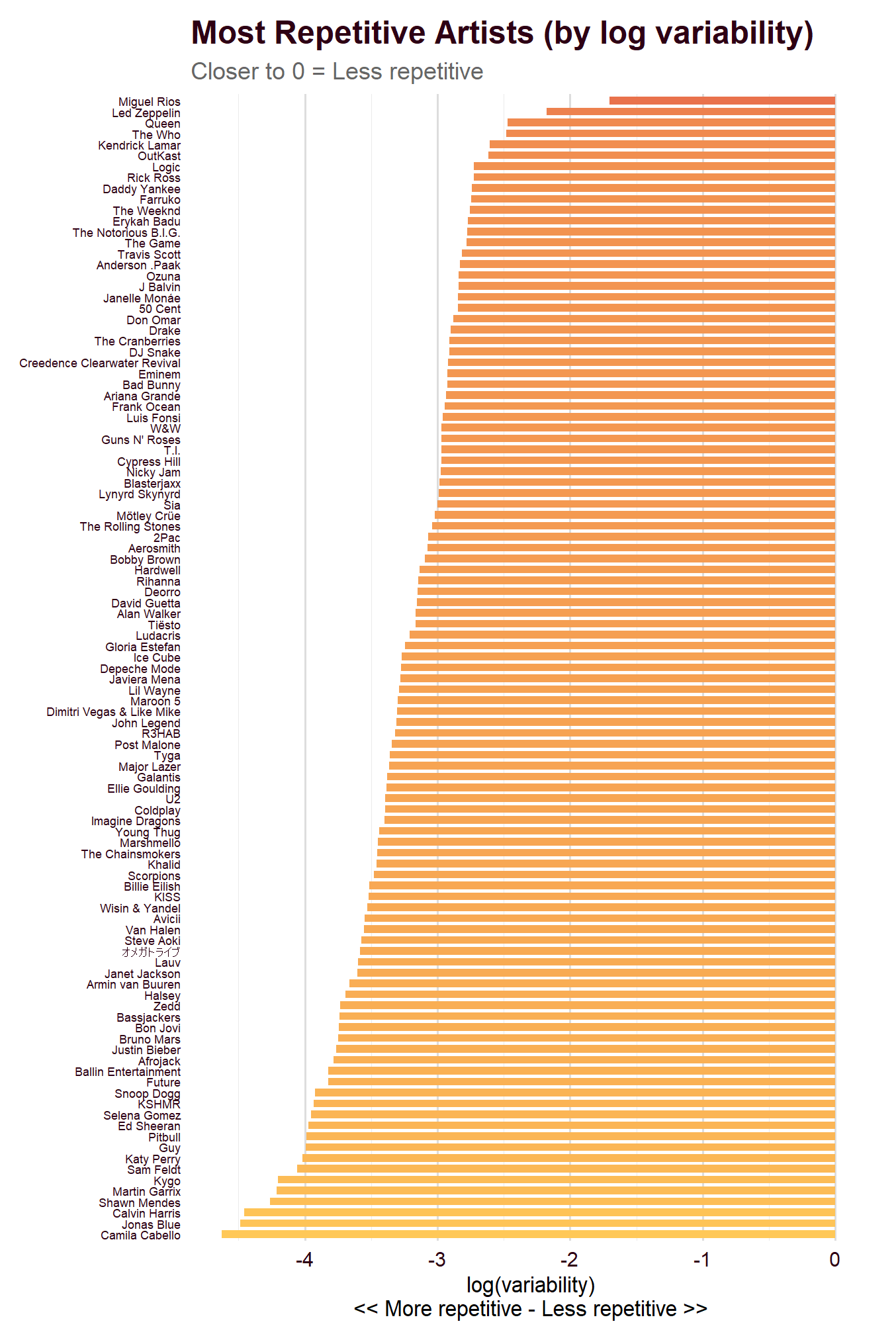
[OC] Is this band objectively repetitive? a simple & no-feelings-involved approach (corrected)
Posted by madkeepz

![[OC] Is this band objectively repetitive? a simple & no-feelings-involved approach (corrected)](https://www.byteseu.com/wp-content/uploads/2025/06/955w8gkuad8f1-1027x1536.png "[OC] Is this band objectively repetitive? a simple & no-feelings-involved approach (corrected)")
[OC] Is this band objectively repetitive? a simple & no-feelings-involved approach (corrected)
Posted by madkeepz
9 Comments
fixed some stuff for the haters 😉
— og post
Music can be repetitive sometimes. But that is subjective, and subjectiveness in music is everything. Or, almost everything.
Some things, you can’t deny. For example, you can’t deny that a song is 3 minutes long. You also can’t deny the tempo (most times). But, ever so often, a song that sounds happy, might be sad to a particular person. You might associate that song with a sad memory and thus, the happiness is gone. Therefore, a song’s vibe cannot be established (major assumption here). Some god-tier statisticians and analysts at spotify do sentiment analysis with music and their work is perfectly fine and the basis of this one. We love them. I hope they keep on working. But let’s think this from an entirely musical perspective then. Let’s accept that any sort of feeling-imprinting on music is impossible. Think of it as saying to a mathematician “hey did you know you can divide by zero?”. That sort of thing. Let’s keep only those metrics we can agree on without any form of discussion. Things like “how long is this song” or “how fast is it”. Using this framework, we can now move towards this post’s problem: “how repetitive is a band?”. As in, if I start listening to a bunch of songs by the same band, how much will I feel that all their songs are the same?.
To this end, and out of sheer saturday boredom, I thought of this very simple analysis. We get a buncha songs from a buncha artists. We drop them into R. We separate them by artist. We find out how much duration and tempo vary for each, and then we just see the result and see if we agree.
For the choice of artists, I used the dataset called “30000 Spotify Songs” from Kaggle. This gives me a lot of songs with different features from varied artists. Afterwards, I kept all artists with 30 or more songs in the dataset. This gives all of them an arguably fair representation for each metric. Now to the fun stuff. I grouped all songs by artist, and obtained the standard deviation and mean for both duration and tempo of all songs. I divided the standard deviation over its mean for each artist, squared it, and obtained an overall squared variation coefficient for duration and tempo. Finally, I just averaged the two and voilá: I now have a repetitiveness metric for each band. This number is high when duration and tempo varies a lot, and low when duration and tempo are repetitive. If a band’s songs feel like they’re are all the same, this should somewhat align with that. One final step: obtain the logarithm of that number – purely to make the whole thing easier to visualize.
Finally, some subjectivity. I bring you here a graph for your viewing pleasure. I think it’s kind of accurate; for example bands like Queen and Zeppelin show a high coefficient while the bottom is populated with mostly contemporaneous electronic artists.
There’s a lot of things to disagree with here, but I always had a fundamental problem with a lot of the spotify metrics: sometimes a happy song is a sad song to someone. So if we expect to really look into it from a truly musical perspective, there are some boundaries that must not be crossed. I hope this works to illustrate that point.
Also even though I used AI to correct parts of my code work and make sure I didn’t make any big grammar and spelling mistakes since english is not my first language, this is 100% from my brain to your monitor, no “hey chatgpt make me a reddit post” bullshit
I’m not seeing the Lumineers or Mumford and Sons on there, I bet they’d score a -10
Ween’s got to be close to 0
Not including Mumford and sons on this is wild
Camila Cabello being the most repetitive artist is incredibly predictable
I don’t understand why you used tempo and duration. Duration is particularly weird to me, since some genres have standard durations, particularly pop songs, which historically had to be designed that way to fit on records. You can also be very creative with limited time. Some genres always use very specific BPM ranges, but they’re highly creative within that frame.
If I were to do this I would be looking at waveform uniformity.
But what kind of strictly artistic statement can be drawn from this? Recorded music is not merely an outlet for creativity, it is also a commodity that reflects the market demand it is trying to meet. Many of the metrics you refer to are more a reflection of necessary sales volumes than they are artistic intent. Anyone who isn’t in the top tier of earners has to make certain concessions to keeping the bills paid. It really says more about the music business than it does the music.
Have you considered Shannon diversity index on the lyrics? Would love to see this colour coded by predominant genre, because an electronic band like Daft Punk would be VERY repetitive using something like lyric diversity.
I find it odd how Taylor Swift isn’t on here. She’s kinda notorious for having songs about breakups back in my day.