Neat. Without knowing much about the indicator, would it be able to go over 100?
Sofi-senpai on
Does anyone have something similar for other/all countries?
Westnest on
It’s interesting that Spain is as high as that despite being a Catholic Mediterranean country. It seems like after Franco they did a complete 180.
For Germanic countries it is expected, as early as the 1st century AD, Roman writers were mentioning how much more women were involved in the public life of Germanic societies compared to Roman and Greek women. Same thing was noted by Arabs for Norman/Frankish women during the Crusades.
highcaliberwit on
Out side the law, what would prevent a 100? Like the US doesn’t have a law that would prevent women 100% to chose how they engage in the economy
standermatt on
If women perform better than men it caps at 100?
CertainNet9823 on
MAD respect for South Korean women
buckwurst on
Can anyone explain the methodology here? How does a country like Saudi Arabia, where a woman can barely leave the house without accompaniment from a male relative rank closely with say China where women can do pretty much anything?
Auspectress on
I looked imto my country, Poland. It has 93,8 points where it is missing to 100 because of pensions. In Poland men retire at 65 and women at 60 and this methodology counts it as female inequality. So it may seem on surface that Poland is less equal than netherlands here and women have it worse, but it is actually other way around so I suspect the methodology is at best subpar
Edit: spelling errors + I think in some criteria a better fitting word would be economic equality for both sexes
Thesaurius on
As a German, women are definitely not economically equal here. There is still a wage gap, and there have been many cases of women being put at a disadvantage compared to men, even in recent years. Legally, men and women are equal, but in society, they are definitely not.
TheRemanence on
Without looking into the factors within the score, you can’t really draw any conclusions from this. Unfortunately I’m quite busy today, otherwise i would.
Anyone else that has the time to look it up should post as a comment so we don’t all have to read through the links.
Feels like this sub needs a rule where all composite measures should be defined in the post.
Tengou on
Without a breakdown of how a score is tabulated these numbers are pretty much meaningless one way or the other.
Corn_viper on
Why don’t companies just hire women if they can pay them less, are they stupid?
Nimrond on
Germany has a tax law to specifically encourage married couples to have one main breadwinner, which cements the status quo. That is to say, half of working women do so part-time, while merely 12% of working men do. Women also only make up around 30% of executive positions. A higher percentage of retired women are at risk of poverty than men. And so on and so forth.
To claim perfect economic equality between the genders sounds insane.
PoneyEnShort on
Saudi Arabia, India, and South Korea, what kind of drunkard made this up
Best-Account-6969 on
What’s crazy is these countries correlate with low native birth rates. Is that the trade off? Example: The next generation of Germans majority won’t be of native German descent.
TheCatInTheHatThings on
In Germany the gender pay gap is 16%, meaning women earn 16% less than men on average.
If we only look at cases where both women and men have the exact same formal qualifications and the exact same conditions, women earn 6% less than men on average.
While this could be worse, it could and should be better.
Nicopootato on
SO what is the index based off of?
YouLearnedNothing on
these studies are always misleading, capped, outliers removed, etc.
At least this one takes a lot into consideration, not just pay, but I would love a closer look at the math
Imwaymoreflythanyou on
Ironically most of the countries women complain about gender pay gap the most.

![[OC] Women's economic equality in the 20 biggest economies](https://www.byteseu.com/wp-content/uploads/2025/06/csn2ipjd9o9f1-1141x1536.png "[OC] Women’s economic equality in the 20 biggest economies")
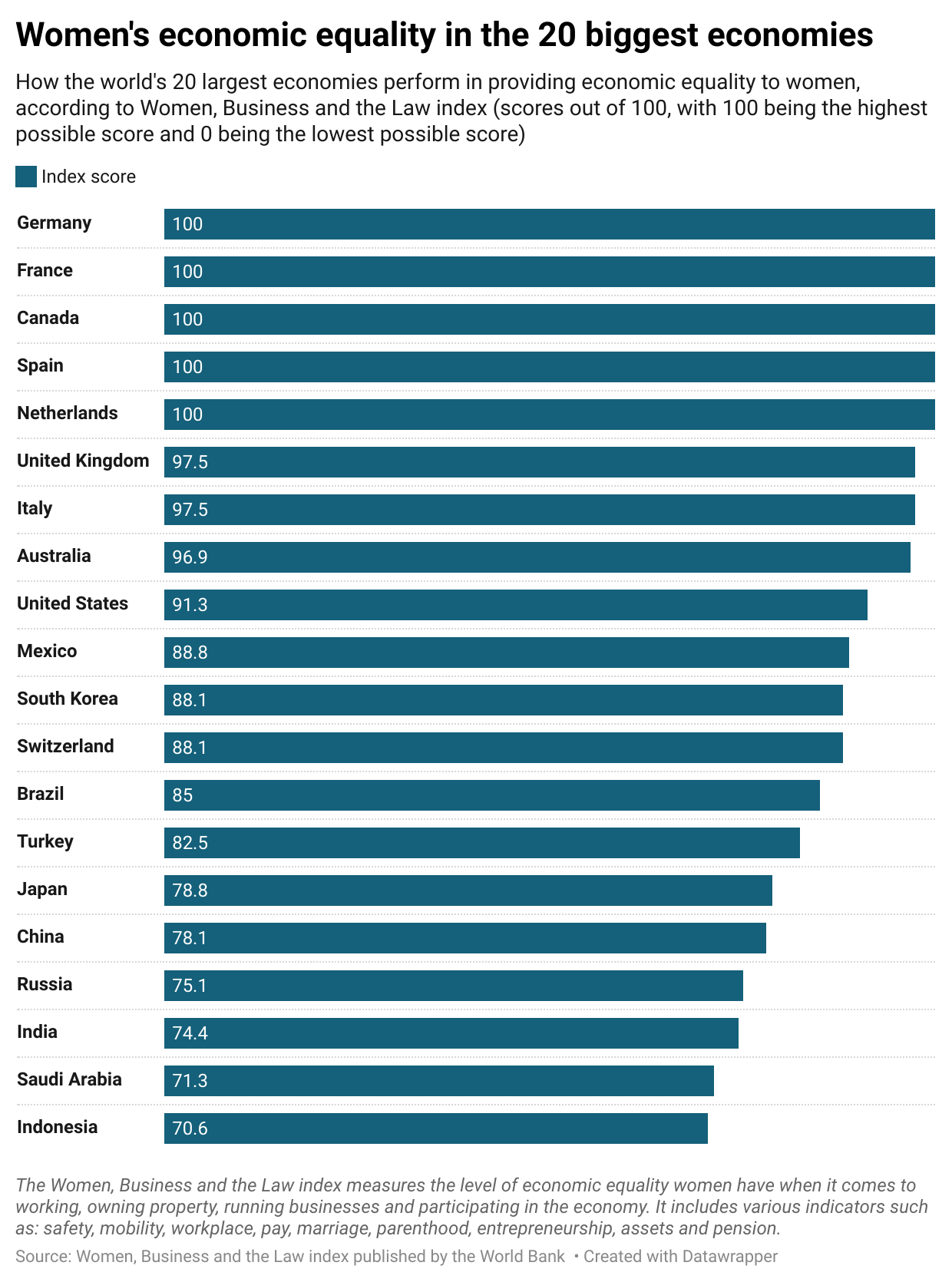
21 Comments
Source: [World Bank](https://wbl.worldbank.org/en/wbl)
Tools: [Datawrapper ](https://www.datawrapper.de/)
Neat. Without knowing much about the indicator, would it be able to go over 100?
Does anyone have something similar for other/all countries?
It’s interesting that Spain is as high as that despite being a Catholic Mediterranean country. It seems like after Franco they did a complete 180.
For Germanic countries it is expected, as early as the 1st century AD, Roman writers were mentioning how much more women were involved in the public life of Germanic societies compared to Roman and Greek women. Same thing was noted by Arabs for Norman/Frankish women during the Crusades.
Out side the law, what would prevent a 100? Like the US doesn’t have a law that would prevent women 100% to chose how they engage in the economy
If women perform better than men it caps at 100?
MAD respect for South Korean women
Can anyone explain the methodology here? How does a country like Saudi Arabia, where a woman can barely leave the house without accompaniment from a male relative rank closely with say China where women can do pretty much anything?
I looked imto my country, Poland. It has 93,8 points where it is missing to 100 because of pensions. In Poland men retire at 65 and women at 60 and this methodology counts it as female inequality. So it may seem on surface that Poland is less equal than netherlands here and women have it worse, but it is actually other way around so I suspect the methodology is at best subpar
Edit: spelling errors + I think in some criteria a better fitting word would be economic equality for both sexes
As a German, women are definitely not economically equal here. There is still a wage gap, and there have been many cases of women being put at a disadvantage compared to men, even in recent years. Legally, men and women are equal, but in society, they are definitely not.
Without looking into the factors within the score, you can’t really draw any conclusions from this. Unfortunately I’m quite busy today, otherwise i would.
Anyone else that has the time to look it up should post as a comment so we don’t all have to read through the links.
Feels like this sub needs a rule where all composite measures should be defined in the post.
Without a breakdown of how a score is tabulated these numbers are pretty much meaningless one way or the other.
Why don’t companies just hire women if they can pay them less, are they stupid?
Germany has a tax law to specifically encourage married couples to have one main breadwinner, which cements the status quo. That is to say, half of working women do so part-time, while merely 12% of working men do. Women also only make up around 30% of executive positions. A higher percentage of retired women are at risk of poverty than men. And so on and so forth.
To claim perfect economic equality between the genders sounds insane.
Saudi Arabia, India, and South Korea, what kind of drunkard made this up
What’s crazy is these countries correlate with low native birth rates. Is that the trade off? Example: The next generation of Germans majority won’t be of native German descent.
In Germany the gender pay gap is 16%, meaning women earn 16% less than men on average.
If we only look at cases where both women and men have the exact same formal qualifications and the exact same conditions, women earn 6% less than men on average.
While this could be worse, it could and should be better.
SO what is the index based off of?
these studies are always misleading, capped, outliers removed, etc.
At least this one takes a lot into consideration, not just pay, but I would love a closer look at the math
Ironically most of the countries women complain about gender pay gap the most.
So what’s the methodology of this?