
This abstract discusses the ongoing scientific debate about how our brains store long-term memories. While many neuroscientists use advanced techniques to study specific memory-related brain cells, the exact mechanism of memory storage isn't fully understood.
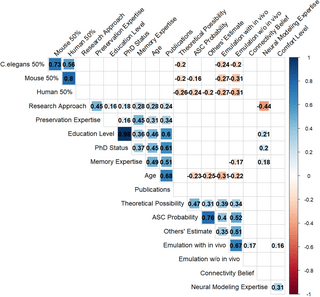
A survey of 312 brain experts, including those specializing in memory research, revealed that about 70% believe long-term memories are primarily stored in the patterns and strengths of connections between brain cells. However, there's no widespread agreement on the precise brain features or scales that are most crucial for this storage.
Scientists were also asked about the likelihood of being able to "extract" long-term memories just by examining a static image of the brain's structure. On average, they estimated about a 40% chance of success, which was similar to their prediction for creating a complete "brain emulation" (a digital copy of a brain) from a preserved brain.
Regarding the future of brain emulation, participants predicted it might be feasible for a simple worm (C. elegans) around 2045, for mice around 2065, and for humans around 2125. Their level of expertise didn't significantly influence their views on memory extraction from brain structure alone.
In summary, despite a general belief that memories are stored in the brain's physical structure, fundamental questions about the exact physical basis of memory storage remain unresolved. This has significant implications for both our theoretical understanding of the brain and the development of future technologies for memory preservation or extraction.
https://journals.plos.org/plosone/article?id=10.1371/journal.pone.0326920
3 Comments
Methodology:
The survey was distributed from August-October 2024 to two separate cohorts of neuroscientists: (1) those who had published research papers directly related to the neurophysiology of memory (Engram Experts); and (2) any attendees with an abstract listed in the Computational and Systems Neuroscience (COSYNE) conference booklets from 2022−2024 (COSYNE Neuroscientists). COSYNE attendees are self-described as those interested in “the exchange of empirical and theoretical approaches to problems in systems neuroscience” [26]. The questions were focused on their beliefs about the physical basis of memory, as well as the implications of these beliefs in various theoretically plausible scenarios. The survey and its implementation were reviewed by the Pearl Institutional Review Board and received an exemption determination (#2024-0303).
Survey questions
The survey consisted of 28 questions divided into six sections: ‘Demographics’, ‘Structural basis of long-term memories’, ‘Theoretical implications of memory storage’, ‘Brain preservation’, ‘Whole brain emulation feasibility’, and ‘Familiarity & comfort with the topics discussed’. Most questions were mandatory for completion, except those that asked participants to optionally provide additional commentary on their responses.
Each of the main sections (i.e., all excluding ‘Demographics’ and ‘Familiarity’) were preceded by a page of information providing contextual information and definitions required for the questions that followed.
Data:
Data Availability: A list of the survey questions is available here:
https://osf.io/agkrn
The full set of participant response data is available
here: https://osf.io/bas2u
I wonder if this can prove something I’m curious about something. I’ll admit this isn’t science but I’m wondering if a study like this can prove something for me and that is; that memories exist ONLY in the brain and this idea that a “soul” carries a complete set of the same properties as a living human is preposterous. That when the brain dies, everything that made someone “who they are” dies with it.
I understand that [long term potentiation ](https://pubmed.ncbi.nlm.nih.gov/14715912/) isn’t the definitve explanation, but I fail to understand why this paper makes absolutely no mention of it and repeatedly speaks about finding a neurophysiological basis for long term memory. Have they never heard about it?