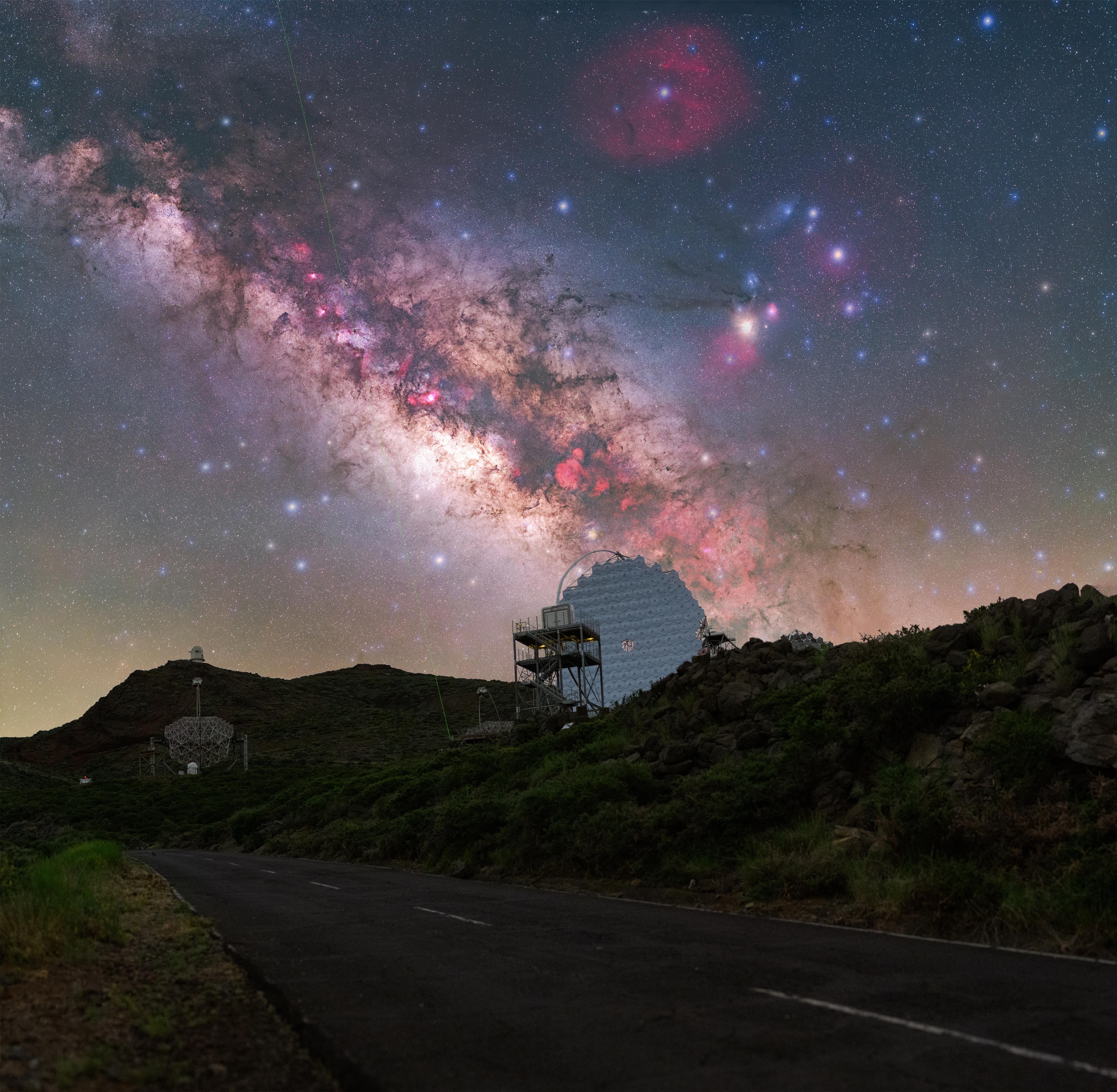
I took this photo of the Milky Way from one of the best skies on Earth: La Palma, Canary Islands.
https://i.redd.it/epksei9ef9bf1.jpeg

I took this photo of the Milky Way from one of the best skies on Earth: La Palma, Canary Islands.
https://i.redd.it/epksei9ef9bf1.jpeg
6 Comments
I shot this picture in Canary Islands during an astrophotography trip, on the island of La Palma, which truly deserves its reputation as one of the best night skies in the world!
If you’re interested, you can find more of my work on [Instagram](https://www.instagram.com/tinmar_g/)
This part of the LP4 road is a well-known spot for astrophotographers on La Palma. It offers a view of the LST telescopes (Large-Sized Telescopes) gamma-ray telescopes designed to detect brief, low-energy gamma-ray signals from universe.
Having visited several years ago, I was excited to return. When I arrived, I discovered that new telescopes had been installed. They look relatively recent and disrupt the perspective I had in mind for my photo. On top of that, their mirrors were covered, preventing the stars from reflecting in them. Too bad, the view of the telescopes is still beautiful.
While shooting the foreground, I noticed a green laser pointing into the sky. Probably authorized photographers who had access to the restricted area, or perhaps a targeting system for the telescope?
On my trip in La Palma, I finally got to try out some new photography techniques I’d been excited to experiment with! I used a Star Glow filter (which gives stars that sparkling effect), and an Hα filter (to reveal red nebulae). Each filter required an additional shot, so for each tile of the panorama, I captured a regular photo, an Hα photo, and one with the glow filter. I was really afraid all that effort would be for nothing but in the end, I’m so happy with how it turned out.
The final image is a panorama taken at 50mm, made up of 6 photos for the sky and 10 for the foreground that I finally cropped.
**Note**: This image is the result of long exposures and specific techniques. While the Milky Way is indeed visible to the naked eye from La Palma, it appears with fewer details and without the colors captured in this photo.
**Sky**: f/1.8 – 45 sec – ISO 2500
**Foreground**: f/1.8 – 30 sec – ISO 5000
Canon 6D (astro-modded) – Skywatcher Star Adventurer – Sigma ART 50mm
Darn, speechless 👌👌👍🏾. How long did it take for eyes to adjust to dark and get a view like that? What was the altitude of that place?
Been up there myself many years ago on an astronomy trip, so cold, wasn’t till we were on our way back that we realised there was snow still in the shady areas away from the sun.
The green laser might have been the Lidar system of MAGIC, used to measure atmospheric properties. It has been there for years, but it’s not always on and the visibility really depends on geometry between you and the beam.
As for the telescopes – there are now 4 LSTs, all will eventually be commissioned and all mirrors will nicely reflect. In the next year a handful of smaller MSTs will pop up around, but also a control building for CTA, which will eventually control all of those, so the landscape will change a lot.
Feel free to ask me questions about this area, I am some hat actively engaged in CTA construction.
Astronomer here! I was lucky enough to go observing once on La Palma for a week (not usually my type of astronomy research but we were taking a student group). Saw the green flash three times that week, because you’re always above the clouds above the ocean (of course I didn’t have my camera for each time).
I also remember sunset up there watching the sunset, with the telescope domes all opening up for the night, and thinking if this really is all there is, I’m ok with that. Just such a peaceful and inspirational place!
The laser is most likely a part of a telescope aiming device.
There is also an animal captured in an image sitting on the far side of the road, looks like a fox or a rabbit 🙂