Austin and San Antonio are about an hour/hour and a half drive apart. Crazy they are that far apart on the scale here
Emergency-Eye-2165 on
Accepted and discouraged aren’t opposites. Accepted and outlawed, or discouraged/encouraged/whatever. I think this would change the results a lot.
giveuschannel83 on
I’m really surprised DC is that low, but maybe it’s because the metro area isn’t as tolerant? DC itself has the most thriving queer scene of any city I’ve lived in.
Meanwhile I’ve also lived in Boston, and while it does feel very tolerant of queer people, it also felt like you really had to try to seek out the community.
bailaoban on
Who’s gonna tell that 30% in Miami.
GregoryGosling on
Imagine living in San Francisco or New York and somehow not accepting gay people
bjb406 on
[ Removed by Reddit ]
Ok-Avocado4068 on
Atlanta being so low given how high its gay population is.. Deep South but still. IIRC it’s 3rd as a percentage of population only behind San Francisco & Seattle
WhatIsTheAmplitude on
Columbus and Indianapolis don’t qualify to be in this survey? I would have liked to see where they landed.
DarthCloakedGuy on
“Should be discouraged by the society” how the fuck do you discourage genetic expression
SoftballGuy on
I’ve only been here for three months, but Baltimore City is the most inclusive space I’ve ever lived in — age, race, gender, orientation of every kind. It’s an amazing city. Is it that the surrounding country is a suburban nightmare?
Max_FI on
A month ago, the actor Jonathan Joss was murdered in San Antonio for his homosexuality.
Tools81 on
Interviewer: Excuse me, should we accept homosexuality?
5% of Denver: Fuck off
Comprehensive_Ad1363 on
Did they do this study 10-20-30 years ago? That would be interesting to see how much it’s changed.
BlueBattleHawk on
I’d be curious to see where Kansas City falls on that list as well.
pujolsrox11 on
Im pretty surprised Orlando is as low as it is. We are extremely prideful here and the gay culture is very diverse IMO.
geeoharee on
Graph is asymmetrical, I want a response curve for ‘homosexuality should be encouraged’
Potential_Camel8736 on
Texas sucks
Source: am gay texan
postwarapartment on
Love to see philly in the top 5 gayest cities
TheBlackCaesar on
This data is squed because New Orleans isn’t on here
gonzo8927 on
FYI there are only about 25 metro area that meet the requirements in the county.
Goes to show you that most people in most cities are pretty accepting. Don’t let the loud minority shake you swag.
tacobell999 on
Why is Riverside separate from LA?
ohheylo on
Purely from the graph design perspective – how did you order the cities after the “% should be accepted” line? I feel like it makes sense to order first by accepted, then if there is a tie, by the no answer % (if your goal is to have the more accepting cities at the top).
As you have it, if there’s a tie… there’s no rhyme or reason for the ordering, and it varies throughout the chart. For instance, New York and Chicago have the same exact results for all 3 responses, but they are separated by Los Angeles.
Mercuryshottoo on
I feel dumb but where is Riverside
Triad64 on
It’ll be 100% by the end of the year.
Unacceptance is such a waste of time. Life is short. Focus on getting our lives back and stopping the steal of the middle class’ lives that is happening every day.
NayaBR on
Houston, we have a problem
lolexecs on
This graph is quite disappointing. Urban areas are okay with LGBTQ people, color me shocked, in rainbows!
What would have been a bit more interesting would be to include an ‘over under.’ For example, what’s the national over under on approval? And where are these cities w/regards to that national average.
staatsclaas on
Gonna need a better understanding of the survey participants.
adammonroemusic on
Riverside ain’t got no 4.7 million people in it.
Edit: I guess they mean Riverside, San Bernardino, Ontario, ect. We just call that the Inland Empire.
Bloke101 on
If this really is pew they need to learn English. Use of the definite article is the hardest thing for non native speakers.
patodruida on
I would like a scatter chart mapping the correlation between low tolerance to LGBT+ vs high tolerance to child marriage and intrafamilial SA.

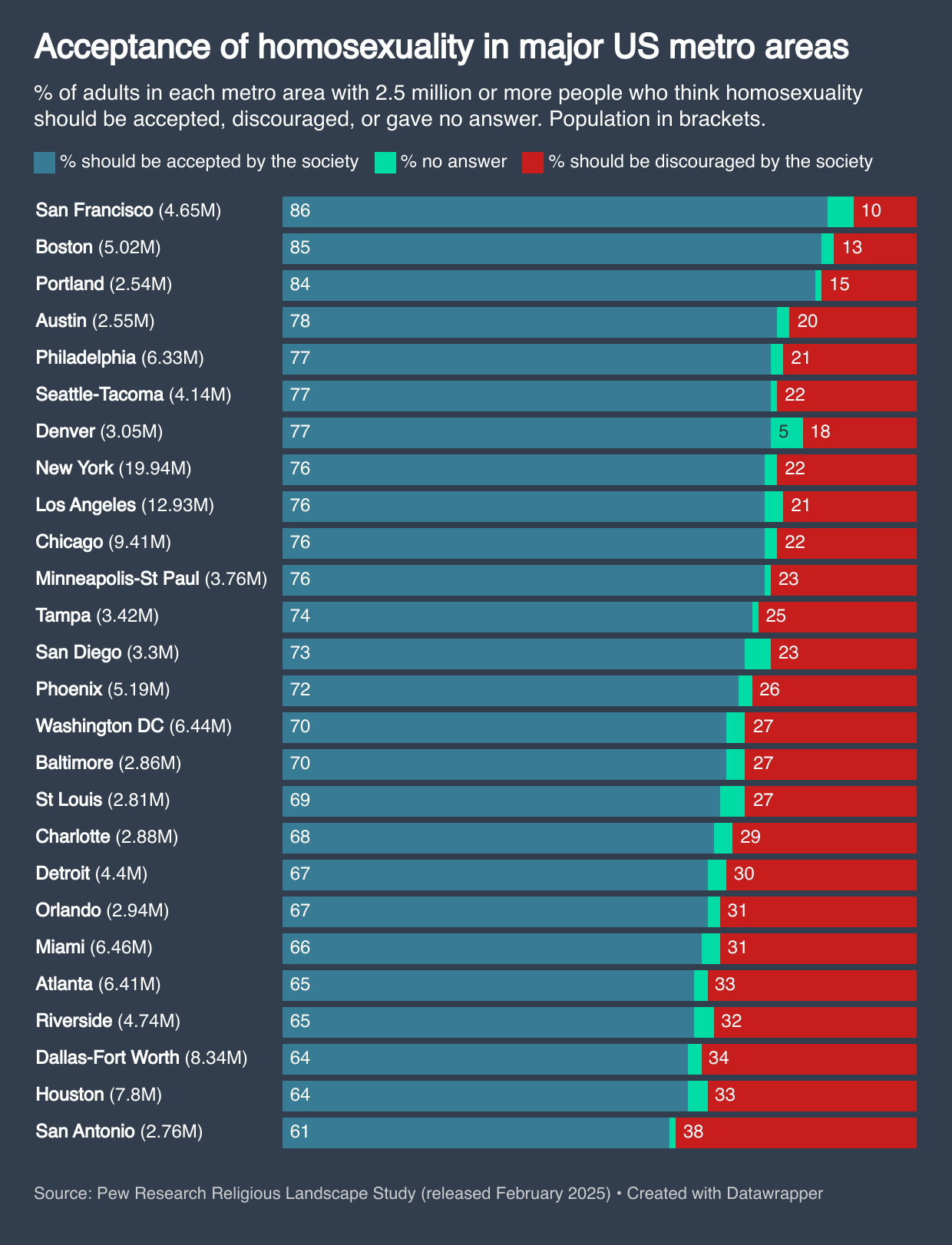
![[OC] Acceptance of homosexuality in major US metro areas](https://www.byteseu.com/wp-content/uploads/2025/07/rpclq4s6h1cf1-1174x1536.png "[OC] Acceptance of homosexuality in major US metro areas")
32 Comments
Source: [Pew Research Religious Landscape Study](https://www.pewresearch.org/religious-landscape-study/)
Tools: [Datawrapper ](https://www.datawrapper.de/)
Atlanta lower than Charlotte, that surprises me.
Austin and San Antonio are about an hour/hour and a half drive apart. Crazy they are that far apart on the scale here
Accepted and discouraged aren’t opposites. Accepted and outlawed, or discouraged/encouraged/whatever. I think this would change the results a lot.
I’m really surprised DC is that low, but maybe it’s because the metro area isn’t as tolerant? DC itself has the most thriving queer scene of any city I’ve lived in.
Meanwhile I’ve also lived in Boston, and while it does feel very tolerant of queer people, it also felt like you really had to try to seek out the community.
Who’s gonna tell that 30% in Miami.
Imagine living in San Francisco or New York and somehow not accepting gay people
[ Removed by Reddit ]
Atlanta being so low given how high its gay population is.. Deep South but still. IIRC it’s 3rd as a percentage of population only behind San Francisco & Seattle
Columbus and Indianapolis don’t qualify to be in this survey? I would have liked to see where they landed.
“Should be discouraged by the society” how the fuck do you discourage genetic expression
I’ve only been here for three months, but Baltimore City is the most inclusive space I’ve ever lived in — age, race, gender, orientation of every kind. It’s an amazing city. Is it that the surrounding country is a suburban nightmare?
A month ago, the actor Jonathan Joss was murdered in San Antonio for his homosexuality.
Interviewer: Excuse me, should we accept homosexuality?
5% of Denver: Fuck off
Did they do this study 10-20-30 years ago? That would be interesting to see how much it’s changed.
I’d be curious to see where Kansas City falls on that list as well.
Im pretty surprised Orlando is as low as it is. We are extremely prideful here and the gay culture is very diverse IMO.
Graph is asymmetrical, I want a response curve for ‘homosexuality should be encouraged’
Texas sucks
Source: am gay texan
Love to see philly in the top 5 gayest cities
This data is squed because New Orleans isn’t on here
FYI there are only about 25 metro area that meet the requirements in the county.
Goes to show you that most people in most cities are pretty accepting. Don’t let the loud minority shake you swag.
Why is Riverside separate from LA?
Purely from the graph design perspective – how did you order the cities after the “% should be accepted” line? I feel like it makes sense to order first by accepted, then if there is a tie, by the no answer % (if your goal is to have the more accepting cities at the top).
As you have it, if there’s a tie… there’s no rhyme or reason for the ordering, and it varies throughout the chart. For instance, New York and Chicago have the same exact results for all 3 responses, but they are separated by Los Angeles.
I feel dumb but where is Riverside
It’ll be 100% by the end of the year.
Unacceptance is such a waste of time. Life is short. Focus on getting our lives back and stopping the steal of the middle class’ lives that is happening every day.
Houston, we have a problem
This graph is quite disappointing. Urban areas are okay with LGBTQ people, color me shocked, in rainbows!
What would have been a bit more interesting would be to include an ‘over under.’ For example, what’s the national over under on approval? And where are these cities w/regards to that national average.
Gonna need a better understanding of the survey participants.
Riverside ain’t got no 4.7 million people in it.
Edit: I guess they mean Riverside, San Bernardino, Ontario, ect. We just call that the Inland Empire.
If this really is pew they need to learn English. Use of the definite article is the hardest thing for non native speakers.
I would like a scatter chart mapping the correlation between low tolerance to LGBT+ vs high tolerance to child marriage and intrafamilial SA.