
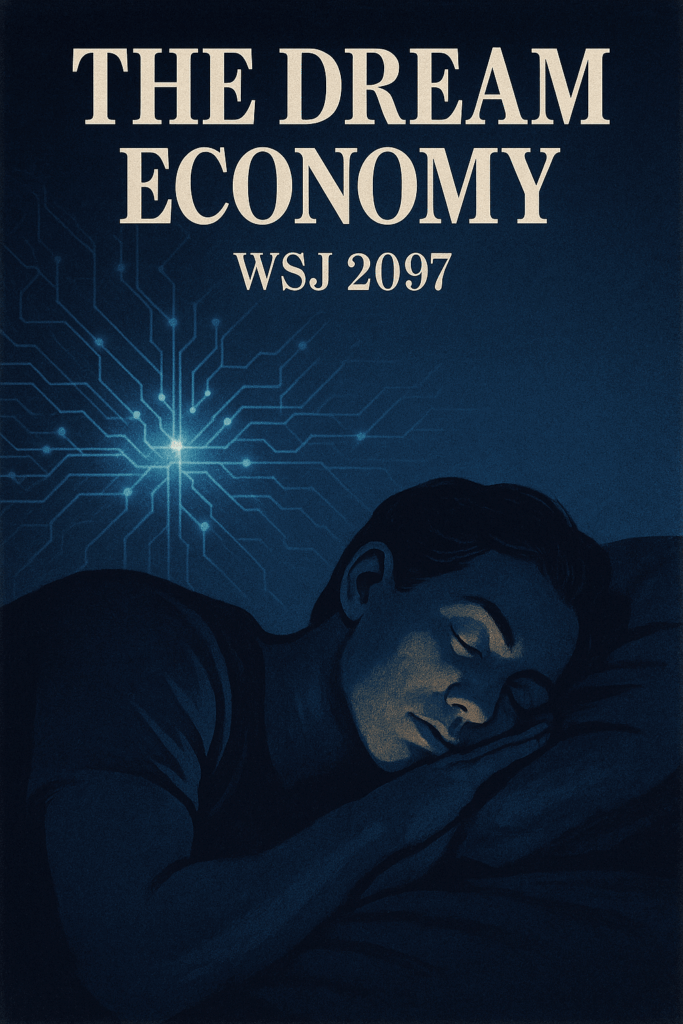
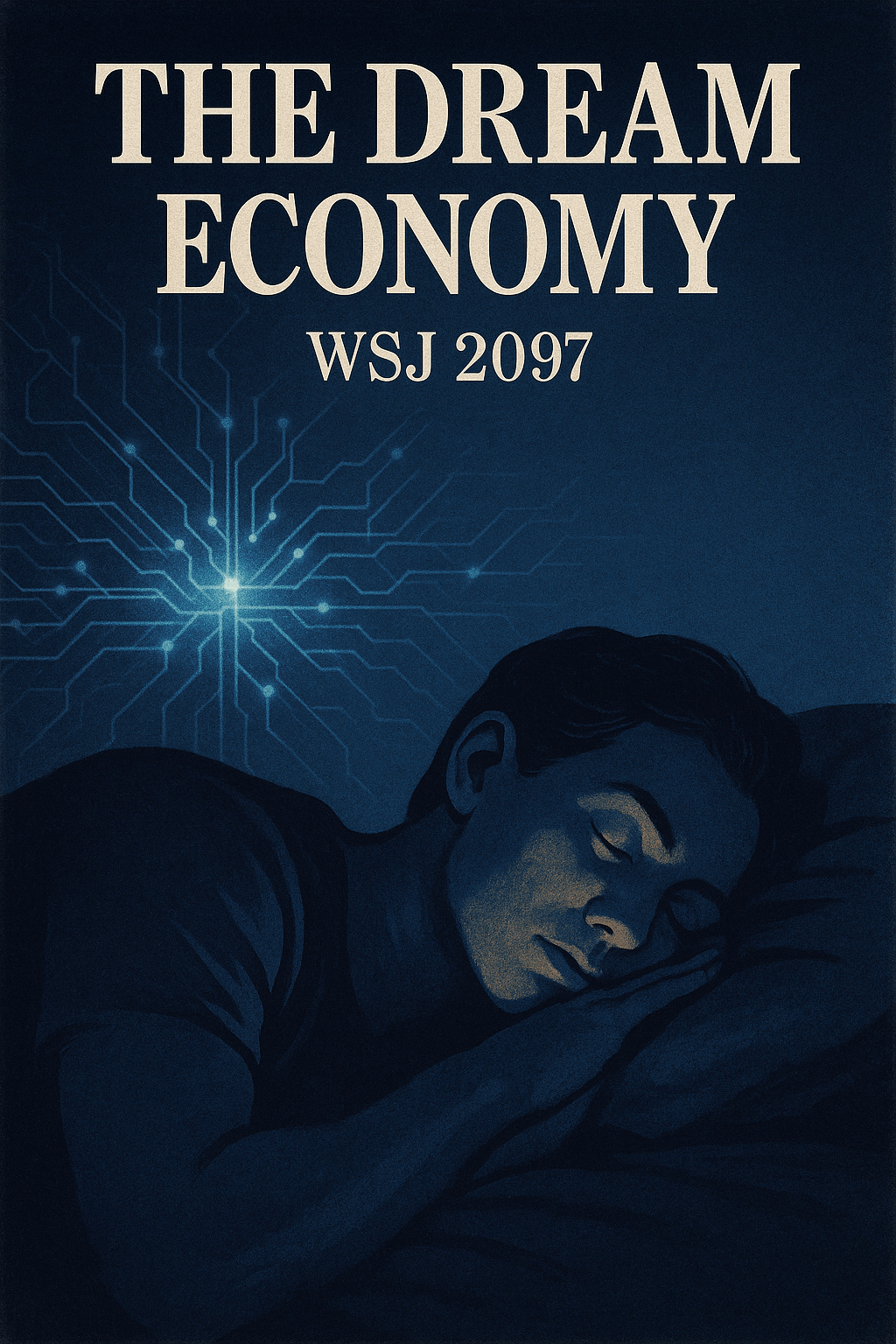
In this speculative Wall Street Journal–style article, I explore a future where AI has automated nearly all creativity—except the chaos of dreaming.
A new class of humans, called Dreamers, are paid fortunes to recall vivid dreams that fuel the next era of AI-generated content.
But natural dreaming is dying. And we’re starting to forget what it means to dream without a machine.
👁️ Full article: https://medium.com/@michaeldonahue2/the-dream-economy-human-imagination-reclaims-its-value-in-an-age-of-artificial-creativity-31f9714c5eee
What do you think? If AI could simulate perfect dreams for you… would you let it?
In 2097, dreams are worth more than gold. AI creates, but only humans dream.
byu/Nermana inFuturology
5 Comments
Thanks for checking out the piece! I’d love to hear your thoughts:
Could this actually happen with the rise of generative AI + neurotech?
Would you sell your dreams to a company like Somnia Collective?
Or are we heading toward something more dystopian?
I’m happy to answer questions, expand on the concept, or workshop ideas from this world.
Sorry, unrealistic. Curiously enough, before the age of LLMs, transformers, and diffusion, there was this project DeepDream that got famous for doing some neat visual dream-like things.
Well, I don’t remember my dreams, so I guess someone like me will be worthless in 2097?
“AI has automated nearly all creativity”
Even in a world where AI does all commercial design and art, folks will still create for creations sake.
commercial farming and wide food avaialbility has made small home farms superfluous for most, but folks still garden for fun, even if not economical. Folks still build forges in their home for blacksmithing, or any other obsolete non economical thing. hobbies don’t need to hold any monetary purpose, so would be rather impossible to ‘automate away’ in its entirety.
Some folks still use typewriters to this day. And in your dystopian future, I can’t imagine that there still wont be a niche for human made luxury goods, the rich love and collect that kinda stuff, so art will still exist.
There’s no reason to think that dreams form a particularly important part of human creativity. I mean it’s easy to find examples where someone was inspired by a dream, but it’s also easy to find any number of examples where at least as far as they know, they were NOT and they still made something creative and new.
This entire thing seems like copium to me, a desparate search for something that makes human beings magically different and special and unique. Humanity has tried that repeatedly in the past, and it’s always been an abysmal failure.
No, the land you happen to live on is not the “land in the middle”. No earth isn’t the center of the solar system. No our sun isn’t the center of the universe. No there’s no magical “soul” that makes life possible only by divine intervention. No human beings aren’t made in Gods image instead we evolved like all other living things.
And no, there’s nothing about our dreams that couldn’t be replicated by other organisms — or by a machine — if there was some value to doing that.
At the same time though, this obsession with “useful work” as the metric of a human beings value is a mistake. It’s already been the case for a long time that every single human being born with a net-worth above a few million dollars can’t do *anything* that is more financially valuable than simply passively putting their net-worth in an index-fund or something.
And yet you don’t see a lot of people worrying about what the children of the rich are to do with their lives. They’re (mostly) fine because it turns out that what you need is a decent source of *income* but not necessarily a job as such.