
![[OC] Population Growth of US Metro Area (2020 - 2024)](https://www.byteseu.com/wp-content/uploads/2025/07/zgovja3908ef1-1525x1536.png "[OC] Population Growth of US Metro Area (2020 – 2024)")
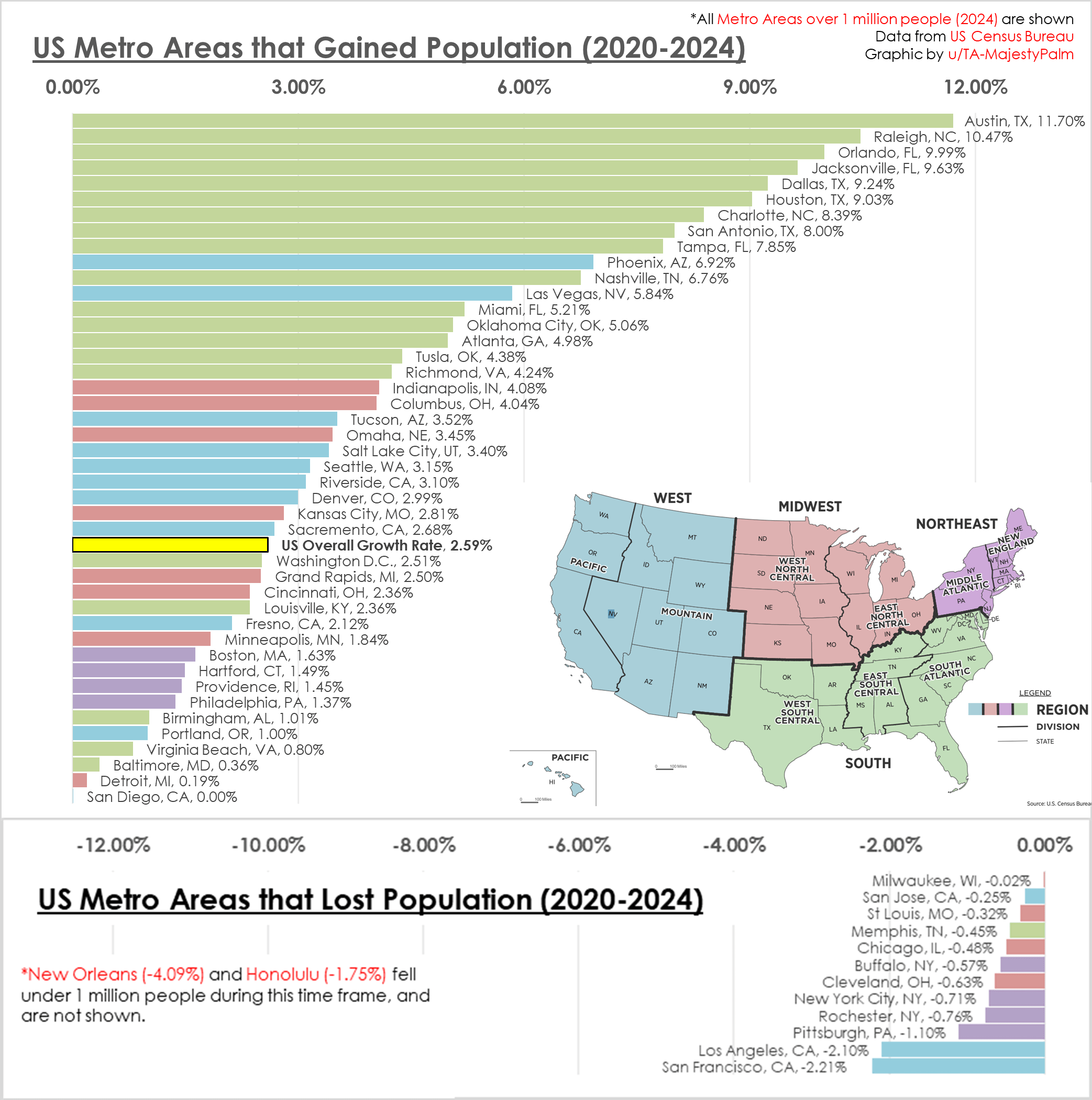
Graphic by me, created in Excel.
All data from the census bureau here: https://www.census.gov/data/tables/time-series/demo/popest/2020s-total-metro-and-micro-statistical-areas.html
Every Metro Area with a population over 1 million (in 2024) is shown. Bars are color coded based on the US Census bureau region (map shown in graphic).
Posted by TA-MajestyPalm
28 Comments
Graphic by me, created in Excel.
All data from the US Census bureau here: https://www.census.gov/data/tables/time-series/demo/popest/2020s-total-metro-and-micro-statistical-areas.html
Every Metro Area with a population over 1 million (in 2024) is shown. Bars are color coded based on the US Census Bureau region (map shown in graphic).
All the top growth cities are places most of Reddit would never choose to live. Shows the disconnect between idealism and reality.
Cool Plattsburgh NY is mid Atlantic. I never knew
Looks like cost of housing is driving people to areas that are going to be more affected by global warming.
[deleted]
[deleted]
Seems like there’s a correlation with low tax rate states, no?
It’s great to see Detroit finally in the positives on these graphs. Hopefully that number keeps on going up!
These in between census estimates are not especially reliable, Chicago was projected as losing population leading up to the 2020 census but when they did the actual count we gained population. Given the way rents are rising I’m fairly certain we are gaining population right now as well, despite the “estimates” saying otherwise.
Seeing the growth of the sunbelt is depressing because you can see us sowing the seeds of a future climate change disaster in 50 years or so. I get why, cost of living is so much better.
I’d love to see the changes in the 20 years when global warming hit harder
I know the Census says Maryland and Delaware are in the South but it would be better if they were in the “Middle Atlantic” category.
But also I wonder what this will look like in the decades to come do to various other reasons, like climate, education, economic factors, etc
How much more built out can the sunbelt get till they just turn into the Northeast/California in 1980 ?
The region clusters are “interesting”. The names given to the two subregions of the midwest are whack and not used by people. Try “Great Lakes” and “Great Plains”. The way the southern states are clustered completely ignores the cultural divisions of Appalachia Tidewater, and the Deep South.
Orlando resident since 2010 and Florida native, please god stop moving here.
Orlandos growth has been insane, still love living here but the traffic is unmanageable now.
Honestly, not surprised by the cali metro area dips. Housing is expensive AF
Stop moving to Raleigh, we’re full
The reason it’s worked for people to move to these lower tax areas is they had the federal safety net. Trump is removing all that, and people may change their behavior when they start suffering from it.
Rochester has a lower COL, is a neat lil’ city, and is in a climate haven. Winters are getting more manageable and there’s a ton of amenities. Houses are affordable and you still get all the blue state social features.
Moved here last year and it’s been awesome. I’d highly recommend it to anyone who people who want density, a back yard, and proximity to the best waterfalls on this continent. (Seriously, there’s awesome waterfalls everywhere here, including a huge one right in center city!)
Top 9 growth cities are in just 3 states! That is pretty wild.
I think this is all downstream of one thing: the invention of air conditioning.
Being uninhabitable until ~1950 means that today there’s still space to sprawl into. No politically fraught debates about infill (yet).
As of 2025 San Jose is only the second US city in history that used to have a population of more than one million but dropped back under one million. Detroit is the other one. To be fair, San Jose peaked at 1.01 million and currently sits at 990,000, but still, an exodus of 20 or 30,000 people in less than 5 years is a lot.
Before anyone chimes in with “what about Cleveland/Baltimore/Detroit?” Those cities peaked at just under one million but never quite crossed the line before their declines.
I‘m just no longer surprised by the things people do. Retiring snow birds don’t account for a big chunk of the top 10 as most of those areas aren’t retirement meccas. My armchair opinion is it’s the lower cost of housing and concerted tax schemes to draw businesses, thus jobs, are bringing people. The warmer weather may be a factor, but that’s probably just the cherry on top.
Those all sound great, but then you look at how regressive those states’ consumption taxes are, how awful the politics are, how insurance companies already know climate change is going to destroy those areas, thus the jacked up rates… Like, you’ve got to really not be thinking long term to move to those areas. And if you’re a young couple looking to start a family, is the big house you can afford more important than the risk of a problematic pregnancy that gets caught up in Southern politics? Obviously, to a big chunk of people, the risk:reward ratio is ok.
Whatever, man. When the heat and weather gets to the point of creating climate refugees, all those folks are gonna be *pissed* when the Northern states start using the *exact same* rhetoric around immigration that they already use to tell them to fuck off.
I wonder if I can find a breakdown of people relocating by age.
I’d really like to see the mean/range/median of the ages of the people in this data set. Something tells me the south is top heavy on population gain because it’s all retirees.
Edit. Math words.
Why do people move to conservative sauna swamps?
People are crazy to want to move to the south
I don’t agree with Maryland with being south, it’s more so mid-atlantic. We are more culturally northern.
I love that you are looking at metropolitan area population and not just city population data! Metropolitan area population data is a much better representation of demographic shifts and a better representation of how a city, itself, is doing than just simply looking at a city’s population data. Bravo!