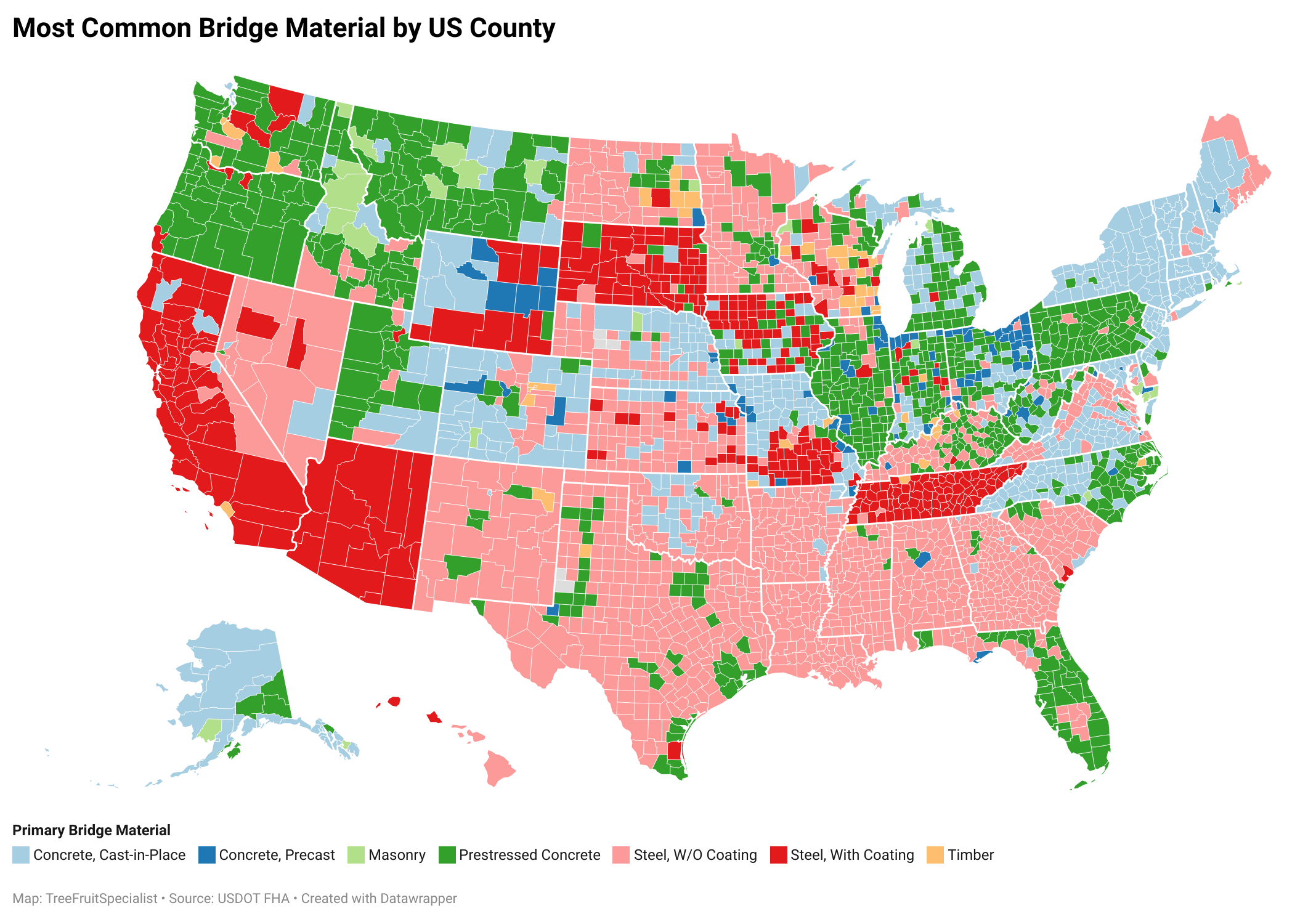
[OC] This map shows the most common structural material used in bridges across every US county, based on the 2025 release of the National Bridge Inventory from the Federal Highway Administration.
* Each county is colored by the single most common material used in its bridges.
* Tooltips include the FIPS code, top bridge type, and the number of bridges using that material.
* Counties with no bridges are shown in light gray.
I cleaned and summarized the data in R, using `dplyr`, `sf`, and `ggplot2`, then exported the final dataset to Datawrapper for easier sharing and interactivity.
This map probably needs seven gradient maps for each specific material showing the percentages of bridges using the material.
rockbottomtraveler on
Pros and cons of steel vs concrete?
Count_Dongula on
This map is likely inaccurate. I am from Los Alamos. There is only, like, one bridge. There is a steel arch called the Omega Bridge, and it’s really not that impressive. Other than this, there are footbridges, but those were mostly wood or steel when I lived there, and they were on trails.
Edit: I looked. Los Alamos has two bridges, neither being concrete. One is 3:03 code and the other 3:11 code, meaning steel. Check for yourself.
Define “bridge”. If you’re talking about any vehicular, pedestrian, or wildlife overpass maintained by government funds, then a culvert would fit this criteria, and the majority of “bridges” would be culverts, which are predominately made of metal or plastic. If this is federal data, they typically classify a bridge as something over a 20′ span clearance, which rules out most culverts.
FightOnForUsc on
It’s interesting to me that you can see the state borders. I would imagine something like this would be more weather dependent. But it’s clear that it’s largely impacted by policy
RoyAndCarol on
Anyone know why NC is split down the middle?
hikeonpast on
I’m guessing that freeway overpasses do not meet your definition of “bridge”. Otherwise, reinforced or prestressed concrete would dominate, at least throughout the west coast.
Consider sharing your input constraints – what is a bridge? Is it foot traffic, vehicular traffic, trains? Is there a minimum span to qualify?
jeffh4 on
I tried asking Google AI and Chat GPT why Tennessee has more Steel with Coating bridges than its neighboring states, but got back “These are the advantages of using Steel with Coatings for bridges” and “Here’s a list of possible reasons that may or may not be true” respectively.
Looks like AI can’t quite answer this question yet.
chicagotim1 on
Well “pre tested” and “coating” certainly *seem* like bullshit based on what this map shows, but I’m not expert
I showed this to my dad, who is a materials engineer and bridge designer, and he laughed.
This map is showing nothing.
retroman1987 on
What is this even showing? Materials for the bridge deck? The girders? The abutments?
PseudonymousJim on
Unless you are counting snow mobile trail bridges I’m pretty sure you missed something. I can assure you the bridges in my county are not most commonly made of timber.
JackIsColors on
You guys are just out here rawdogging steel? We obviously could never do that in Pennsylvania that’s insane
aronenark on
Bring back masonry bridges. I want to traverse the world one 30-foot span at a time!
kr4t0s007 on
So no paper or paper derivatives?
SvenDia on
Something seems very off with the data and the way it’s presented gives the wrong impression. Most concrete bridges that you drive on are reinforced with steel rebar. Whether the concrete is cast in place, precast or prestressed, they all have a lot of rebar, so they are hybrids of concrete and steel.
It’s possible that rural bridges are made just with concrete or timber, but that’s because they don’t see the kind of heavy freight traffic that requires the use of stronger materials.
TreeFruitSpecialist on
To answer some common questions:
**What bridges are included in this map?**
This visualization is based on the *Federal Highway Administration’s National Bridge Inventory (NBI)*, which in 2025 documented 743,398 publicly maintained vehicular bridges across the United States.
To qualify for inclusion in the NBI, a structure must:
* Be greater than 20 feet (6.1 meters) in length
* Carry public vehicular traffic, regardless of functional class
* Be subject to routine federal inspection standards
This means the dataset includes not only interstates and highways, but also bridges on local and county roads, in rural areas, on tribal lands, and within urban environments. It covers bridges over water, roads, railways, or valleys, any structure meeting the federal definition.
**What bridges are not included?**
* Pedestrian-only bridges, snowmobile routes, and private bridges
* Railroad bridges
* Structures under 20 feet in length unless they are on the National Highway System or otherwise federally classified
* Culverts and minor drainage features not classified as bridges
**What is meant by material?**
The primary “bridge material” refers to the main structural load-carrying elements, meaning the superstructure (girders, trusses, arches, etc.), not the deck or surface of the bridge.
kfury on
Looked for the bridges of Madison County. Checks out.
GoldenMegaStaff on
WHAT – this is so wrong. CA way more prestress concrete bridges than anything else – unless this data is from like 1945.
CharleyZia on
“…that TruCoat. You don’t get it, you get oxidation problems.”
EngagedInConvexation on
The truth about Madison County, Iowa. Finally.
swampfish on
This map is a giant fuck you to the colour blind.
Kaister0000 on
Why would southern states opt for non coated steel? These places see a lot more humidity than places like AZ that probably dont need coated steel as much. But also what does coated steel mean? Painted?

![Steel vs. Concrete: What Are America's Bridges Really Made Of? [OC]](https://www.byteseu.com/wp-content/uploads/2025/07/l8hb0s5yz2ff1-1536x1073.png "Steel vs. Concrete: What Are America’s Bridges Really Made Of? [OC]")
26 Comments
[OC] This map shows the most common structural material used in bridges across every US county, based on the 2025 release of the National Bridge Inventory from the Federal Highway Administration.
* Each county is colored by the single most common material used in its bridges.
* Tooltips include the FIPS code, top bridge type, and the number of bridges using that material.
* Counties with no bridges are shown in light gray.
I cleaned and summarized the data in R, using `dplyr`, `sf`, and `ggplot2`, then exported the final dataset to Datawrapper for easier sharing and interactivity.
**Live Map (interactive):**
[Click here to explore it](https://www.datawrapper.de/_/iuzyW/)
**Total Bridges in Dataset:** 743,398
**Source:** [Federal Highway Administration – NBI 2025](https://www.fhwa.dot.gov/bridge/nbi/disclaim.cfm?nbiYear=2025allstatesallrecsdel&nbiZip=zip)
**Tools:** R (data wrangling + spatial join), Datawrapper (map)
This map probably needs seven gradient maps for each specific material showing the percentages of bridges using the material.
Pros and cons of steel vs concrete?
This map is likely inaccurate. I am from Los Alamos. There is only, like, one bridge. There is a steel arch called the Omega Bridge, and it’s really not that impressive. Other than this, there are footbridges, but those were mostly wood or steel when I lived there, and they were on trails.
Edit: I looked. Los Alamos has two bridges, neither being concrete. One is 3:03 code and the other 3:11 code, meaning steel. Check for yourself.
https://geodata.bts.gov/datasets/usdot::national-bridge-inventory/explore?location=35.887223%2C-106.336501%2C12.00
Colorblindness fucking me on this map
Define “bridge”. If you’re talking about any vehicular, pedestrian, or wildlife overpass maintained by government funds, then a culvert would fit this criteria, and the majority of “bridges” would be culverts, which are predominately made of metal or plastic. If this is federal data, they typically classify a bridge as something over a 20′ span clearance, which rules out most culverts.
It’s interesting to me that you can see the state borders. I would imagine something like this would be more weather dependent. But it’s clear that it’s largely impacted by policy
Anyone know why NC is split down the middle?
I’m guessing that freeway overpasses do not meet your definition of “bridge”. Otherwise, reinforced or prestressed concrete would dominate, at least throughout the west coast.
Consider sharing your input constraints – what is a bridge? Is it foot traffic, vehicular traffic, trains? Is there a minimum span to qualify?
I tried asking Google AI and Chat GPT why Tennessee has more Steel with Coating bridges than its neighboring states, but got back “These are the advantages of using Steel with Coatings for bridges” and “Here’s a list of possible reasons that may or may not be true” respectively.
Looks like AI can’t quite answer this question yet.
Well “pre tested” and “coating” certainly *seem* like bullshit based on what this map shows, but I’m not expert
What the heck are they doing in Wisconsin and ND
https://preview.redd.it/bd9a1i3u33ff1.jpeg?width=225&format=pjpg&auto=webp&s=72622718d559f9b8578936aeb05e9a44931eba2a
I showed this to my dad, who is a materials engineer and bridge designer, and he laughed.
This map is showing nothing.
What is this even showing? Materials for the bridge deck? The girders? The abutments?
Unless you are counting snow mobile trail bridges I’m pretty sure you missed something. I can assure you the bridges in my county are not most commonly made of timber.
You guys are just out here rawdogging steel? We obviously could never do that in Pennsylvania that’s insane
Bring back masonry bridges. I want to traverse the world one 30-foot span at a time!
So no paper or paper derivatives?
Something seems very off with the data and the way it’s presented gives the wrong impression. Most concrete bridges that you drive on are reinforced with steel rebar. Whether the concrete is cast in place, precast or prestressed, they all have a lot of rebar, so they are hybrids of concrete and steel.
It’s possible that rural bridges are made just with concrete or timber, but that’s because they don’t see the kind of heavy freight traffic that requires the use of stronger materials.
To answer some common questions:
**What bridges are included in this map?**
This visualization is based on the *Federal Highway Administration’s National Bridge Inventory (NBI)*, which in 2025 documented 743,398 publicly maintained vehicular bridges across the United States.
To qualify for inclusion in the NBI, a structure must:
* Be greater than 20 feet (6.1 meters) in length
* Carry public vehicular traffic, regardless of functional class
* Be subject to routine federal inspection standards
This means the dataset includes not only interstates and highways, but also bridges on local and county roads, in rural areas, on tribal lands, and within urban environments. It covers bridges over water, roads, railways, or valleys, any structure meeting the federal definition.
**What bridges are not included?**
* Pedestrian-only bridges, snowmobile routes, and private bridges
* Railroad bridges
* Structures under 20 feet in length unless they are on the National Highway System or otherwise federally classified
* Culverts and minor drainage features not classified as bridges
**What is meant by material?**
The primary “bridge material” refers to the main structural load-carrying elements, meaning the superstructure (girders, trusses, arches, etc.), not the deck or surface of the bridge.
Looked for the bridges of Madison County. Checks out.
WHAT – this is so wrong. CA way more prestress concrete bridges than anything else – unless this data is from like 1945.
“…that TruCoat. You don’t get it, you get oxidation problems.”
The truth about Madison County, Iowa. Finally.
This map is a giant fuck you to the colour blind.
Why would southern states opt for non coated steel? These places see a lot more humidity than places like AZ that probably dont need coated steel as much. But also what does coated steel mean? Painted?