
![[OC] Female labor force participation rate](https://www.byteseu.com/wp-content/uploads/2025/08/9eyxr41wi8gf1-1536x1536.png "[OC] Female labor force participation rate")
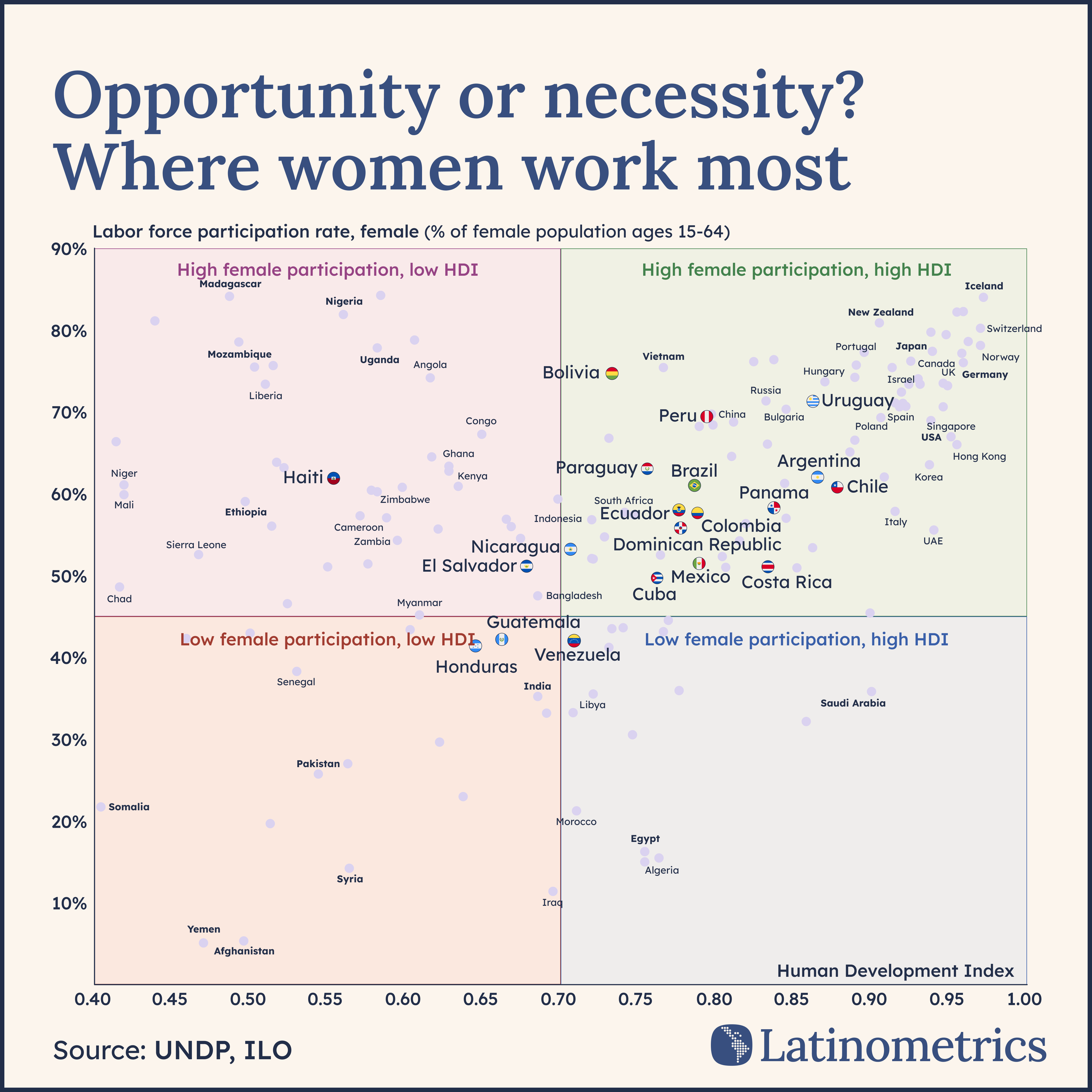
🌍 💼 Why do women work more in both the richest AND poorest countries? The surprising global pattern will change how you think about development…↓
Opportunity or necessity? Where women work most.
Twenty years ago, Kofi Annan, then the Secretary-General of the United Nations, said that “There is no tool for development more effective than the empowerment of women.”
To Annan, most major developmental issues requiring global attention – from economic productivity, infant and maternal mortality, and nutrition to HIV prevention and education – would be best served by empowering women and improving their qualities of life.
And without any doubt, many of the world’s most developed countries tend to have women integrated in their labor forces. Europe, for example, contains global leaders like Iceland, Sweden, and Switzerland. On the flip side, least developed countries (LDCs) like Afghanistan, Somalia, and Yemen are all among the countries with the lowest participation by women in the workforce.
But the global pattern is more nuanced than a simple upward curve.
In fact, female labor force participation tends to peak at both ends of the development spectrum. In wealthy countries, women often work due to greater educational and economic opportunity. In some of the poorest countries, by contrast, women work out of necessity—often in informal or subsistence roles—because households cannot survive on a single income.
This dichotomy is somewhat visible within Latin America as well. Southern Cone countries like Argentina, Chile, and Uruguay are regional leaders in female participation, reflecting their relatively high levels of development. By contrast, less than 45% of females work in Honduras, Guatemala, and Venezuela.
[story continues… 💌]
Source: Human Development Index | Human Development Reports Labor force participation rate, female (% of female population ages 15-64) (modeled ILO estimate) | Data
Tools: Figma, Rawgraphs
Posted by latinometrics
6 Comments
It seems pretty straightforward to me.
High income countries: with plenty of income you can afford to pay for childcare, labor saving devices, and services. It makes economic sense for most people (including women) to work.
Middle income countries: most families can’t earn enough to afford external childcare, as many labor saving devices, services, etc. This makes caring for home/family a full time job all on its own. *Somebody* needs to do that job, and that somebody is usually women. So less women participate in paid labor because they’re busy doing the unpaid labor at home.
Low income countries: most people earn barely enough to survive. Man woman, elderly, young children, disabled… not working is not an option. If that means grueling long hours doing unpaid domestic labor after a full day of work, too bad. If that means bringing your baby with you to work every day because no one else can babysit, that’s life.
It’s one of those things governments absolutely love. *Two* taxable incomes per household? Hell yes!
The Middle East is always at the scene of the crime of women not being able to participate in the workforce
In the Arabian gulf, most women were allowed to get out of the house to work a century ago, because a single income wasn’t enough to sustain the family. The tradition of not letting women out of the house was reserved for the upper classes who could afford it. As the economy improved, families could start to afford not letting women out, so rich families did that. Now thag trend’s reversed, with more affluent and Westernized families adopting more feminist practices
Women in poor countries work out of necesity. The jobs are not well paid in any way , mostly they are maids, have a spot in the local market, farmers … it is a necesity/survival economy. Their husbands are not earning well either , which is why women (and the older kids) also start working even with low levels of education
That is surprisingly low for the US