Link to the paper: https://arxiv.org/pdf/2508.03814
An image of the candidate planet: https://static.scientificamerican.com/dam/m/13a15b7f066e910f/original/alpha_centauri_3_panel_dss_hubble_webb.jpg?m=1754586844.062&w=900

Link to the paper: https://arxiv.org/pdf/2508.03814
An image of the candidate planet: https://static.scientificamerican.com/dam/m/13a15b7f066e910f/original/alpha_centauri_3_panel_dss_hubble_webb.jpg?m=1754586844.062&w=900
6 Comments
Plain language summary:
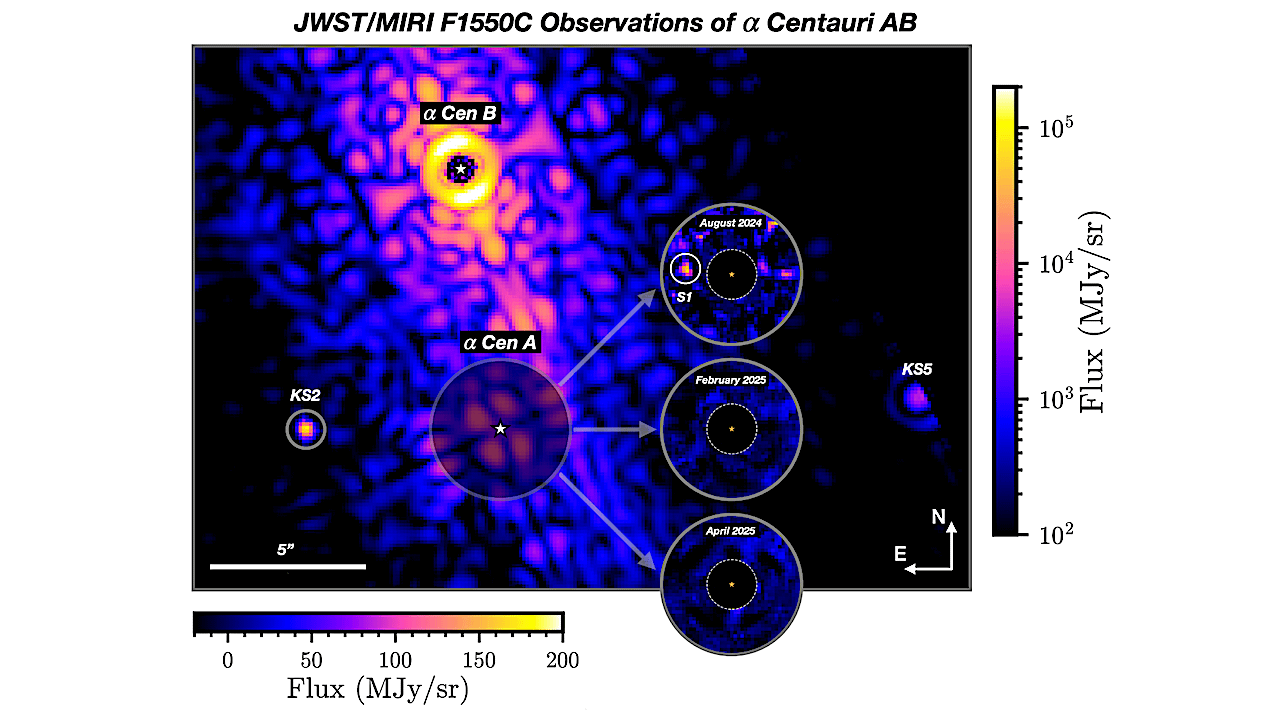
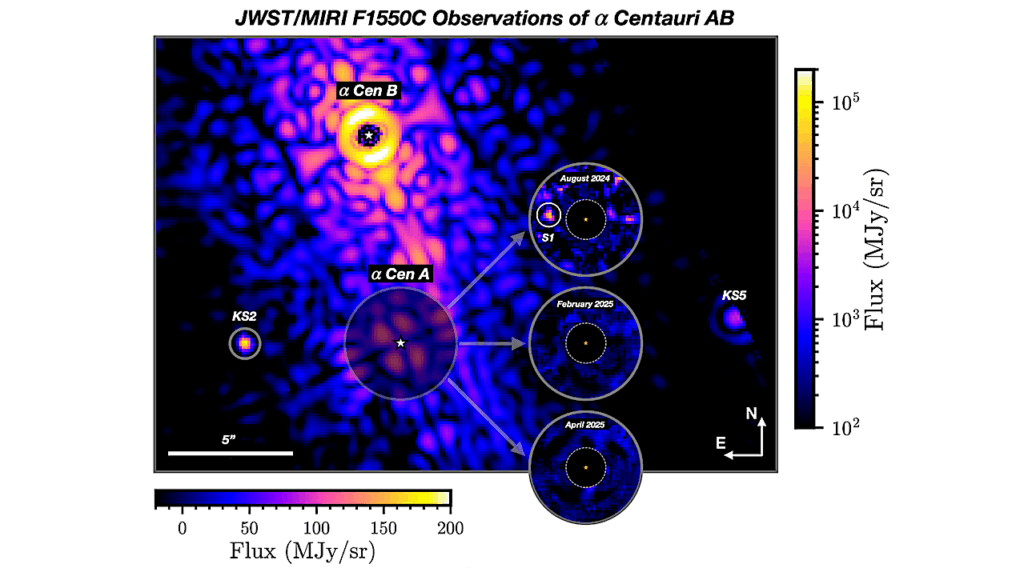
Researchers used the James Webb Space Telescope to observe Alpha Centauri A, the closest Sun-like star to the Earth. The star was observed three times: in August 2024, February 2025, and April 2025. In the first observation a faint point of light was detected near the star (named S1). S1 wasn’t recovered in the next two observations. To explain this, the authors suggest that if S1 is the same object that was spotted in 2019 (named C1), its orbital motion could have rendered it undetectable in the later observations.
The planet candidate has an estimated equilibrium temperature of 225 K (-48°C, -54,67°F), a radius similar to Jupiter, and a mass between 90–150 times that of the Earth. Its orbit would be highly eccentric e~0.4 and inclined relative to the system plane.
Is this the same world as C1 that may have been detected in February 2021 by the VLT?
[deleted]
Wouldn’t a giant planet kinda automatically not be a habitable planet for humanity because of the difference in gravity?
> These suggest that the planet candidate is on an eccentric (e≈0.4) orbit significantly inclined with respect to α Cen AB orbital plane (imutual≈50∘, or ≈130∘).
That is not an orbit suitable for habitability. Any moon would be exposed to extreme changes. The inclined, eccentric orbit also suggests that planets around Alpha Centauri A aren’t going to have the most stable orbits long term. Other planets near the habitable zone are going to have their orbits be disrupted by that gas giant. It’s interesting to see how different it is from the Solar System, how unstable the orbits are for planets in a binary star system.
Dibs. I call dibs. It’s mine now and if anyone goes there first put my frozen brain on that ship.