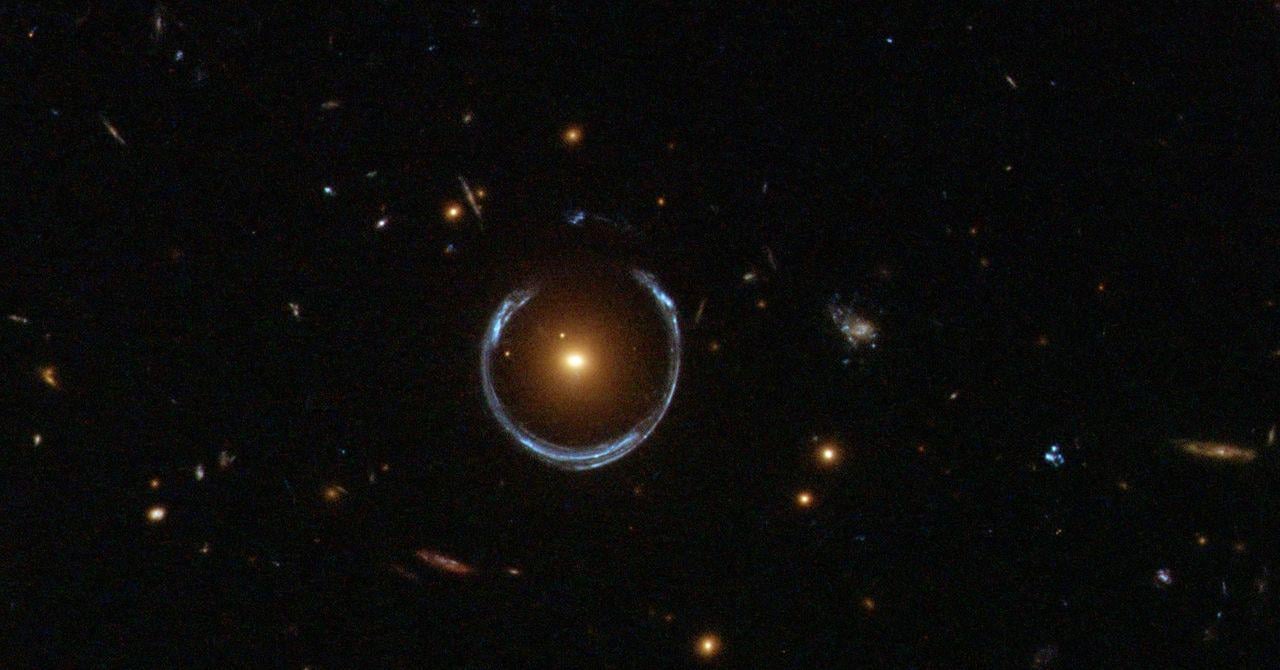
This Might Be the Most Massive Black Hole Ever Discovered
https://www.wired.com/story/this-is-probably-the-most-massive-black-hole-in-history-gravitational-lens/

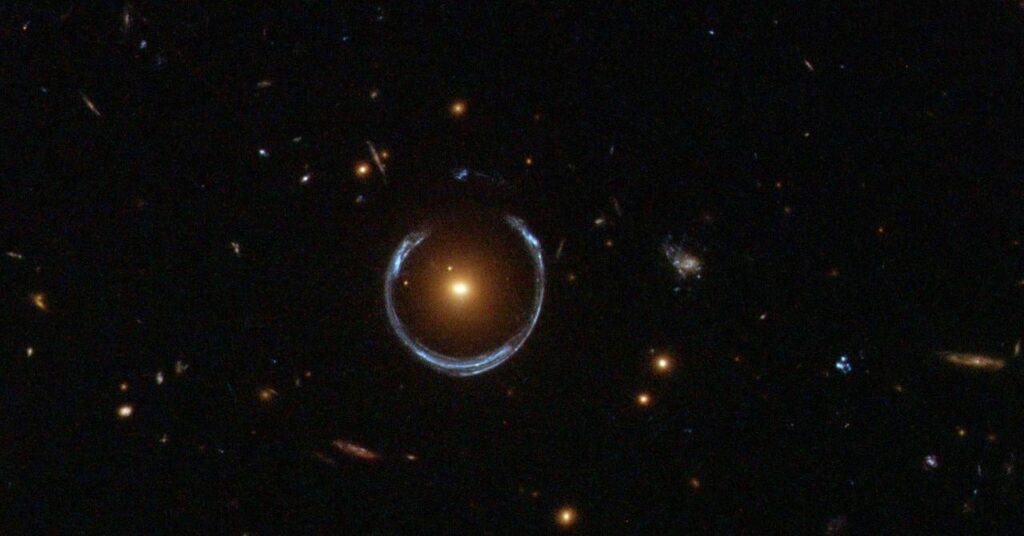
This Might Be the Most Massive Black Hole Ever Discovered
https://www.wired.com/story/this-is-probably-the-most-massive-black-hole-in-history-gravitational-lens/
6 Comments
New measurements of the galaxy at the heart of the “Cosmic Horseshoe” indicate that it could house the most massive object ever seen in the universe.
Read the full article: [https://www.wired.com/story/this-is-probably-the-most-massive-black-hole-in-history-gravitational-lens/](https://www.wired.com/story/this-is-probably-the-most-massive-black-hole-in-history-gravitational-lens/)
In the article, it says “Although there are no direct observations of this black hole, measurements of the motion of light in the ring and the velocity of stars in the inner regions of the galaxy are consistent with the presence of an ultramassive black hole.”
My question is how (the actual f*ck) do you calculate the velocity of stars in the inner regions of a galaxy nearly 6b ly away? Are you even able to resolve different objects at those distances? Or can it be done by monitoring spikes in certain wavelengths that appear at regular intervals? Aren’t there similar problems with resolution, etc.?
Also, the gravitational lensing could (presumably) be cause by a very massive galaxy, even if the black hole at its centre wasn’t particularly large, right? Like there’s no guarantee that black holes increase in size proportionally to the galaxies that orbit them (I was under the impression that galaxies are held together by mutual gravitational attraction, rather than attraction to a singular central object)?
Guess they finally found OP’s mom?
(Sorry, had to make sure the essentials were covered)
Great, how much are tickets? I’m ready to move on to the next timeline, please
I don’t think they can resolve individuzl stars . I asked myself the same question reading the article and I think when a galaxy is so dense the spectrum of emission from stars in a given region ends up pretty homogenous , so I guess it’s easy to have a reference spectrum and measure the redshift and blueshift of the central region relative to that spectrum . Either that or they’re looking at specific rays of emission .
Your mom jokes incoming in 3.. 2.. ah too late