School phone bans expand to 35 US states, sparking national debate | Teachers report fewer disruptions after states limit student phone use
https://www.techspot.com/news/109168-school-phone-bans-expand-17-additional-states.html

School phone bans expand to 35 US states, sparking national debate | Teachers report fewer disruptions after states limit student phone use
https://www.techspot.com/news/109168-school-phone-bans-expand-17-additional-states.html
18 Comments
From the article: The big picture: Restricting cell phone use has become one of the most significant policy shifts in schools in recent years. In just two academic years, what started as an isolated measure in Florida has grown into a national debate involving nearly three dozen states, as well as educators, parents, and researchers. While it’s still too early to determine its full impact, the restrictions have already reshaped the daily routines of millions of students.
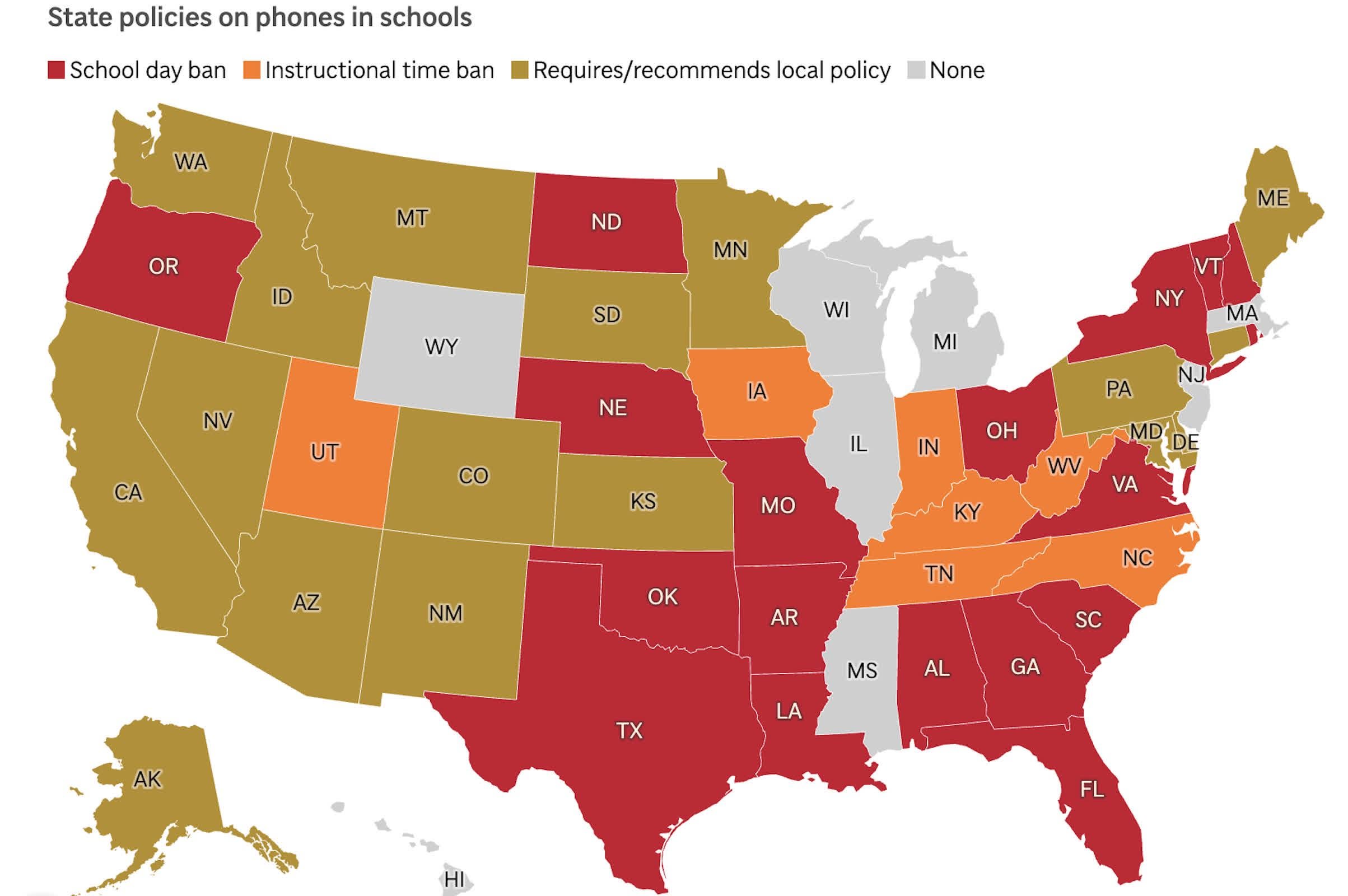
Seventeen states and the District of Columbia began this academic year with new limits on student cellphone use, marking one of the fastest-moving trends in American education policy. With the latest additions, a total of 35 states now have laws or rules restricting phones and other electronic devices during the school day.
The rapid adoption of these policies follows Florida’s 2023 law – the first statewide mandate of its kind – and represents a rare instance of bipartisan agreement. Lawmakers from both parties argue that phone use interferes with learning and student well-being. Supporters link phones to classroom disruptions and reduced focus, while critics contend that the evidence is not yet conclusive.
The scope of the bans varies by state. Several prohibit phones throughout the school day. Some, such as Georgia and Florida, enforce “bell-to-bell” restrictions only for kindergarten through eighth grade. Seven states limit prohibitions to class time, allowing students to use devices during lunch or passing periods. Other states leave it to districts to set their own policies, often with the implicit expectation that tighter controls will follow.
Classroom enforcement differs widely. Some students begin the day by placing phones in magnetic lockable pouches or retrieving loaner devices from dedicated storage lockers.
Early reports suggest students are adjusting to the new limits, though reactions remain mixed. At McNair High School near Atlanta, where restrictions began last year, junior Audreanna Johnson told the Associated Press that initial pushback is starting to ease. Many students initially resisted turning over their phones because they were used to texting classmates and socializing during lessons.
Still, some students note drawbacks. Johnson said she relies on music through headphones to concentrate on schoolwork and expressed frustration at losing that option.
At Kentucky’s Doss High School, senior Jamel Bishop observed that the ban is reshaping classroom dynamics. With fewer interruptions, he said, teachers can provide “more one-on-one time for the students who actually need it.”
Parents are equally conflicted. Researchers at Emory University, who surveyed 125 Georgia school districts, found that parental resistance is the single largest obstacle to regulating phone use in schools. Many parents want reassurance that they can contact their children immediately in case of emergencies.
Parent advocates such as Jason Allen of the National Parents Union argue that schools need to address both safety communication and social-emotional development when implementing restrictions. “We just changed the cellphone policy, but aren’t meeting the parents’ needs,” Allen said.
Evidence on the impact of phone bans is still emerging. Teachers often welcome the policies, reporting calmer classrooms and easier instruction.
Julie Gazmararian, a public health professor at Emory studying a ban in Marietta middle schools, said educators observed fewer disruptions and more student interactions in hallways and cafeterias. Discipline referrals also declined, though she cautioned that her research is ongoing and cannot yet determine whether mental health outcomes or bullying rates are changing.
Other scholars urge caution. Munmun De Choudhury, a Georgia Tech professor, noted that while social media use strongly correlates with poor mental health, research has not proven causation. “We need to be able to quantify what types of social media use are causing harm, what types of social media use can be beneficial,” she said.
Despite growing momentum, not all legislatures are on board. Earlier this year, Wyoming’s Senate defeated a bill requiring districts to adopt cellphone policies, with opponents arguing that decision-making should remain with teachers and parents. In Michigan, a Republican proposal for a statewide ban in K-8 classrooms and high school instructional periods failed in the House after Democrats objected on grounds of local control.
My state has a school day ban and as a parent, I’m all for it.
When I was a kid phones were not around, at least not smartphones, and kids didn’t have them. But there were other things like Gameboys or tamagotchis that a student may have tried to sneak into class. But they knew they were sneaking them in, they implicitly knew it was not allowed to have them in class and that if caught they’d be in trouble and start making up the dumb excuses children make.
Nowadays what surprises me, and that’s something many people who are teachers have told me, is that when they see a student with a phone and tell them to put them down and that they’re not allowed, a lot of the times the students don’t just do it, but instead ask “why is it not allowed”, and not in the cheeky contrarian way some children ask why to resist authority, but it’s completely genuine. They honestly don’t understand why it’s not allowed or how it could be considered disruptive.
The “but what about emergencies?” argument is so weak compared to the damage that having the phones available all the time does
Seems like common sense. I feel for the teachers having to deal with cell phones the last decade+. Makes no sense at all and sets kids up for failure.
Anecdotally, I’m a teacher and many of us used to collect them before class and it was a constant battle. The school unilaterally mandated it midway through last semester and it is wonderful. In my experience, they should 100% be banned from schools (or at least from classrooms).
Personally, I support phone bans in classrooms, but wouldve been so pissed if I didn’t have one during lunch. I wonder what the schools would do with other portable like switches bc I played a shit ton of that during lunch or during downtime in class with friends when we got our work done.
Next, get rid of all the computers outside of actual compsci instruction.
Why is it a debate? What’s the argument for allowing phones during school? I got my first iPhone in high school, if the teacher saw that shit they took it for the rest of the day and literally nobody had a problem with it. Even I knew it was a reasonable consequence of getting caught with it
Quebec just banned them. This September will be the first semester with the ban in effect. Keep an eye on how that goes if you’re curious!
But how will we know if there’s a school shooting? Y’all basically stole our kids freedom of speech. Texting during a shooting cause police are useless was their only way of getting help….
My kids school district just implemented a bell to bell ban, right when they’re going into middle school where things have really deteriorated due to social media and phones in general. I’m overjoyed they won’t have to deal with it and will be able to go to school without that influence.
Parent of two school age kids on one of the states with bans. I don’t agree with a LOT of the politics in my state but I am 100% behind this. The evidence on kids and smartphones is overall scary about how much they can harm development, education, socialization, self-reliance, etc. My state has a hard ban on bringing any device to school, not just a squishy “not in class” ban that’s onerous for teachers to enforce. Have seen zero problems and teachers are very happy with it. My kids are too young for phones IMO but many kids still have them so this also saves me from having to have my kids exposed to phones when I don’t want them to yet and also avoids conversations about why cant’ they have them bc X Y and Z do. Great policy, thrilled we have it.
I always thought if i were a teacher, specifially history, id challenge my students to use their phones to fact check me in real time. I would tell them there is one piece of information in each lesson that will be wrong, like a date or name, and whoever can call me out on it will get an extra point. If they are going to be on their phones, they might as well use them to study in class instead of goofing off. No idea if this will actually work, just an idea i had
I feel like we should expect a little more out of schools than just blanket bans. There are responsible ways to have a cell phone in school. Cell phones aren’t a new thing these days and kids have always had things that can be disruptive to the classroom, cell phones are just the latest thing. Teachers and schools can find ways to deal with it, just like they’ve figured it out in the past.
Maybe phone makers can start to work on a “School Mode”, where the phone can make and receive calls for emergencies but have no application functions. We can have airplane mode, so why not school mode?
> national debate
There is no debate. You put your kid in school, the school says no distracting devices…. you either comply or pull your kid out of school. NO EXCEPTIONS!
How little Johnny and Suzie made it through school in the 60s/70s/80s/90s/00s/10s I’ll never, ever understand. /s
Unless the country has solved school shooting, there is not a chance in hell l’d send my kid to school without a way to directly communicate with them.