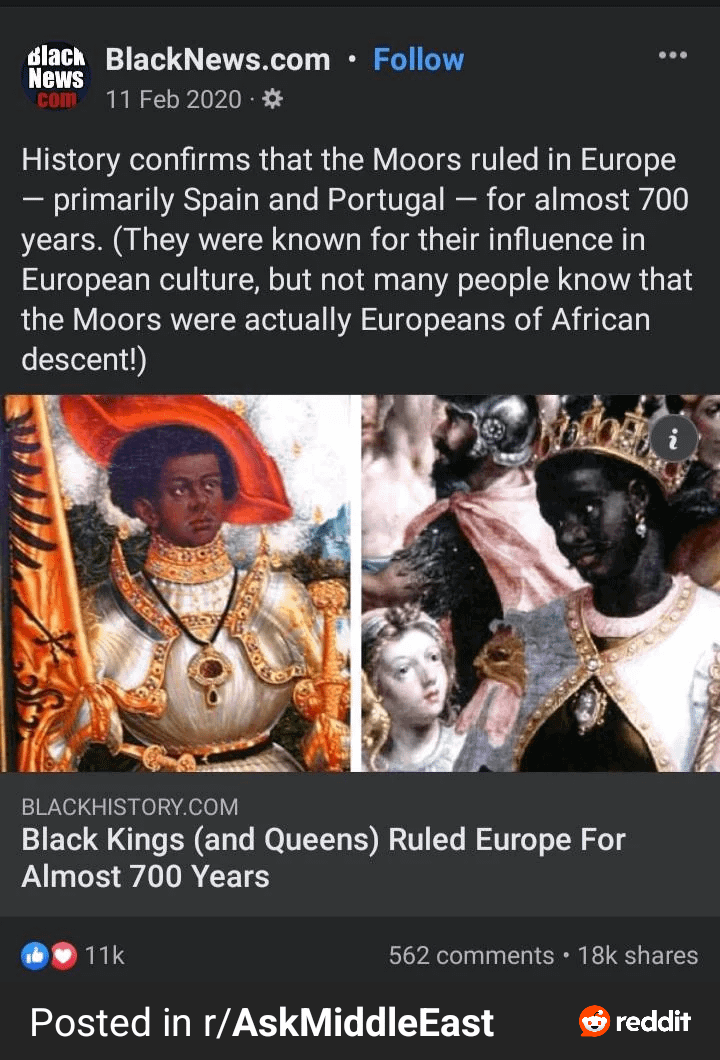
Thought on the growing African American mouvement who claim that the Berbers who ruled Al-Andalus were black
https://i.redd.it/3m64wdool1lf1.png
Posted by Quiet-Drawer-8896

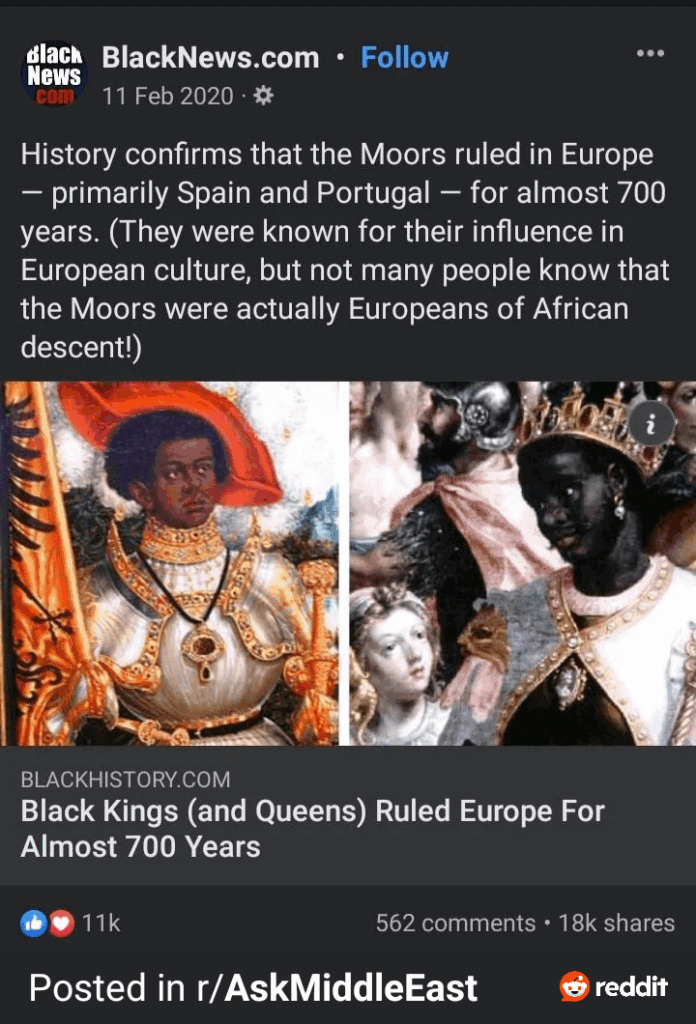
Thought on the growing African American mouvement who claim that the Berbers who ruled Al-Andalus were black
https://i.redd.it/3m64wdool1lf1.png
Posted by Quiet-Drawer-8896
9 Comments
Some of them were. We certainly depict them as black in the cross of alcoraz. the masmudas were certainly black based on writing at the time (and they eventually formed the almohads around 11/12th century).
what’s the problem if some black people in America want to feel kinship? why this matter at all?
Vale, ahora. Decidme qué es lo relevante en esto?
[removed]
I mean, Berbers are indeed African, are they as black as someone from Congo? No. Are they black enough for some of them to be considered “black” under US culture? Unlikely but not impossible. Most likely most Berbers would be considered “arab” or “middle eastern” simply because US race categories are dumb af.
You could probably find people in Spain that come from Spanish heritage that would be considered “blacks” if they were to be in the US.
From my POV, the black community in the US lacks guidance and they try to give importance to things that are unimportant. The fact they still allow the term “African American” is part of it, as they would never call a white guy “European American” and also negate the reality of Caribbeans who did not necessarily come from Africa, hence perpetuating the racism that keeps on living in the US.
Su primer error es pensar que moros es un grupo étnico y no una denominación genérica para musulmanes de toda clase
I’m not getting your point. The moors ruled the Iberian peninsula indeed. So?
There is northern Africa and there is sub Sahara. Yes the black people were in Andalucía, and yes they had sometimes high ranks. But they were never kangz.
Also, lets just look at Morocco, Algeria, Arabia. And then tell me again how black they are.
Next thing they try you to believe is, Cleopatra was black.
By the way, the person on the left is a Christian.
Also, those black moors are the ones that enslaved ( Saqliba) white woman and children. The color was not important to enslave but the religion was.
A mi lo que más me sorprende de los conspiranóicos afrocentristas es que mucho que si Cleopatra era negra, esto, los olmecas, incluso Shakespeare que eso ya sí es para nota, pero del imperio de Mali ni se acuerdan, es la obsesión con darle la vuelta a la historia en vez de reclamar atención para la historia real del África subsahariana.
This is at the same level as the black Cleopatra.