
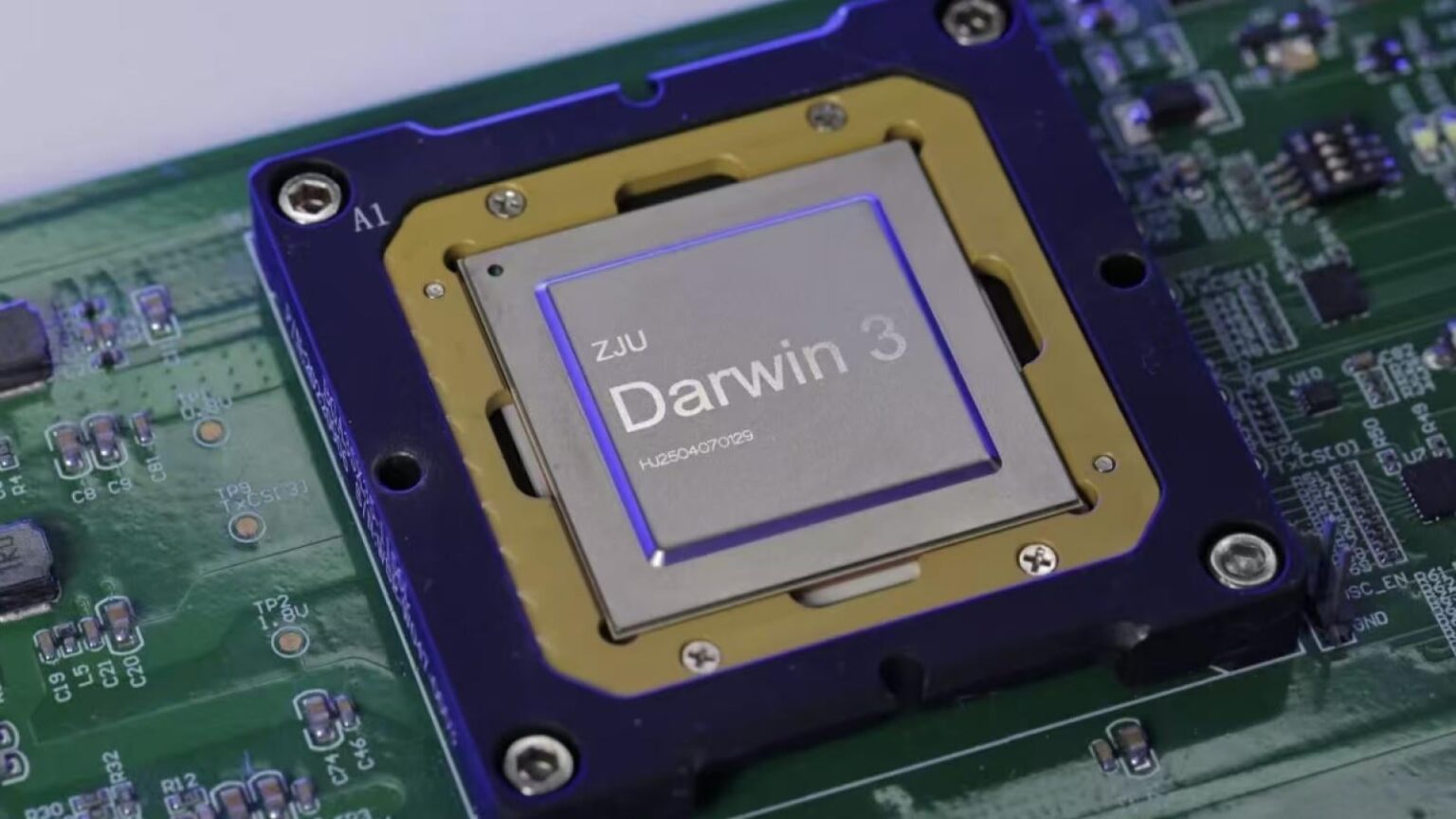
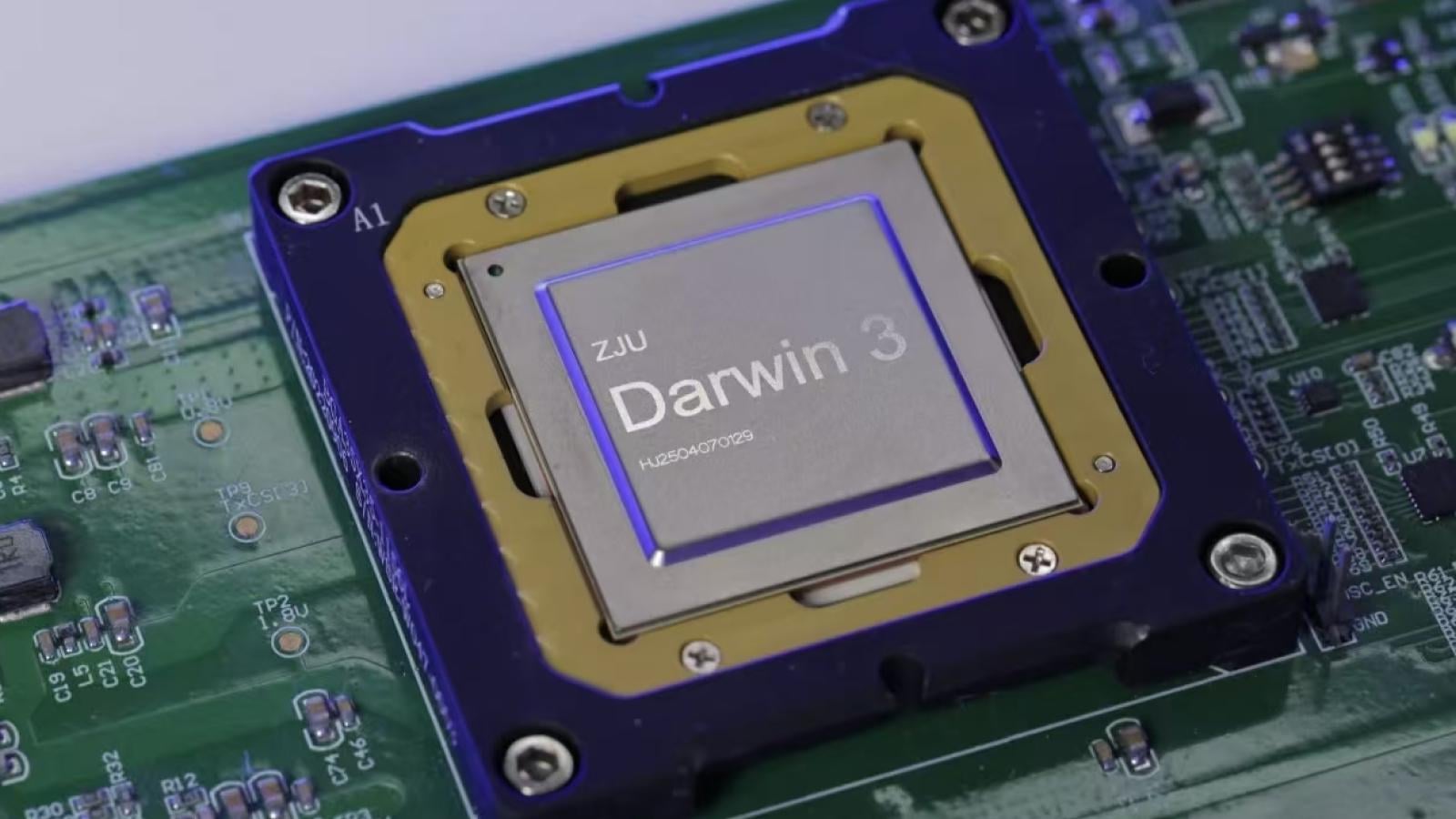
China’s ‘Darwin Monkey’/’Wukong’ is the world’s largest brain-inspired supercomputer with over 100 billion synapses, similar to the neural structure of a macaque
https://www.livescience.com/technology/computing/chinas-darwin-monkey-is-the-worlds-largest-brain-inspired-supercomputer
3 Comments
> Scientists in China have unveiled a supercomputer built on brain-like architecture, specifically, that of a monkey. Called Darwin Monkey or “Wukong”, the system features **over 2 billion artificial neurons** and more than 100 billion synapses, putting it roughly on par with the neural structure of a macaque.
> The researchers hope it will serve as a **simulation tool** for neuroscientists while also providing a stepping stone toward **artificial general intelligence** (AGI), an artificial intelligence (AI) system that possesses human-like intelligence and reasoning.
> Unlike traditional artificial neural networks, which follow classical computing principles and process data via continuously changing binary values, neuromorphic systems like Darwin Monkey are driven by spiking neural networks (SNNs). SNNs mimic how signals are transmitted between neurons in the brains of mammals.
> A biological neuron fires an electrical pulse when the signals it receives from other neurons **reach a level strong enough to trigger a response**. Artificial neurons in SNNs mimic this mechanism, firing **only** when they’ve built up enough electrical input. SNNs physically replicate the way information moves between biological neurons. This configuration allows SNNs to process data in parallel, potentially making them **more powerful than conventional supercomputer architectures.**
> Darwin Monkey consumes **just 2,000 watts of power**, roughly the equivalent of an electric kettle or hairdryer, despite being powered by 960 Darwin III neuromorphic chips, each of which supports up to 2.35 million spiking neurons. The previous record-holder in neuromorphic computing was Intel’s Hala Point system, which comprises **1.15 billion** artificial neurons and 128 billion artificial synapses distributed over 140,544 processing cores.
> It follows the launch of Darwin Mouse (“Mickey”) in September 2020, which contains 120 million artificial neurons, the equivalent of a mouse’s brain.
If we could place a **sky**-high **net**work of satellites into orbit, equipped with these supercomputers and the most advanced artificial intelligence software, it could be a great boon for humanity’s progress.
I think these comparisons are missing some of the complexity in an organic brain.
For example, they store a single number for each “neuron” and send that out to each “synapse”. But real synapses have many neurotransmitters at each junction (around 500 for humans), each can be up or down regulated, and of course are different at each synapse (up to around 50,000 for each neuron). So, just in terms of number of connections, this thing could be less complex than a macaque by 7 orders of magnitude. Beyond that, there are the various hormonal systems in a real brain, adding to the complexity again.
It’s interesting tech, of course, but comparisons to animals can be very misleading.