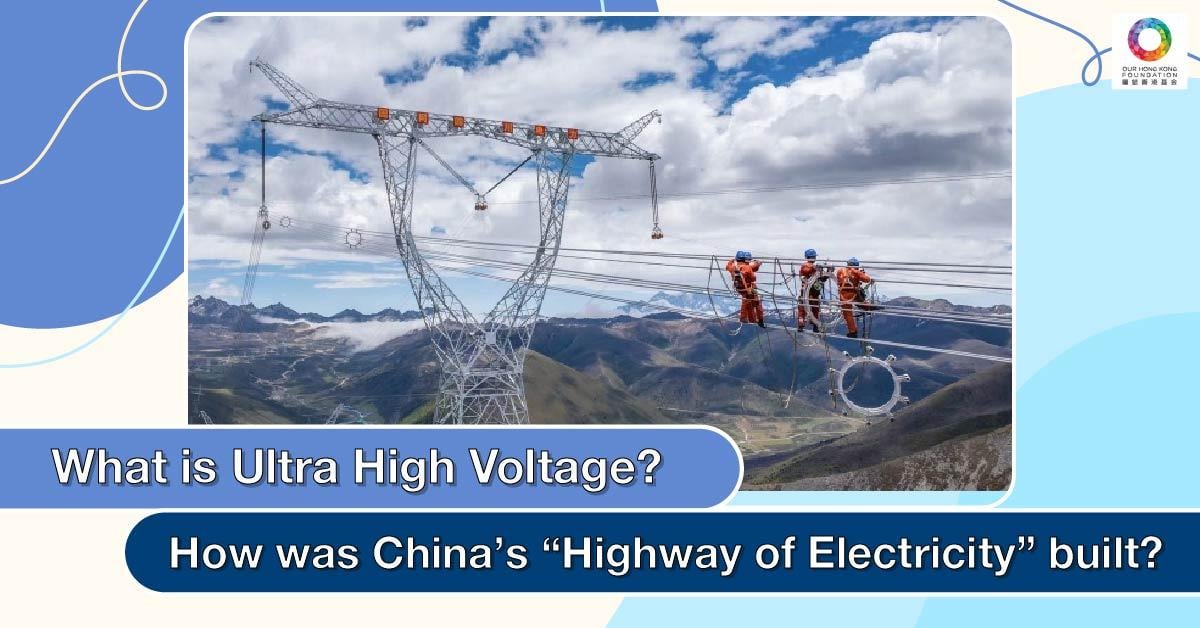
China’s Ultra High Voltage “Electricity Highway” project: one second of power transmission over 1500km away is enough to sustain a household for two years
https://www.ourchinastory.com/en/14967/China’s-UHV-project:-The-world-leading-

China’s Ultra High Voltage “Electricity Highway” project: one second of power transmission over 1500km away is enough to sustain a household for two years
https://www.ourchinastory.com/en/14967/China’s-UHV-project:-The-world-leading-
6 Comments
> In just 0.005 seconds, green energy from China’s Qinghai Province can be transmitted to Henan Province over 1,500 km away; one second of power transmission is enough to sustain a household for two years…This is the magic of China’s Ultra High Voltage Transmission Project.
> Ultra High Voltage (UHV) technology, often dubbed the “**highway of electricity**”, stands as one of gilded hallmarks of China’s manufacturing. From the operation of the first UHV project in 2009 to the present, China has built 19 Ultra High Voltage AC lines and 20 DC lines, with transmission lengths exceeding **40,000 km**, forming the main energy artery of the country’s “West-to-East Power Transmission” initiative.
> Generally speaking, transmission voltages are categorized into high voltage, extra high voltage, and ultra high voltage. Ultra High Voltage transmission technology refers to **AC transmission of 1,000 kilovolts and DC transmission of ±800 kilovolts or above**.
> Compared to high voltage and extra high voltage, Ultra High Voltage has advantages such as **higher transmission efficiency, longer transmission distances, lower line losses, and land savings.**
> For instance, under the same power transmission conditions, the transmission distances of 1,000 kilovolts Ultra High Voltage AC and ±1,100 kilovolts Ultra High Voltage DC are four times and five times those of 500 kilovolts transmission lines, respectively, with line losses reduced to only 25%.
> Since the 1960s, developed countries like the United States, Japan, and the Soviet Union have conducted research on Ultra High Voltage transmission technology and have launched various projects. However, due to technical challenges and operational efficiency issues, **they eventually reduced or halted operations.**
> Dozens of research institutions and universities, over 200 equipment manufacturing enterprises, more than 500 construction units, and hundreds of thousands of people have participated in basic research, technology development, equipment manufacturing, system design, experimental verification, project construction, and commissioning operations of Ultra High Voltage, **overcoming 310 key technologies.**
One of the issues with renewables has been that some of the best spots to generate energy are really far away from civilisation. A really long cable will experience transmission loss losing much of the power before it even gets to where its needed and pumping a lot of energy though fewer cables can cause failures due to heat which is where these cables come in handy. But it seems like the technology is still expensive and difficult to utilise so itll be quite some time before its widespread enough to say stick a giant solar array in a desert and funnel energy half way across the Planet. But the potenial is huge.
Waiting for the western nationalists to tell me why this is bad
Futurology and technology have been taken over by vote bots that just promote China.
What could possibly go wrong?
Firing megawatts of energy in fractions of a second down a fucking wire.
The EM pulse alone would have major effects on any nearby electronic equipment. Health effects? Who knows?
What if one of those wires breaks during transmission? Anyone near that break is dead. Considering the power levels that could be miles away.
I mean, this is an accomplishment, but not a technological one, it’s an administrative one. The issue in the USA is we can’t just take peoples land and build on it. It’s a regulatory nightmare. The issue in Europe is that it’s simply unnecessary. They don’t need ultra high voltage because the power doesn’t need to go as far.
In short: not a technological achievement, but an administrative one.