
Europe as a whole became a set of islands from the Jurassic, when the Supercontinent Pangea broke; This would continue throughout the Jurassic to the Cretaceous, to the era of mammals.
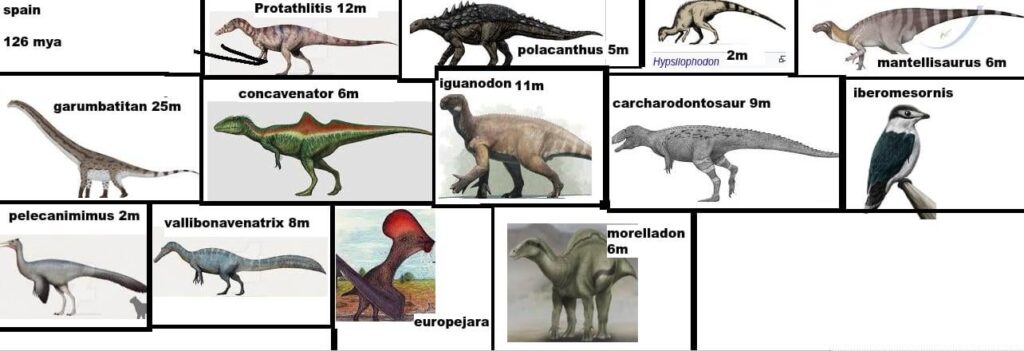
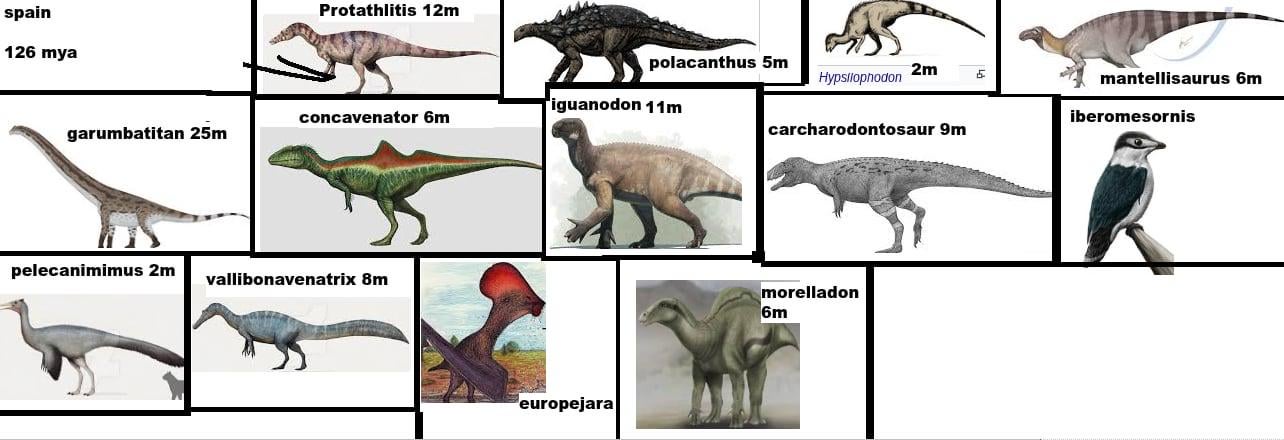
Here I am going to talk about the animals that lived on the prehistoric island of Spain 126 million years ago.
These data are based on the fossil site of Las Hoyas and the Morella formation, both of the same period of the Cretaceous, and being on the same island, it is plausible that animals coexist, even if they come from different sites.
https://www.sciencedirect.com/science/article/abs/pii/S0195667114002390
https://www.nature.com/articles/s41598-023-33418-2
The iguanodonte is one of the most emblematic dinosaurs of all time, being one of the first to be described. It was a 11 m long herbivorous that could chew its food primitively through a lower jaw swing. It had an enormous spike on the thumb. It was widely distributed throughout Europe.
Morelladon was a relative 6 m long, known for his humps on the back. Mantellisaurus was also a 6 m long iguanodon.
Hypsilophodon was a small bipedal herbivore, distant relative of the iguanodonte, 2 m long.
Polacanthus was a thorny anquilosaurs 5 m long and well armored.
Garumbatitan was a huge 25 m long neck sauropod that would have weighed more than 30 metric tons.
Pelecanimimus was a distant relative of the most famous gallimimus, but smaller, 2 m long, and with small teeth in the mouth.
Convenator was a Carcarodontosaurus. These dinosaurs were one of the main predators of the Earth in the first half of the Cretaceous. Convenator is distinguished by the two little humps on the back, as well as what seemed small spikes in the arms. It measured up to 6 m long.
An unidentified carcharodontosaurus is known in Morella. The bones we have belong to a youth copy, while adults probably measured 9 m long and were the maximum predators of the island. They would have had a mouth with sharp teeth that could inflict the most serious injuries to their prey.
Europe was a pterosourium known for its elaborate ridges and measured two meters long with its size. Actually, it was frugivoro, which means that it ate fruit.
Vallibonavenatrix was a spiny spiny. These carnivores thermopods have long snouts to those of the crocodiles and conical teeth, and are widely considered piscivores, also known as fish canteens. This measured 8 m long.
Protathlitis was also a spiny, fish dining room. But this measured up to 12 m long, much larger than any theropod of the island.
Iberomesornis was a small enantiornitino. They are also known as opposite birds because their limbs were oriented opposite to those of modern birds; They had teeth and claws on the fingers. In fact, they were extinguished along with the other dinosaurs; It is believed that, since they lived in the trees, while the ancestors of the modern birds were more terrestrial, this left the tree birds of vulnerable opposite wings. The asteroid triggered global forest fires and destroyed its trees.
https://i.redd.it/mr5mc0xa63nf1.jpeg
Posted by Powerful_Gas_7833
1 Comment
Amazing, stunning…