That's not such good news …
https://www.youtube.com/watch?v=iDaG4zt0NKc
https://www.nature.com/articles/s41612-025-01098-6

That's not such good news …
https://www.youtube.com/watch?v=iDaG4zt0NKc
https://www.nature.com/articles/s41612-025-01098-6
6 Comments
First time I’ve heard about the ozone in… years. A quick google search shows that it’s healing. Of course punching rockets through the layer will have some affect but to be honest it’s not gong to reverse or even stop the healing. I don’t see an issue as the scientific, economic and societal changes that the space exploration and colonization will bring far outweigh the minor issue.
NOTE: TLDR at the bottom… this comment is about the paper, not the video.
“Ozone losses are driven by the chlorine produced from solid rocket motor propellant, and black carbon which is emitted from most propellants.”
Not really common amongst the new generation of launchers actually.
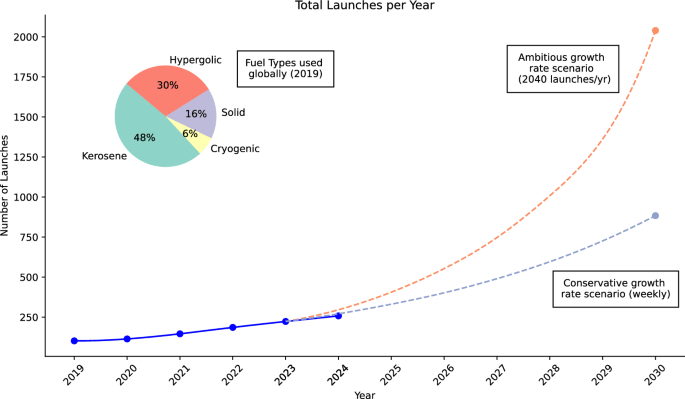
Kerosene is the larger of the evils noted in the paper, but the problem is that the paper assumes the same vehicles are launching over the next few decades.
High carbon outputs are more substantial with RP-1 and open cycle gas generator engines. (Also noted by the paper, one of the graphics merge all non-kerosene propellants under “cryogenic” and separates hypergolic and solids as their own categories.
Open cycle gas generator kerolox engines are present on Falcon. However, Falcon is supposed to be replaced by Starship over the next decade or two; starting with high cadence, low risk Starlink launches. This open cycle gas generator cycle with kerosene isn’t really present in the US sector beyond that on other LVs. Similarly, the other categories of hazardous propellants listed aren’t really present in US LVs anymore; either Vulcan optionally using solids. The PRC is also moving away from this, developing closed cycles where the big hazard of black carbon is not really present by virtue of the combustion process in that cycle.
Currently, the trend of propellants has been focused on reusable methalox closed cycle engines, where the exhaust is primarily base constituents, with black carbon appearing as film cooling and slight OF ratio adjustments. Vulcan, New Glenn, Neutron, NOVA, and Starship all use more advanced closed cycles that need to avoid carbon black to avoid contaminant buildup for reuse. Aside from Vulcan, none use solid propellants, and none use hypergolics. The article points out that they have no data for these methalox and closed cycle designs specifically.
Later in the article, it stresses that solids (in particularly the chlorine emissions from them) are the biggest issue. With ULA disposing of their Atlas fleet, solids from the US are dwindling significantly.
They also assume that only 4% of launches will be reusable at peak. The list above is all partially reusable, with Vulcan’s questionably functional SMART reuse and two fully reusable designs. Perhaps the PRC will up their cadence, but I do not expect them to reach a capture of 96% of launches; especially with the lineup and market available in the US. As noted earlier, avoiding carbon soot is a significant aspect of reusable vehicle design, it’s pretty relevant, and part of the reason why methane is being transitioned into service now.
TLDR:
In short, it’s good to look into, but this article makes some assumptions that don’t really work in my opinion. Ignoring the cycle is a pretty big move, and with a substantial portion of the paper dedicated to solid propulsion, there’s a lot of concerns about an area that is expected to shrink, not grow in line with the industry.
Speed-played the video. He discusses 2 main subjects:
1. pollution caused by rocket exhausts.
2. pollution caused by dead satellites re-entering.
I just focused on listening the first point – he makes a very true point that solid fuel rockets, and kerosene rockets, emit soot and other pollutants that are not good. But then IMO he drops the ball by focusing on Starlink and its 30000 satellites – but that mega-constallation will be enabled by Starship, which uses an entirely different fuel (methane, which I understand is far less polluting) and he does not consider it.
Sounds like that prediction that London would be covered in horse manure in a very short time.
The man calculating that had assumed uncapped exponential growth of horse cart numbers, and had ignored the growth of other forms of transportation.
Video and article assume a future we _already_ know will not happen.
This belongs in r/noshitsherlock. Not only are the actual rockets a pollution problem, it’s the whole back-end industry that is takes to make said fuels.
I posted a comment about this to a different thread here in r/space a week or so ago and was downvoted to hell!
Everyone is cheering on rocket launches not realizing they’re actually hurting the future livability on *this* planet. People think the atmosphere is just some “sphere” and we can go in and out of it without ramifications.