
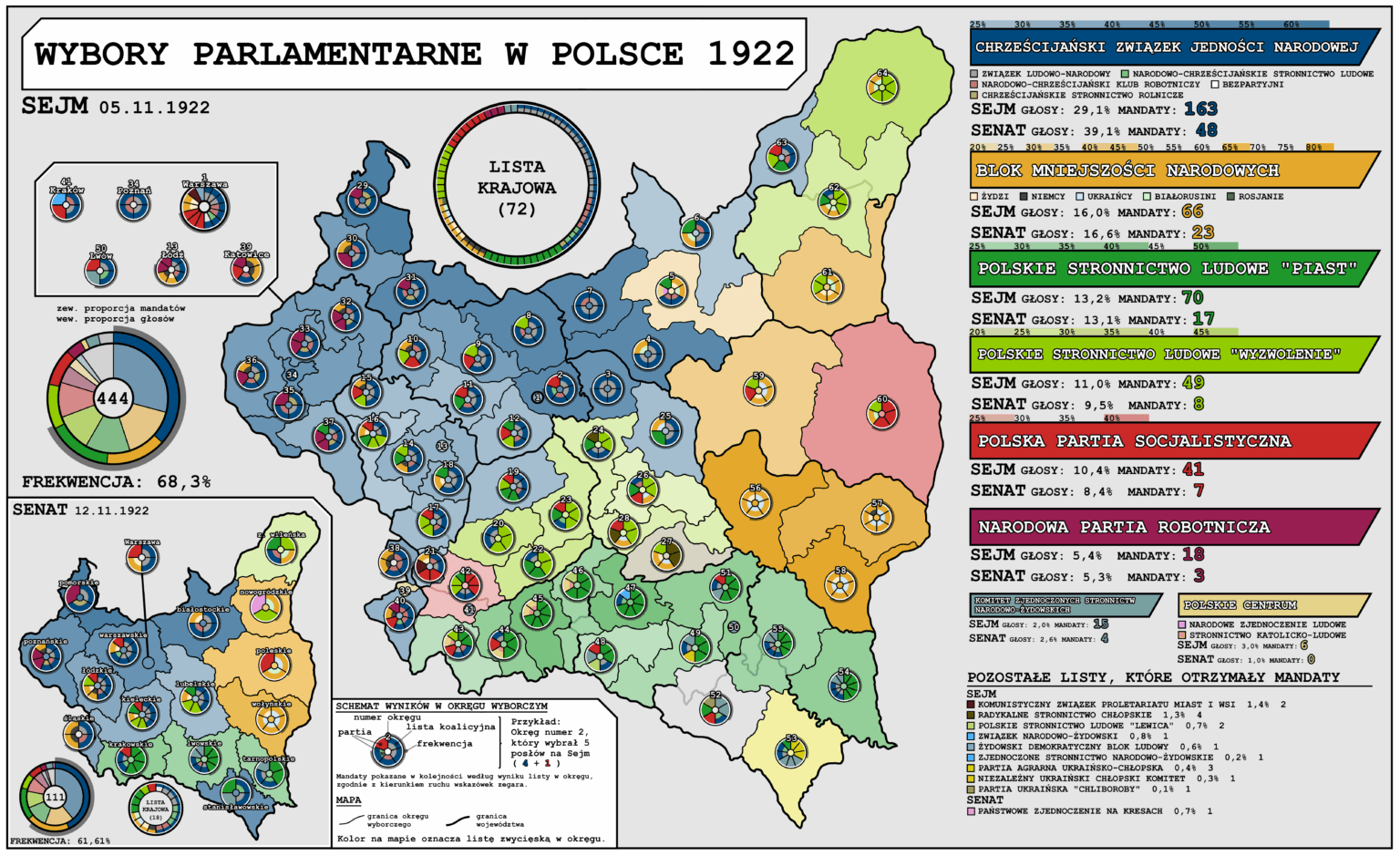
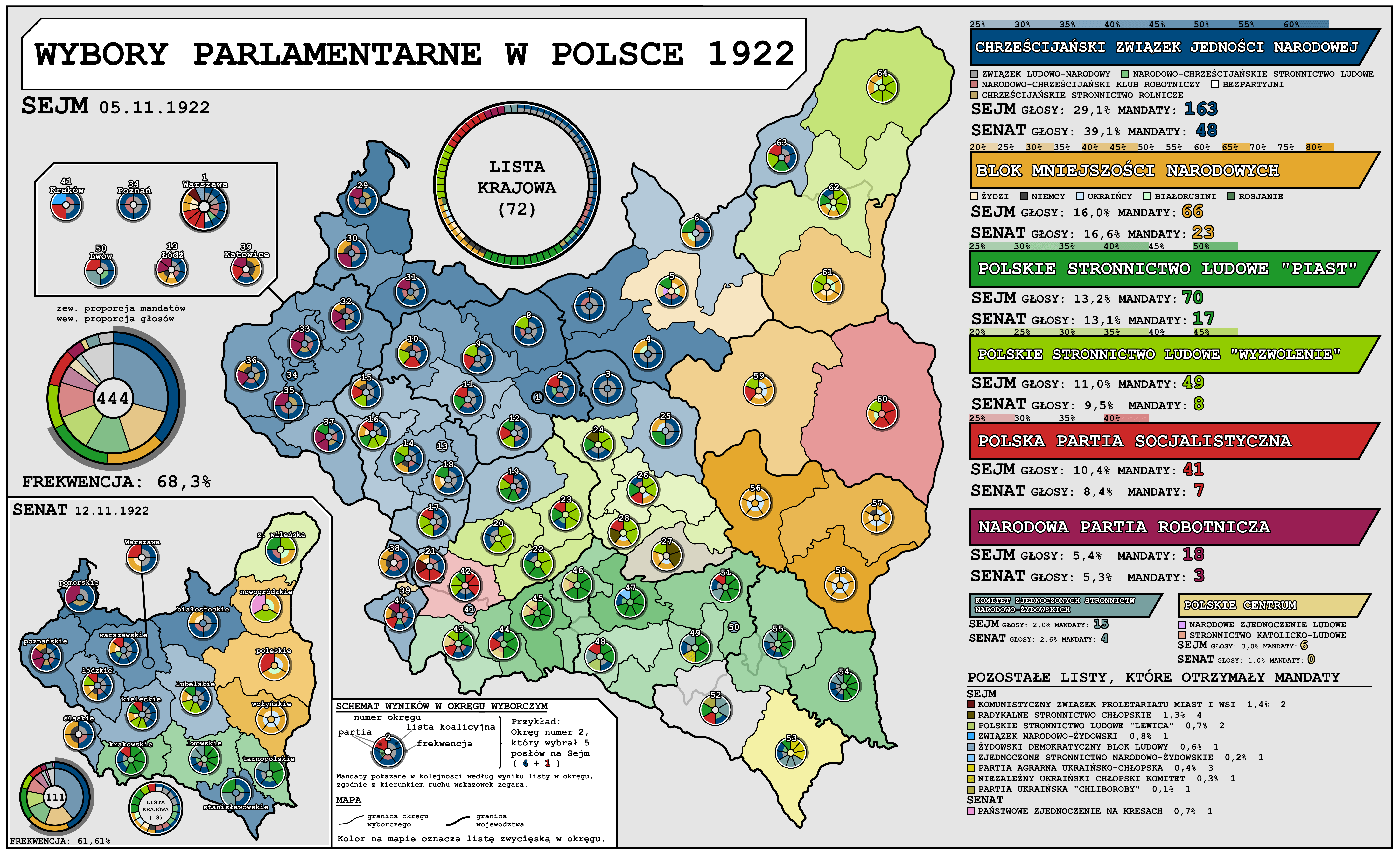
A map showing the results of parliamentary elections in 1922, both to the Sejm and the Senate.
Own work. Source: Sejm and Senate 1922-1927: a handbook for voters, containing election results in poviats, districts, voivodships, images of senators and parliamentary deputies, as well as illustrative maps, 1923 Rzepecki Karol. Made available by the Greater Poland Digital Library [link].
The only elections held in the democratic interwar Poland throughout its entire territory. Elections to the Legislative Sejm 1919-1922 covered only a part of the area forming the country and they were characterized by some chaotic and makeshift. The next election of 1928 will be held in the conditions of the emerging sanation dictatorship.
PARTICIPANTS
- The Christian Union of National Unity – called by the left and the center "Sustainable" Coalition of the Endecian Folk-Naroding Association and several Christian parties. The unquestioned winner of the election, although he did not reach his dream independent majority. The main fraction in most governments established between 1922 elections and the May coup.
- Block of the National Minorities of the Republic of Poland – A joint list created by German, Jewish, Belarusian and Ukrainian politicians from the Prussian provinces, Kresów and Kongressówka – in Galicia, Jewish parties created their own committees, and Ukrainians in large part of the election boycotted.
- Polish People’s Party "Hub" – Frack of Chadecki and the conservative Polish People’s Party under the leadership of Witos, a three -time prime minister. Defined in the abovementioned source as a central party (p. 490).
- Polish People’s Party "Release" – Socialist and left -wing branch of the Polish People’s Party under the leadership of Thugutt. This "Release" submitted Gabriel Narutowicz’s candidacy in the presidential election.
- Polish Socialist Party – left and workers’ party. The Prime Minister of the Provisional Government in Lublin Ignacy Daszyński and the first Prime Minister of the Second Polish Republic Jędrzej Moraczewski came from this group.
- National Workers’ Party – a party referred to in the abovementioned source as central (p. 490), with a clearly social and workers’, but also a nationalist character, the strongest in the city of Łódź and the former Prussian district.
- The United National-Jewish Party Committee – A list of Jewish politicians in Galicia, where the idea of BMN did not accept.
- Polish center – Electoral Agreement concluded by two Christian parties, prominently present in the Legislative Sejm 1919-1922. In view of the election defeat, the Polish center did not create its own club, and MPs from this list joined the ChJSN groups.
- Other groups are primarily local peasant and Galician parties and committees: Jewish and Ukrainian (so -called chliborobi). Perhaps the germ of Polish communists should be specified, which obtained 2 seats, and the state union supported by Józef Piłsudski, which in elections to the Sejm suffered a complete defeat, although it gained one senator.
Electoral law
The 1922 election took place, as did the parliamentary elections in the Third Polish Republic, in multi -lending constituencies, where the fines were separated by the D’Hondt method. However, the electoral law at that time differed from today in several key points:
- No election threshold. An artificial election threshold was not in force around the country. As a consequence, even groups with support below the percentage had a chance to get fines, if they enjoyed sufficiently great support in individual districts.
- Closed list. The voter in 1922 could not, like today, to choose any candidate from the selected list, which he would vote. The candidate queue was determined by the election committee. What can be interesting, no electoral cards were used in this election in the contemporary understanding – the voted voice consisted of placing a card in the envelope with only the list number written on it.
- Size of constituencies. While the currently applicable Electoral Code specifies that at least 7 deputies are elected in each constituency (Article 201. § 2.), then there were even 4 -mandate districts, and none outside the city of Warsaw had more than 10 of them. Naturally in combination with the D’Hondt method, it rewarded larger groups – the best example is District No. 3 (Siedlce, Sokołów and Węgów), where He seized all 4 seats with 55% support.
- Domestic list. The concept known to older voters – in the Third Polish Republic was in force until the 1997 election. Some deputies (72) were selected not from the district lists, but from the state list: these seats received lists that introduced MPs in at least 6 districts, in proportion to the number of fines obtained. In the same principle, 18 senatorial seats were distributed between the letters that introduced senators in at least 3 Senate districts.
- Senate elections. In contrast to contemporary elections using single -member constituencies and majority, in the 1922 election senators were elected in constituencies with voivodship borders (with the capital city of Warsaw treated separately) by the same method as deputies. Elections to the Senate took place a week after the Sejm election.
Recommended games
"ZVarious Russian" – Find the only one among four hundred and four Russian MP! Additional points for using only the eyes.
"What does German do here?" – How do you think where a random German MP in Volhynia came from? The answer will help you find a section "electoral law".
"Polish roulette" – collect a group of friends and draw alternately numbers in the range from 1 to 64. Whoever draws a district without a single deputy of Chzi "foreign element" And game waste!
https://i.redd.it/023yvfb6ykqf1.png
Posted by LoopMuhZoop
5 Comments
Widać zabory
WOW, kawał świetnej roboty. Winszuję.
r/WidacZabory
Szkoda, że Chjena z Witosem się nie zdołali na stałe dogadać i oszczędzić nam gównianej sanacji.
Ten pojedynczy Niemiec zapewne >!wszedł z listy krajowej, tj. w skali kraju wyłoniono kilku kandydatów z partii dlatego że partia wprowadziła posłów w 6 okręgach, a ten akurat znalazł w szczęśliwej grupce.!<