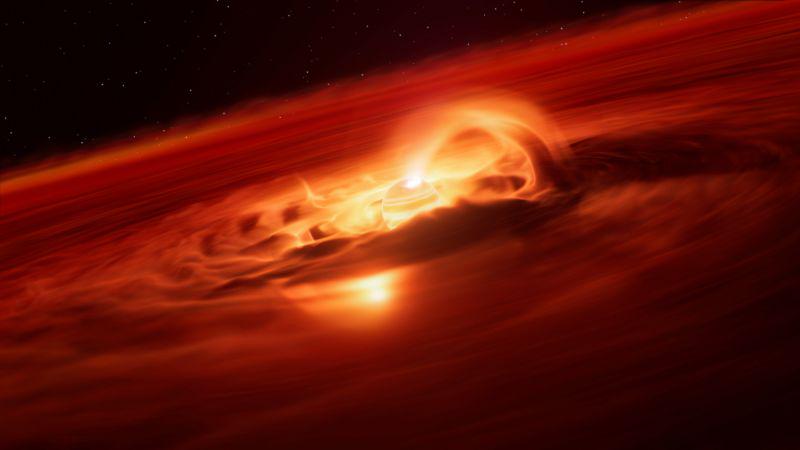
Rogue planet caught behaving like a star in unprecedented observation
https://www.cnn.com/2025/10/02/science/rogue-planet-growth-spurt?utm_medium=social&utm_campaign=missions&utm_source=reddit

Rogue planet caught behaving like a star in unprecedented observation
https://www.cnn.com/2025/10/02/science/rogue-planet-growth-spurt?utm_medium=social&utm_campaign=missions&utm_source=reddit
11 Comments
Astronomers have observed a planet that in some ways behaves more like a star — including a massive growth spurt unlike anything witnessed before in a free-floating planet.
The rogue planet, which does not orbit any star, is called Cha 1107-7626 and is outside of our solar system, 620 light-years from Earth in the Chamaeleon constellation. A single [light-year](https://www.cnn.com/2023/03/31/world/bill-nye-light-year-scn), or the distance light travels in one year, is equal to 5.88 trillion miles (9.46 trillion kilometers).
The planet has a mass five to 10 times that of Jupiter, the largest planet in our solar system. And it’s getting bigger every second, according to new research published Thursday in The Astrophysical Journal Letters.
>The planet unexpectedly began gorging on the gas surrounding it a few months ago and is now swallowing down six billion tonnes (2.2 trillion pounds) every second
How dense would the gas around the planet have to be to allow this? And why is it called “the gas surrounding the planet” and not just it’s atmosphere? Is the gas not caught in its gravity well?
So… If it keeps growing to the point of fusion processes starting, it becomes a star? Is this surprising? All stars must have a similar phase of accretion before they are large enough to ignite, as far as I understand it. Unless the accretion disk and gas surrounding it are too small, so it never reaches ignition.
5 to 10 Jupiter masses is 0.5 to one solar mass. The only reason this isn’t a star is that it is not yet dense enough to ignite. Should eventually be a red dwarf or even sunlike star.
So, an object that is forming has a weight of 3/4 of the brown dwarf and keeps gaining weight.
I don’t think “planet behaving like a star” is a correct description; it’s the brown dwarf in a process of formation. Yes, it’s cool we can observe this process, but absolutely nothing unexpected.
Report that planet that’s gone rogue and is now misbehaving!
I’m curious how many pixels are actually detected/seen of this planet and/or the accretion disk. I’d be surprised if it was more than one pixel.
Consider that there are only around thirty stars (besides Sol) that show up as more than one pixel (“resolvable”).
https://en.m.wikipedia.org/wiki/List_of_stars_with_resolved_images
So a t dawrf is accreating matter, how is this not just a young star. its mass is on the low end for t tauri stars and is in a star forming region. Lets just check back in a couple million years when it ignites.
The rogue planet should know it’s place. It’s a supporting actor at best.
I wonder how we would be able to tell the difference between stars formed from rogue planets and stars that formed from direct collapse.
I wonder what it going to happen as it begins to light up. I bet it is going to pulse for a while until the mass reaches a point that continuous ignition can be maintained. An Initial fusion reaction would begin and heat things up causing the material to spread out and then ignition would stop, things would cool and then shrink to reignite again, cycling until the total mass is enough to keep the ignition going continuously. The pulses might even eject some of the material again slowing or even stopping the pulsing for a while. Maybe it is stuck in an endless loop where it just can’t get itself going – where else would the dust cloud come from that it happens to be sitting in.