
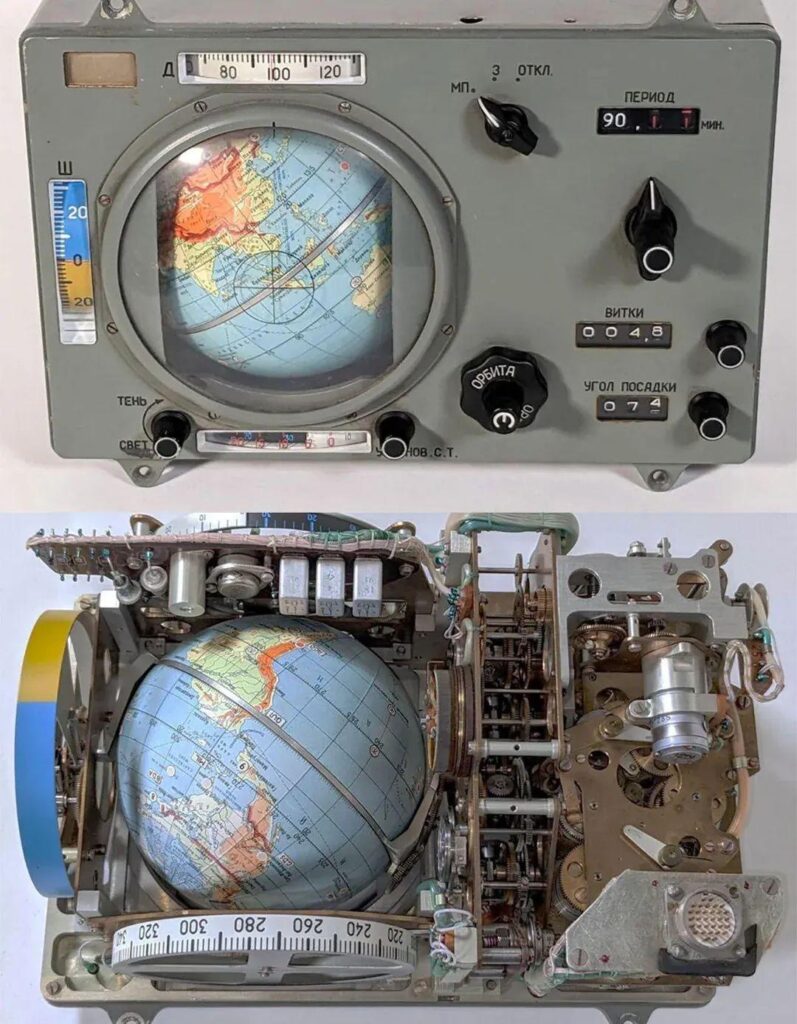
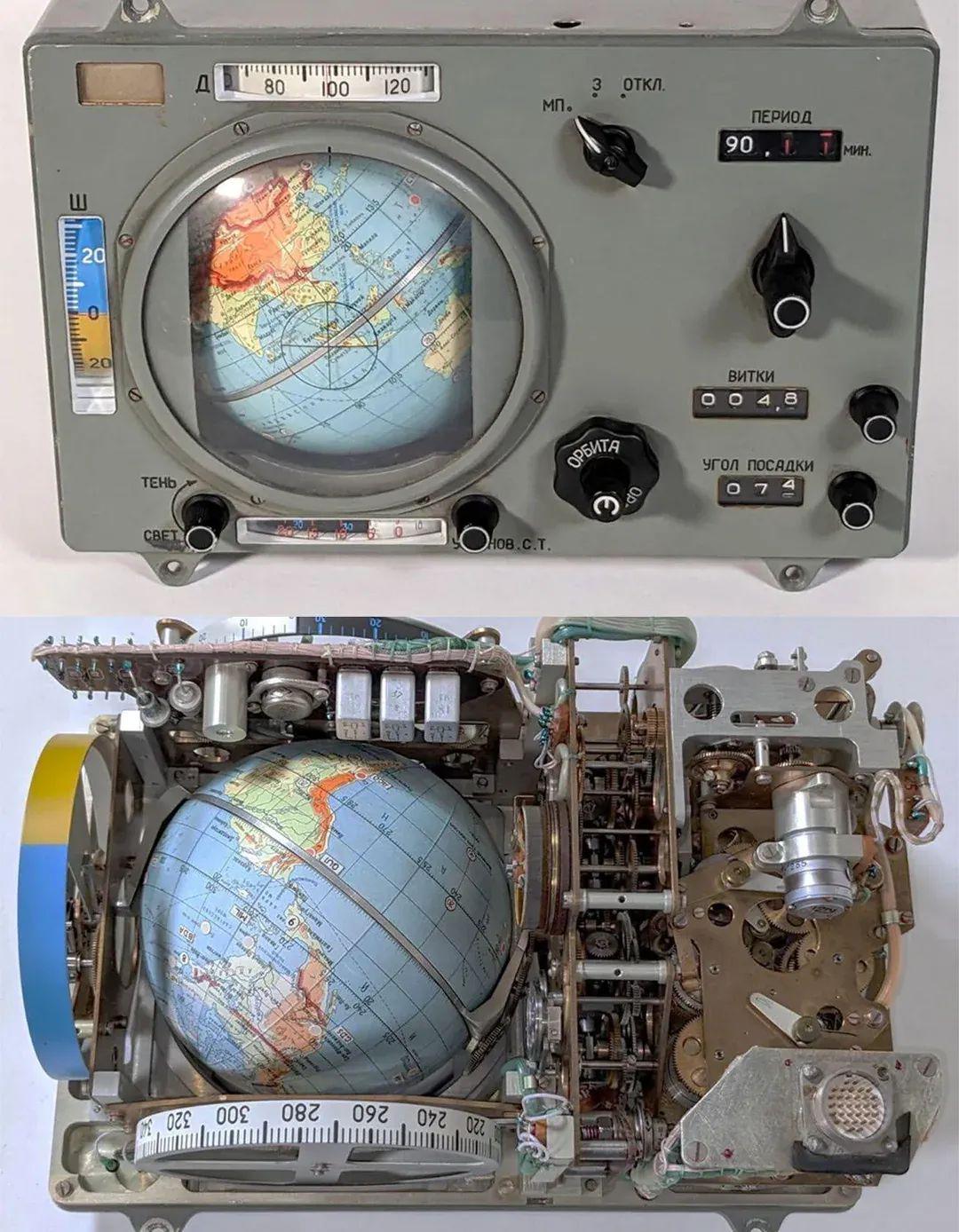
Globus INK, a Soviet era mechanical spaceflight navigation system from the 1960s. It featured a rotating, 5" globe to display the spacecraft's real-time position relative to Earth and calculated orbital parameters using an intricate system of gears, cams, and differentials. Photo by Ken Shirriff
https://i.redd.it/i05y33h9o9tf1.jpeg
6 Comments
The Globus INK (Глобус ИНК) is a mechanical navigation system developed by the Soviet Union in the early 1960s and used on Восход, Восток, and Союз missions to display the spacecraft’s position relative to Earth. The device featured a rotating globe five inches in diameter under a transparent dome with crosshairs indicating the point directly beneath the spacecraft. Its movement was driven by an intricate system of gears, cams, and differentials allowing it to rotate in two dimensions to indicate the orbit and simulate Earth’s rotation. The system included disc-shaped indicators for longitude and latitude, an orbit counter, and a backlit landing position indicator. All components were housed in a robust aluminum casing measuring approximately 11.5 inches by 8 inches by 5.5 inches and designed to function reliably in the harsh conditions of space. The Globus INK is a testament to Soviet engineering ingenuity and provided cosmonauts with a reliable means of navigation during missions. Today it remains a historical artifact reflecting the early days of human spaceflight and the innovative spirit of its creators.
I love these mechanical computers, they are truly work of art
I’ve seen a video of a 2000s Soyuz space computer and it had similar computer inside
When looking at this mechanical monstrocity I struggle to imagine how such a device could be reliable enough for spaceflight.
Reminds me of the USN analog fire control computers on ships and subs, which were in use on older platforms well into the ‘80s. Real works of art, incredibly precise and accurate and totally reliable. They still worked even if the 400hz bus was shit. Digital fire control 4-stopped if you looked at it cross-eyed, turning ships/subs of the line into the USS Helen Keller.
Iirc they have multiple part series on YT on that thing and it was for Apollo-Soyuz prep(?) or something.
Beautiful piece of engineering. Though always wonder where those old pieces sit compared to new instrumentals on fmea/fmeca(or what they use in particular sector) and all statistical evals and stuff. Just to see how far progress went since.
Тhis is just the Антікітhеrа Мехаnізм, comrades.