I would like to know what percentage of the state with the smallest population can fit in the country’s largest stadium.
Google_Knows_Already on
I remember walking into my first sports venue as a kid and realizing just how many people there are in the world. It was eye-opening to see 40 thousand folks just gather in a small(ish) area like that
reddit0924223 on
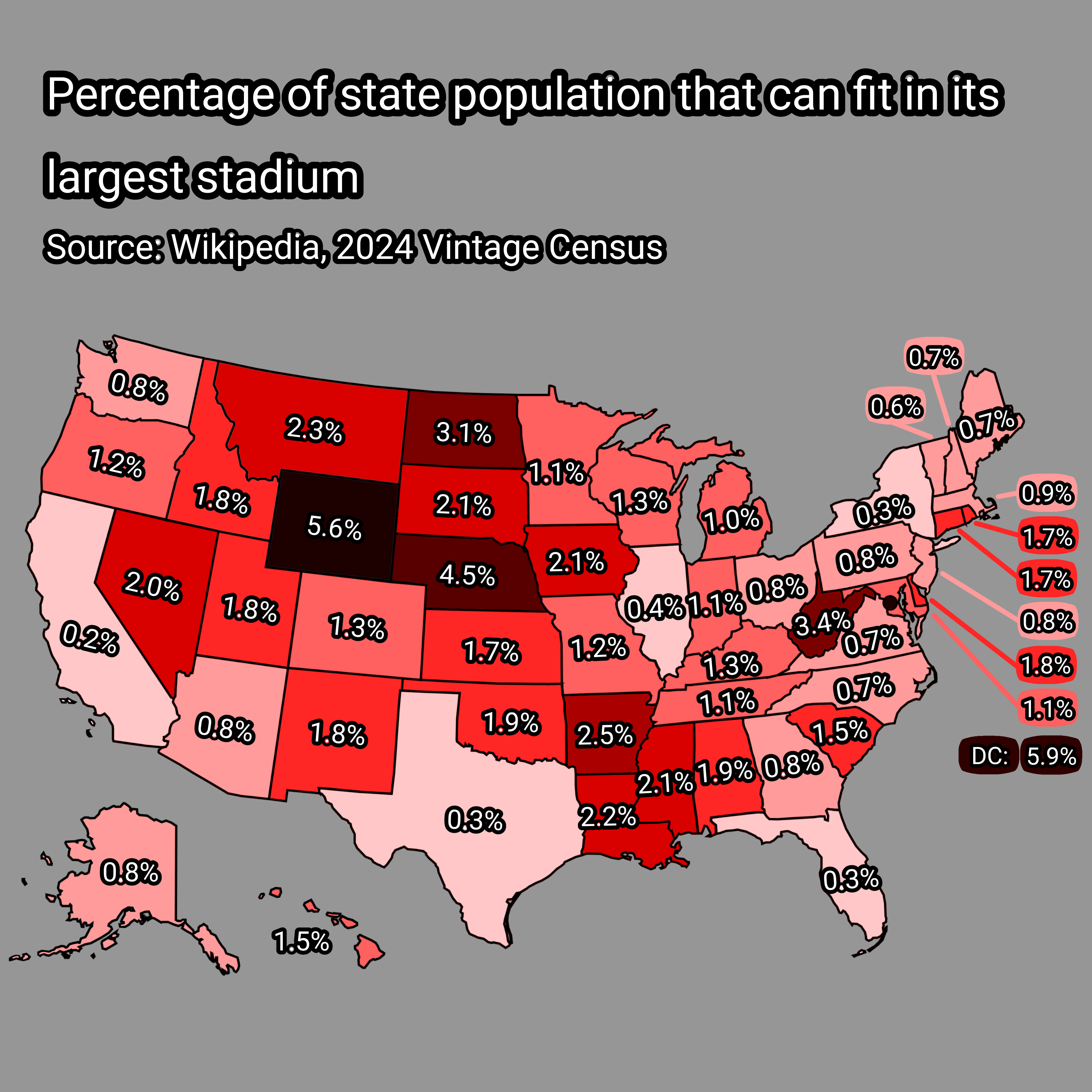
And DC, with 5.9%, is only a tiny portion of the huge metro area that would go to that stadium.
AppalachianGuy87 on
Fun fact Mountaineer Field in Morgantown, WV is larger than the two largest cities of Charleston and Huntington.
scotterson34 on
In Nebraska, that stadium filled up becomes the state’s 3rd biggest city. Crazy to think about
Black_Bear_US on
Somehow my mind is being more blown by the states with the smallest numbers, given how populous they are. There are SO many people living in Cali, and you’re telling me that 1 in 500 of them could be in one building watching the same game. Wild!
No-Lunch4249 on
This is the kind of content I like
Hectorc34 on
New Mexico achieved the 9th most populated Municipality at a football game back in September 27th when the New Mexico Lobos played New Mexico State Aggies! About 37440 fans attending the game.
TwoDaveHebners on
FYI – The largest stadium in Indiana is the Indianapolis Motor Speedway, it has 257,000 permanent seats and holds up to 400,000 on race day (3.7% to 5.7% of population).
HarryWaters on
Indiana population is 6,924,000, Indianapolis Motor Speedway has a capacity of 400,000. Indiana should be 17.3%.
During the Indy 500, it houses 0.11% of the US.
RDMvb6 on
Also crazy to think that these stadiums are financially viable despite being fully utilized for their intended purpose only like 8- 12 times per year. Sure there are smaller events held in them too but they are empty the vast majority of the time.
sparkyumr98 on
So, this is effectively an inverse map of state populations, kinda like how almost all state maps end up being population maps of some sort (unless they are per capita).
What I think would be interesting is the percentage of each state’s population that can fit in the summation of the state’s NCAA Division I (and maybe DII) stadia. I think that might link the public funding for college football to the population.
thecrgm on
Is that state Wyoming and is it the university of Wyoming stadium?
Danktizzle on
Memorial stadium (where our chunk of the $30 billion annual revenues that doesn’t go to the husker employees working hard on the field) is the third largest city in the state on game day.

![Percentage of state population that can fit in its largest stadium [OC]](https://www.byteseu.com/wp-content/uploads/2025/10/uwptyl3q8wtf1-1536x1536.png "Percentage of state population that can fit in its largest stadium [OC]")
14 Comments
Interesting.
I would like to know what percentage of the state with the smallest population can fit in the country’s largest stadium.
I remember walking into my first sports venue as a kid and realizing just how many people there are in the world. It was eye-opening to see 40 thousand folks just gather in a small(ish) area like that
And DC, with 5.9%, is only a tiny portion of the huge metro area that would go to that stadium.
Fun fact Mountaineer Field in Morgantown, WV is larger than the two largest cities of Charleston and Huntington.
In Nebraska, that stadium filled up becomes the state’s 3rd biggest city. Crazy to think about
Somehow my mind is being more blown by the states with the smallest numbers, given how populous they are. There are SO many people living in Cali, and you’re telling me that 1 in 500 of them could be in one building watching the same game. Wild!
This is the kind of content I like
New Mexico achieved the 9th most populated Municipality at a football game back in September 27th when the New Mexico Lobos played New Mexico State Aggies! About 37440 fans attending the game.
FYI – The largest stadium in Indiana is the Indianapolis Motor Speedway, it has 257,000 permanent seats and holds up to 400,000 on race day (3.7% to 5.7% of population).
Indiana population is 6,924,000, Indianapolis Motor Speedway has a capacity of 400,000. Indiana should be 17.3%.
During the Indy 500, it houses 0.11% of the US.
Also crazy to think that these stadiums are financially viable despite being fully utilized for their intended purpose only like 8- 12 times per year. Sure there are smaller events held in them too but they are empty the vast majority of the time.
So, this is effectively an inverse map of state populations, kinda like how almost all state maps end up being population maps of some sort (unless they are per capita).
What I think would be interesting is the percentage of each state’s population that can fit in the summation of the state’s NCAA Division I (and maybe DII) stadia. I think that might link the public funding for college football to the population.
Is that state Wyoming and is it the university of Wyoming stadium?
Memorial stadium (where our chunk of the $30 billion annual revenues that doesn’t go to the husker employees working hard on the field) is the third largest city in the state on game day.