
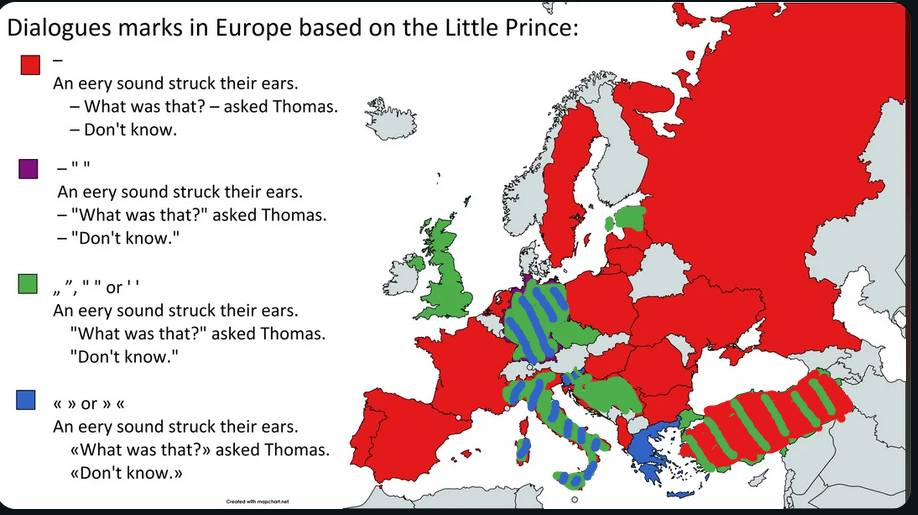
Hi guys. I’m working on a map showing how dialogues are marked in books in various languages/countries in Europe. Could you tell me how are dialogues (usually) marked in Norwegian books? Are they marked with dashes like this:
An eerie sound struck their ears.
– What was that? – asked Thomas.
– Don’t know.
or with quotation marks like this:
An eerie sound struck their ears.
"What was that?" – asked Thomas.
"Don’t know."
?
Maybe somehow differently? I wasn’t able to reach Norwegian Little Prince and I based my "analysis" on it. Please, note that I’m not asking about quotations, but about dialogues specifically. I put a sketch of my next version of the map if you’re curious and for attention.
https://i.redd.it/c5k7bws3dxtf1.png
Posted by PLrc
14 Comments
Opened a couple books and they were all the blue option
Blue is correct.
Differs from book to book, but from what I remember it’s usually Blue or Green
Blue is common, but in primary school (1980’s) I was taught green.
Pretty sure i have seen a variety of ways. Maybe it depends when it was printed.
Opened multiple books and everyone used the blue one, except for one which used the red option. I thought maybe it was a publisher thing, but i have another book from the same publisher who also used blue
[ Anførselstegn (sitattegn, gåseøyne, hermetegn) – Korrekturavdelingen.no](https://www.korrekturavdelingen.no/anforselstegn.htm)
I checked The Little Prince. It is available in Norwegian on the Norwegian National Library online (if you are in Norway). It uses the red style for the dialogue. Both in the 1977 version and in the 2003 version. This is interesting as the most common way to mark dialogues is Norway the blue style.
Red is the most readable
Have read something well north of a thousand books in Norwegian, and have seen all styles except the purple one.
Officially, «text» is the way to quote or mark speech in Norwegian. Using “text” is anglification
[https://www.korrekturavdelingen.no/anforselstegn.htm](https://www.korrekturavdelingen.no/anforselstegn.htm)
Checked one of my books, had the blue option!
«quote» is most common,
„quote” was common before 1900, but is not used anymore.
Some places use “quote”, but this is mostly due to influence from other languages.
https://sprakradet.no/godt-og-korrekt-sprak/rettskriving-og-grammatikk/tegn/hermeteikn/
A fun example is the statue that is front of the royal palace. It was forst written with ““, but that was wrong so they chiseled it out to be „“.
https://www.aftenposten.no/oslo/i/jwy0/kranglet-i-ti-aar-om-rytterstatuen-paa-karl-johan
<< in books and ” in handwriting