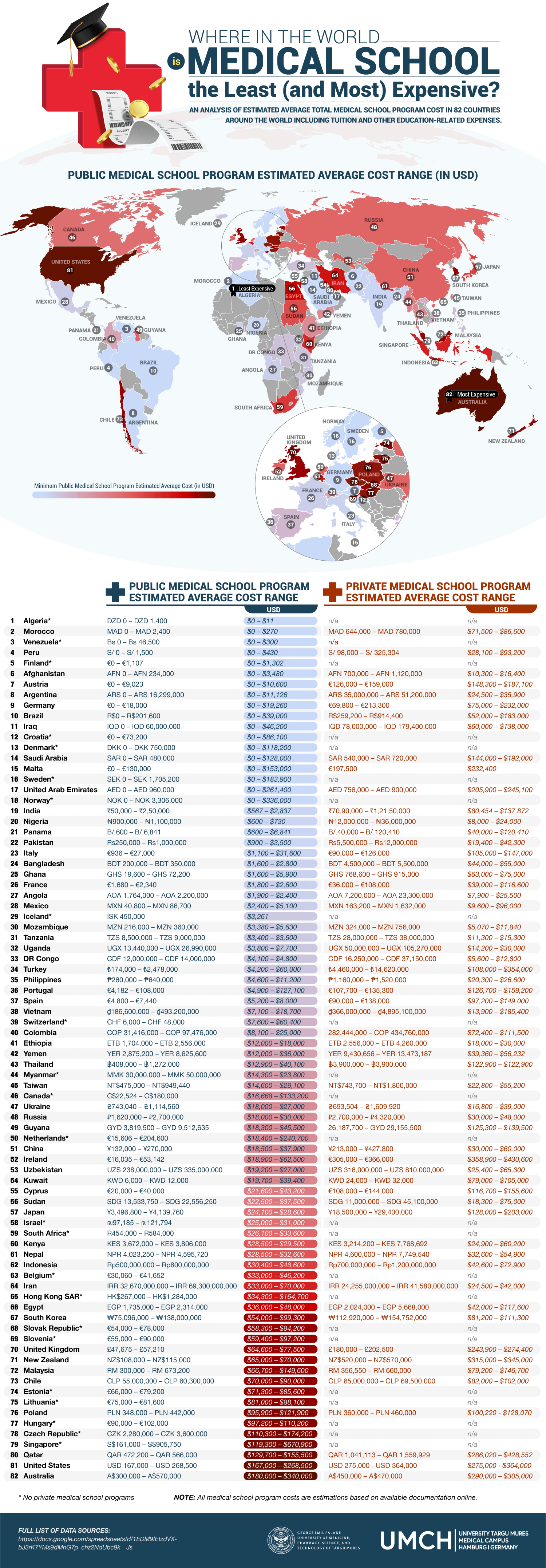
Countries ranked (least to most) by the average cost of their public medical school programs [OC]
Posted by UMCHhamburg

![Countries ranked (least to most) by the average cost of their public medical school programs [OC]](https://www.byteseu.com/wp-content/uploads/2025/10/02wr83ai4cuf1-535x1536.png "Countries ranked (least to most) by the average cost of their public medical school programs [OC]")
Countries ranked (least to most) by the average cost of their public medical school programs [OC]
Posted by UMCHhamburg
21 Comments
Created with Adobe Illustrator. The full list of sources can be found here: [https://docs.google.com/spreadsheets/d/1EDM9IEtzdVXbJ3rK7YMs9dMnG7p_chz2NdUbc9k__Js/edit?pli=1&gid=0#gid=0](https://docs.google.com/spreadsheets/d/1EDM9IEtzdVXbJ3rK7YMs9dMnG7p_chz2NdUbc9k__Js/edit?pli=1&gid=0#gid=0)
Now do average salaries of physicians in those countries
I don’t see how the Australian public system can possibly be that expensive. Uni is ~50-60k assuming you’re an Australian resident coming out of high school, and then you’re paid after that 70-90k initially and it ramps up from there. There are costs after that for specialists, but that seems strange to include if you’re talking about generic “medical school”.
Maybe you’re confused about “domestic” vs “commonwealth supported”? Virtually everyone is commonwealth supported if they are a permanent resident of Australia. Domestic fees apply in niche cases.
I must say there has to be a remark – cost for appliers
It’s interesting about a real cost as a whole
I’m curious about the Belgium data. I would assume it’s the cost for a non EU citizen because standard tuition is 835€ a year and you get financial aid for attending the university until you are 24 to the tune of 2000€ a year. Non EU member is 5010 € a year.
Cost is one thing, availablity of actually studying is another.
I recently talked with a lady who is studying dentistry in Latvia because in order to study dentistry in her home country of Canada she would have to wait years in line; afai understood, it’s not the matter of cost.
For Canada the low end of tuition numbers is only for Quebec. All but 1 (mcgill) are in french and I believe you have to be a Quebec resident for a certain time to qualify for low tuition
I think visually this is a good format, and I think you did a great job making it ascetically beautiful.
I also think, however, there might be a better way to sort and aggregate the data to be more insightful. Sorting by the minimum without regard for the actual distribution of prices makes the color/sorting not useful. The best example of this issue is Norway and Algeria being the same color despite having a ~$336,000 range and an $11 range respectively. The map colors would lead you to believe they have similar costs while the actual distribution of costs indicates these countries have very different realities.
The German costs for the public program seem to include cost of living. When applying for a program you have to show proof you can sustain yourself.
Singapore has a great program
This data is not beautiful.
Lazy collection and under researched.
What the hell is an “average cost range” and why would you sort based on the lowest possible fee?
Idk how it’s supposed to be so much in Poland? On average in Poland school year costs 50k złoty (private) and public is fully free from beginning to getting degree (Some fees may exist but it’s no more than 1000zł in total through 6 years)
Public higher education in Brazil costs $0. In fact, lots of students *get paid* grants to help with living expenses. Although I recognize that courses like Medicine and Dentistry often involve buying your own equipment (tools, textbooks, and so on). But it doesn’t come close to 200K BRL.
Israel’s is $30k USD. Must be nice having the US feed them so many billions
Expensive places have expensive medical schools.
I blame Hollywood and TV networks for glorifying physicians in the US.
The cost in Sweden is zero. In fact most students get **paid to study** (about 22000$ for the 5,5 year medical program), so the actual number in your chart should probably be negative.
You seem to ignore that majority of medical students in Lithuania study for free.
American doctors have significantly higher salaries though. But yeah, it should be more affordable.
What is it with anglophone countries and lack of accessible education?