
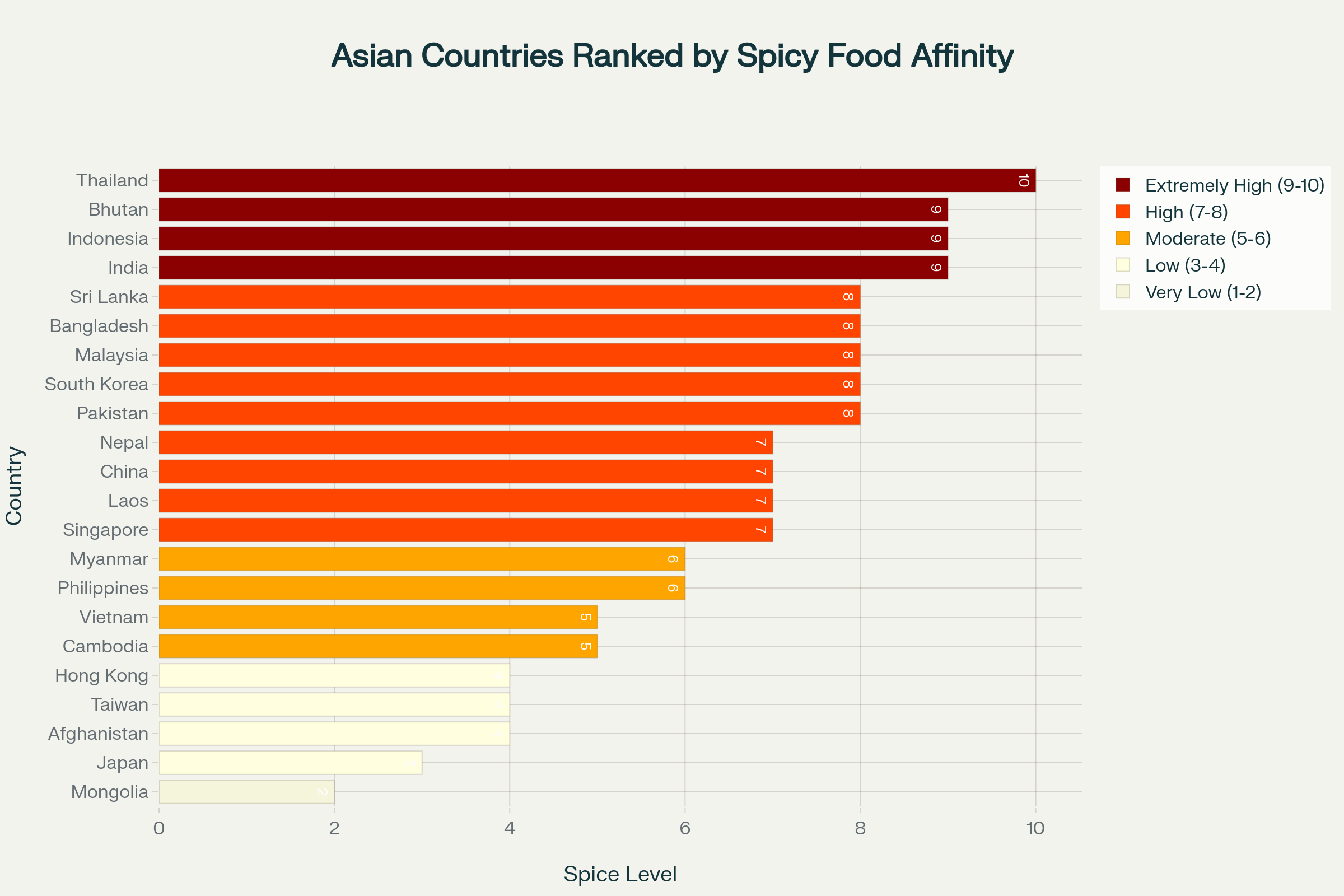
![[OC] Asian Countries Ranked by Spice Affinity](https://www.byteseu.com/wp-content/uploads/2025/11/jn89aaxb2gyf1-1536x1024.png "[OC] Asian Countries Ranked by Spice Affinity")
Sources:
- World Population Review: Spicy Food Countries 2025
- TheTopTens: Countries with the Spiciest Food
- Little India: Spice Tolerance by Country
- SplashTravels: Ranking Countries Spiciest Cuisines
- Gastro Obscura: Ema Datshi (Bhutan)
- Alibaba Spice: Vietnamese Heat Levels
- Fremont Kabob: Afghan Spices
- BangkokJam (Singapore): Spicy Food Guide
- WorldAtlas: Countries With the Spiciest Food
- CambodiaFoodGuide: Cambodian Cuisine Insights
- TopTravelsights: Mongolian Food
Tool Used: Perplexity Research
Posted by chmod-77
22 Comments
As a Korean I always thought i could handle spicy food, until I had my Thai wifes “normal” spicy level. I was sweating profusely, watery eyes and in actual pain. Thai spicy is really on another level. Its the real deal.
Another proof that finns and mongolians share heritage /j
why did you turn the numbers sideways???
I don’t understand your methodology — how did you turn your sources into a numerical scale? How did for example sources #5, #7, and #11 become comparative?
Is this a composite index made from subjective lists? I know we cant really get mean scoville measurement for dishes, but we could also have used weight of chilies eaten per capita, adjusting for fresh and dried chillies.
But honestly, it’s use cases like this that we should just use expert judgment.
Surprised Cambodia is so low, from what I know from my Cambodian friends, they love spicy food/spices. One made me a “not-spicy” sauce that was 90% pepper 😂
I’ve eaten a ton of Korean food and none of it compares to the spice level of some Chinese dishes.
What kind of peppers do thai people use regularly? Do they have something similar to ghost peppers (c. chinense)? Asking because classic thai peppers are c. annuum and are not that hot.
More like Far Eastern countries
Ok but this kind of tracks for my my Taiwanese husband lol
You simply cannot generalize data for Indians.
I’m surprised the Philippines is as high as it is on this list. While there are a handful of spicy dishes, they aren’t that spicy, and they aren’t the norm. I’d guess that 95% of foods actually eaten on a daily basis in the Philippines are not spicy.
Are there theories as to why some countries adopted chiles and some didn’t?
This list may not be helpful to someone unfamiliar with the cuisines listed.
Large countries like China and India have multiple divergent culinary traditions. For example:
* Cantonese cuisine, a subset of Chinese cuisine, has extremely low level of spice usage.
* Sichuan cuisine, another subset of Chinese cuisine, is known for its spice.
I’m a bit surprised by Mongolia ranking so low
Terms need to be defined for this to start to become meaningful. What is ‘spice affinity’? OP appears to be equating spiciness with ‘heat’ but the two aren’t the same. You can load a dish with a wide range of gorgeous spices, resulting in a delicate and subtle meal.
Indonesia #3 makes no sense if you have ever been to Java and/or Bali
A Thai restaurant near us has spice levels of Mild, Medium, Spicy and “Thai Spicy.”
On some monitors, the colours for both ‘Low’ and ‘Very Low’ vanish into the white and are exceedingly hard to tell apart. an adjustment is necessary–maybe making low less pale yellow and the very low a pale green?
Spice or spicy? English is not my first language, but aren’t there lots of spices that are not particularly spicy?
So this is just a meta-analysis of other food blogger’s subjective opinions?
Does this actually represent reality, or does it only show up the stereotypes that food writers have?
How is this objective? What is the methodology?
How is Japan on this list. They have the blandest food from a spice perspective, even items marked as spicy or hot with three chillies 🌶️ 🌶️🌶️ do not taste even slightly spicy.
Maybe because I’m a Brit and we [eat a lot of spicy foods](https://en.wikipedia.org/wiki/Curry_in_the_United_Kingdom) but even in Indian restaurants in Japan (most are Tibetan) with Indian colleagues we ask for very spicy and then when the food comes we look at each other confused as it’s not spicy at all.