An extremely luminous flare recorded from a supermassive black hole
https://www.nature.com/articles/s41550-025-02699-0

An extremely luminous flare recorded from a supermassive black hole
https://www.nature.com/articles/s41550-025-02699-0
1 Comment
Astronomer here! This is a pretty intriguing discovery! [Here](https://www.caltech.edu/about/news/black-hole-flare-is-biggest-and-most-distant-seen) is a link to a press release though for those who don’t want to read a paper/ don’t have access to Nature.
So, first off, the biggest black holes in our universe are called [supermassive black holes (SMBH)](https://en.wikipedia.org/wiki/Supermassive_black_hole), which are at least 100,000 times more massive than our sun (but can be many billions). Pretty much every regular galaxy out there has a SMBH at the center, but in most cases they are quiescent- a fancy word for “not detectable.” Take our own SMBH in our galaxy as an example, [Sagittarius A*](https://en.wikipedia.org/wiki/Sagittarius_A*)- it has a small level of stray dust and gas falling onto it, so we can detect this interaction from Earth before it crosses the event horizon for the SMBH, but it’s at a low enough level that if Sag A* was a few million light years away from us it would be undetectable, aka quiescent.
However, there is a category of SMBH that are different, called [Active Galactic Nuclei (AGN)](https://en.wikipedia.org/wiki/Active_galactic_nucleus). These guys release a significant amount of emission all across the electromagnetic spectrum, and are thought to be doing so due to large amounts of stray dust and gas falling onto the SMBH. The thing about AGN though is they do a lot of wild things that are not predictable- you can see flares that are some of the brightest things you can see out there, very rapidly, that can then fade super fast or plateau or do a ton of other things. (Turns out black holes are complicated, who knew?) They’re probably due to more compact amounts of dust falling onto the SMBH and the like.
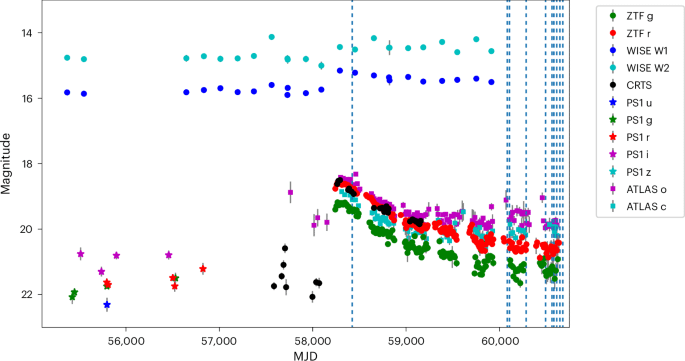
Anyway, even in the AGN world, this result is an intriguing one because it’s the brightest EVER AGN flare! It occurred in a galaxy called J2245+3743 10 billion light years away from us (so, back when the universe was relatively new), with a SMBH about 500 million times the mass of our sun, and it’s tough to explain this flare via traditional models of AGN. Instead, the team favors an unusual event called a Tidal Disruption Event (TDE), which is when a star gets ripped apart by a SMBH due to tidal forces around it. (I study these for my research! [Here](https://www.scientificamerican.com/article/why-some-black-holes-keep-burping-light-after-eating-a-star/) is an article I wrote this summer for Scientific American if you want to learn more!) These are rare compared to AGN flares, and often tough to distinguish between just the random flaring events AGN do… but this flare is SO BRIGHT it’s tough to know for sure, but a TDE is a decent possibility for what caused it. What’s more, in order to be from a TDE the flare would have to be from a star 30 times the mass of our sun that was ripped apart- by far the largest TDE ever detected, most stars shredded are smaller than our sun!- which would also be really exciting.
So yeah, lots going on with this event! AGN are cool! TDEs are cooler! Science is awesome!