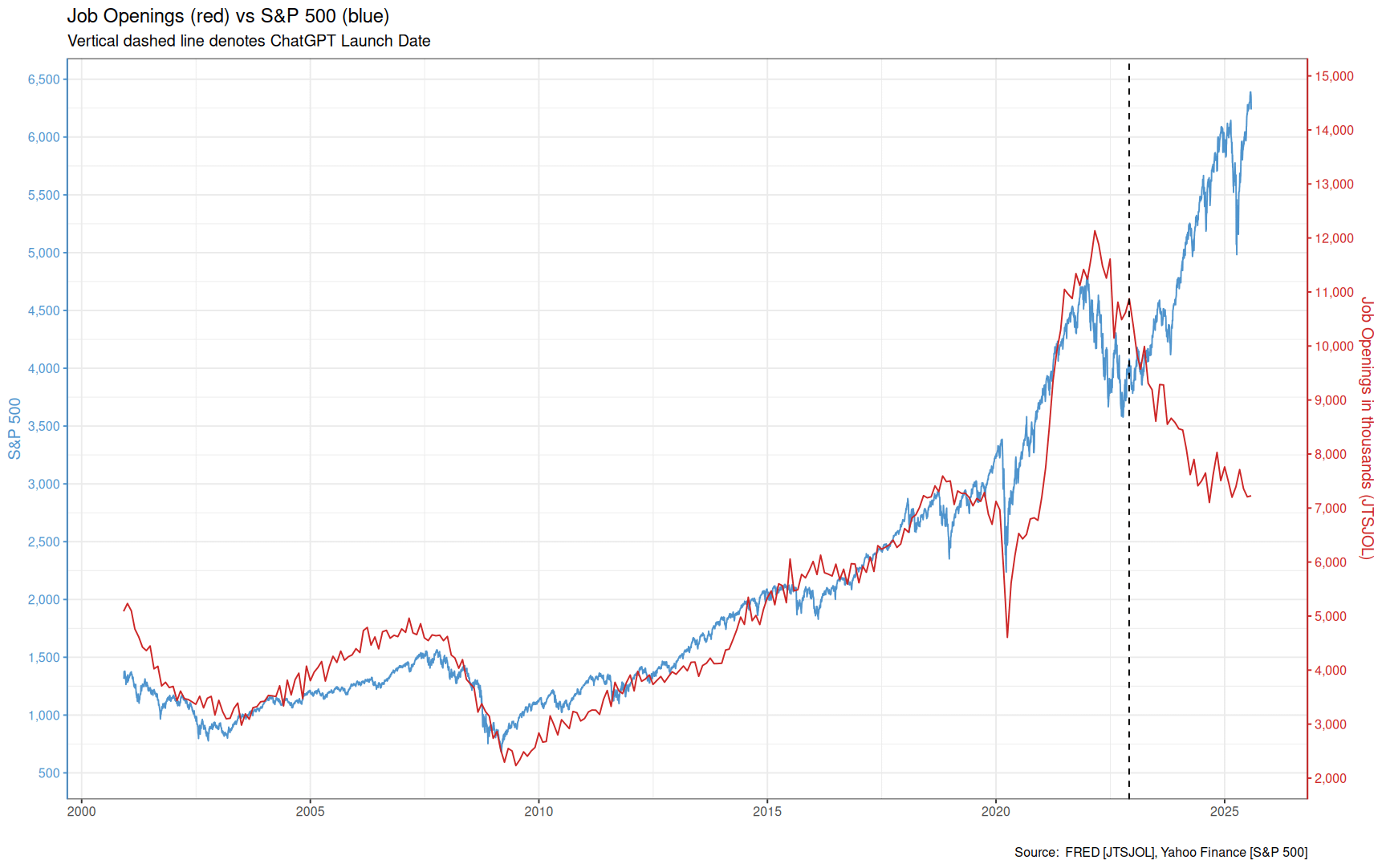
[OC] – US Job Openings [JTSJOL] vs S&P 500, with vertical line denoting the release date of ChatGPT
Posted by MetricT

![[OC] - US Job Openings [JTSJOL] vs S&P 500, with vertical line denoting the release date of ChatGPT](https://www.byteseu.com/wp-content/uploads/2025/11/la5cicclgvzf1-1536x965.png "[OC] – US Job Openings [JTSJOL] vs S&P 500, with vertical line denoting the release date of ChatGPT")
[OC] – US Job Openings [JTSJOL] vs S&P 500, with vertical line denoting the release date of ChatGPT
Posted by MetricT
20 Comments
My suspicion is the divergence in the graph is less “AI is eating jobs” or “AI creates more revenue with fewer workers”, and more “AI is in a massive bubble and the stock market should be lower”. OpenAI engaging in moral hazard and trying to get a federal backstop (“Heads we win, tails you lose”/”too big to fail”) tends to supports that conclusion
AI is destroying some marginal jobs around the edges, but it’s proving harder to automate jobs than a lot of MBA’s thought, which is why [businesses are slowing their investments in AI](https://i.imgur.com/z8meK6E.png) in recent months.
My sense is that business executives are pointing the finger at AI for layoffs rather than tariffs, business uncertainty, economic conditions to avoid risking Trump’s ire.
Created with R, with job opening data pulled from FRED::JTSJOL, and S&P500 data from Yahoo Finance.
Your new job is riding the S&P I guess. The rich get richer.
I am sad to report that *this* data is, in fact, not beautiful.
(But thank you for posting it OP!)
Someone plot the interest rates on top of this
I think there’s a bit of dangerous correlation/causation implication here. Your comment softens that somewhat, but my interpretation is that tariffs are forcing employers to cut costs while AI hype is keeping the market afloat.
When did interest rates start to change? I’ve heard that’s a better infliction point
no correlation to AI as its not mature yet, jobs were already going down. also, this isn’t the first time someone has posted this exact graph.
Can you put the grey vertical dash at every year instead of every 2.5 years?
I actually don’t think it’s all AI. I think that companies have slowed down their backfilling of jobs. People tend to leave and companies typically will backfill. I think ‘tariffs’, the H1-B visa cost and uncertainty has led to companies just not backfilling and telling the current employees to ‘use AI’ more.
I think we can all agree that correlation implies causation, so this graph shows a clear cause and effect relationship here.
Now, if you’ll all excuse me, I’m going to go sell a bunch of ice cream. If I can sell enough, summer will appear.
I bet OP thinks he is very clever.
Classic logical fallacy, just because A preceeds B doe snot prove that A caused B.
The chart looks misleading because it compares two unrelated things (job openings and the S&P 500) on separate scales that make them look connected. It also suggests a cause-and-effect link with ChatGPT’s launch, but that’s not supported by the data.
I don’t see the correlation with job openings and ChatGPT’s release. Jobs were clearly trending down before ChatGPT.
Another thing that actually aligns even better is the end of zero interest rate policy. S&P rebounded once the market saw that jobs (costs) were being cut.
There were a lot of jobs created that never should have been created. The COVID money printing made the market (both jobs and Stocks) do the wrong thing.
Did you use AI to make this post? Critical thinking and idea formilation are not jobs but are being outsourced to AI just the same.
I think that AI is not ready to replace jobs but that won’t stop executives from doing it to reach maximum quarterly earnings. By the time they realize it’s not adequate it will be too late.
I’d like to see this log scale so the previous swings aren’t washed out by recent years. What we care about is relative change, not absolute.
Correlation =/= Causation.
Also, even in the plot, you can see the job openings falling atleast 6 months before the ChatGPT release. Conincidentally, this aligns the interest rate rising. The only interesting thing here is that SP500 is being propped up by AI hype – which is already well known.
The underlying implication that ChatGPT is replacing jobs is not true based on this graph.
So it looks like there was a dip at the start of the pandemic, then it shot up during the stimulus, then the new hires got laid off when the stimulus ended, and now we’re back to where we were before except for the AI bubble in the stock market. Is that about right?