
![[OC] U.S. Serial-Killer Wave vs. Demographic Pass-Through by Generation (1950–2015)](https://www.byteseu.com/wp-content/uploads/2025/11/kkjdj3aaonzf1-1024x581.jpeg "[OC] U.S. Serial-Killer Wave vs. Demographic Pass-Through by Generation (1950–2015)")
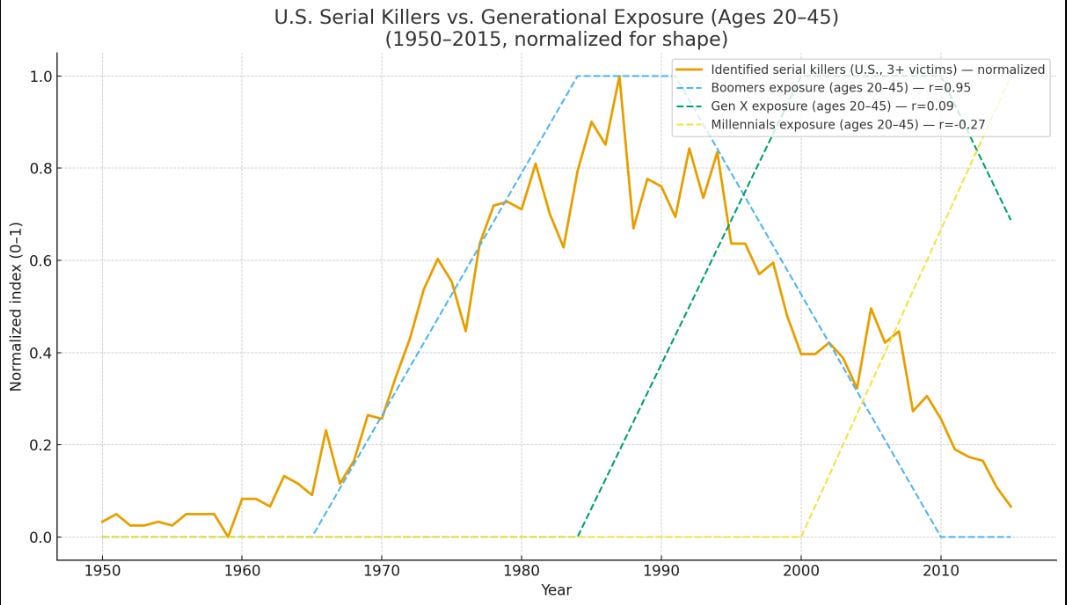
I overlaid the annual count of identified U.S. serial killers ( 3+ victims) with three demographic pass-through curves for the three major current US Generations (Baby Boomers, Gen X, and Millennials) each convolved with an active-age built from the Radford/FGCU serial-killer age stats.
- Active-age bell curve: 20 – 45 years of age . First, what % of SK's start between ages 20 and 45? Using Radford/FGCU’s age-at-series-start distribution by decades: 20s = 45.3%, 30s = 27.0%, 40s = 10.7%. To translate “40s” into 40–45, we need a within-decade split; the report only provides 40–49. Assuming a roughly even spread across the 40–49 bin, 6 of 10 years (ages 40–45) would account for about 0.60 × 10.7% ≈ 6.4%. BUT! If anything that underestimates things because the younger you are in your 40's the more likely you are to not have physical disabilities that could impair your serial killing abilities so I'm going to arbitrarily bump that up to 7.7% which gives us an estimated share of the 20–45 age bracket to be ≈80% of serial killers.
- Generations (birth years):
- Baby Boomers: 1946–1964 (U.S. Census convention)
- Gen X: 1965–1980 (Pew)
- Millennials: 1981–1996 (Pew)
What we see
- Boomers : r ≈ 0.95 vs. the measured series. The curve rises in the early 1970s, peaks mid/late-1980s, and declines through the 1990s, matching the classic U.S. serial-killer surge/ebb REDONKULOUSLY well.
- Gen X (green, dashed): r ≈ 0.25. The curve peaks late 1990s–2000s (doesn't match at all.)
- Millennials (yellow, dashed): r ≈ −0.23. Their pass-through ramps mostly after ~2005 (doesn't match at all. )
Graph made in Chatgpt.
(sources)
- Radford/FGCU Serial Killer Information Center (annual counts, age tables): http://maamodt.asp.radford.edu/Serial%20Killer%20Information%20Center/Serial%20Killer%20Statistics.pdf
- Baby Boomer cohort definition (U.S. Census, 1946–1964): [https://www.census.gov/library/stories/2019/12/by-the-numbers-baby-boomers.html]()
- Gen X and Millennial definitions (Pew Research Center): [https://www.pewresearch.org/short-reads/2018/03/01/defining-generations-where-millennials-end-and-generation-z-begins/]()
Posted by jrralls
19 Comments
The number of serial killers has dropped precipitously as law enforcement forensics have improved – as evidenced by the solid line in your graph. Of course the curve won’t match up well with Gen X and later.
Probably not much of a ‘causal’ variable, but I’d love to see this correlated against atmospheric lead levels.
looks like the real headline is “serial killers are boomers”
The obvious conclusion is that boomers are all serial killers, but I think this reflects copycat crime and the fads and trends of extreme misanthropes. Back in the ’70s, if you wanted to be the worst of the bad guys you’d take up serial killing. In the ’90s, all the cool psychopaths were doing workplace shootings. If you wanted to be a villain in the 2010’s, school shootings were where it was at.
How do I read this for understanding the dashed lines for each generation? So millenials is just going up?
I would say the decline in serial killers has seen a rise in mass murderers.
> Millenials Are Killing Serial Killers
wait that’s not quite right
Is this another Roe v Wade thing?
> Graph made in Chatgpt.
Put that at the top so we can ignore you easier.
Lead baby. It’s all lead. Lead crime hypothesis is all but proved. The Middle East has just pulled lead from their gasoline, and now academics are looking at this, to see if the pattern continues. That will be the silver bullet if we see the trend continue.
There’s a reason they are a generation of sociopaths. Some of it is cultural, but the environmental factors cannot be overlooked.
I’m going to suggest another factor because it can’t be all lead exposure. Hitchhiking. People stopped hitchhiking because of how many people were getting murdered.
Murderland is a book that just came out about this and it shows the majority of serial killers were children raised just downwind of heavy metal smelters, especially in the US. Environmental regulations basically closed all of the smelters from the turn of the century and forced them out of cities or overseas.
Post WW2 tauma kind of apparent. Alcoholic vets recovering from misunderstood or untreated PTSD, abuse, broken homes, etc. Other factors sure, but I remember something about it from psych way back in the day.
It’s hard to be a serial killer nowadays when your possible target is live streaming, having phones listening in on you every single moment, and you leaving DNA samples everywhere you go
This is not beautiful at all.
To summarize the hypothesized correlates/causation in the comments:
– removal of lead from gasoline
– improvements in forensic science + social factors leading to more murders being solved before killer can become a serial murderer
– social factors leading individuals with ASPD (broadly) to favor other types of antisocial behaviors such as mass shootings, etc. over serial murders
There, reddit has already written someone’s criminology grant proposal or dissertation, or at least part of the intro. Have at it.
I’d also like to add that this graph is fine and interesting but there is nothing particularly beautiful regarding the data visualization.
I have read that some of the rise in serial killers was due to ptsd from ww2 veterans coming home. It was not a thing then so fathers that were suffering took it out on their families.
Another interesting thing I can read from this…. The numbers came down right in line with the development of genetic forensics. Much harder to get away with 3+ murders now before being caught. This effect also makes modern Forensic Files episodes much less entertaining. haha.
Gotta be the lead that used to be in petrol or something?