
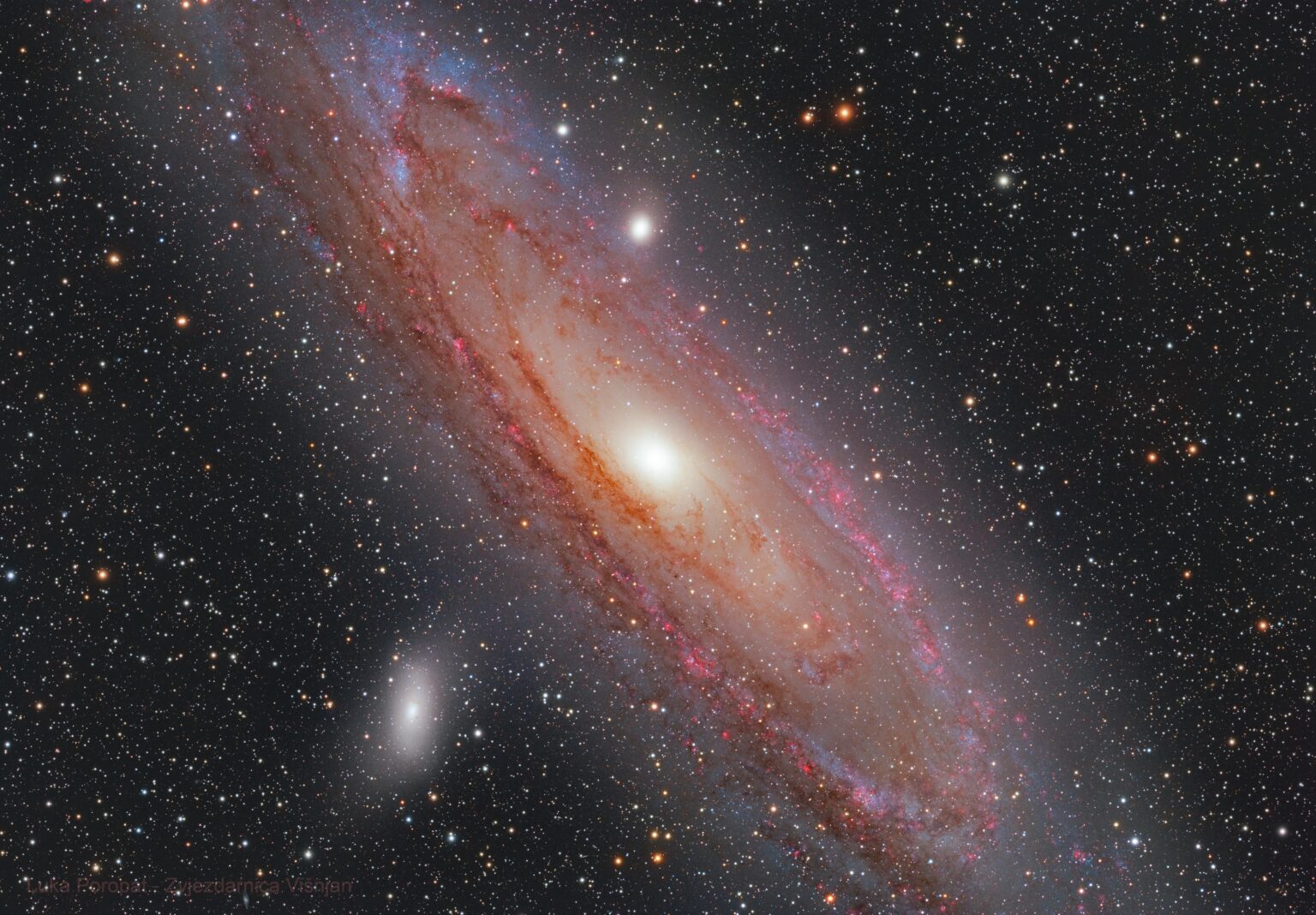
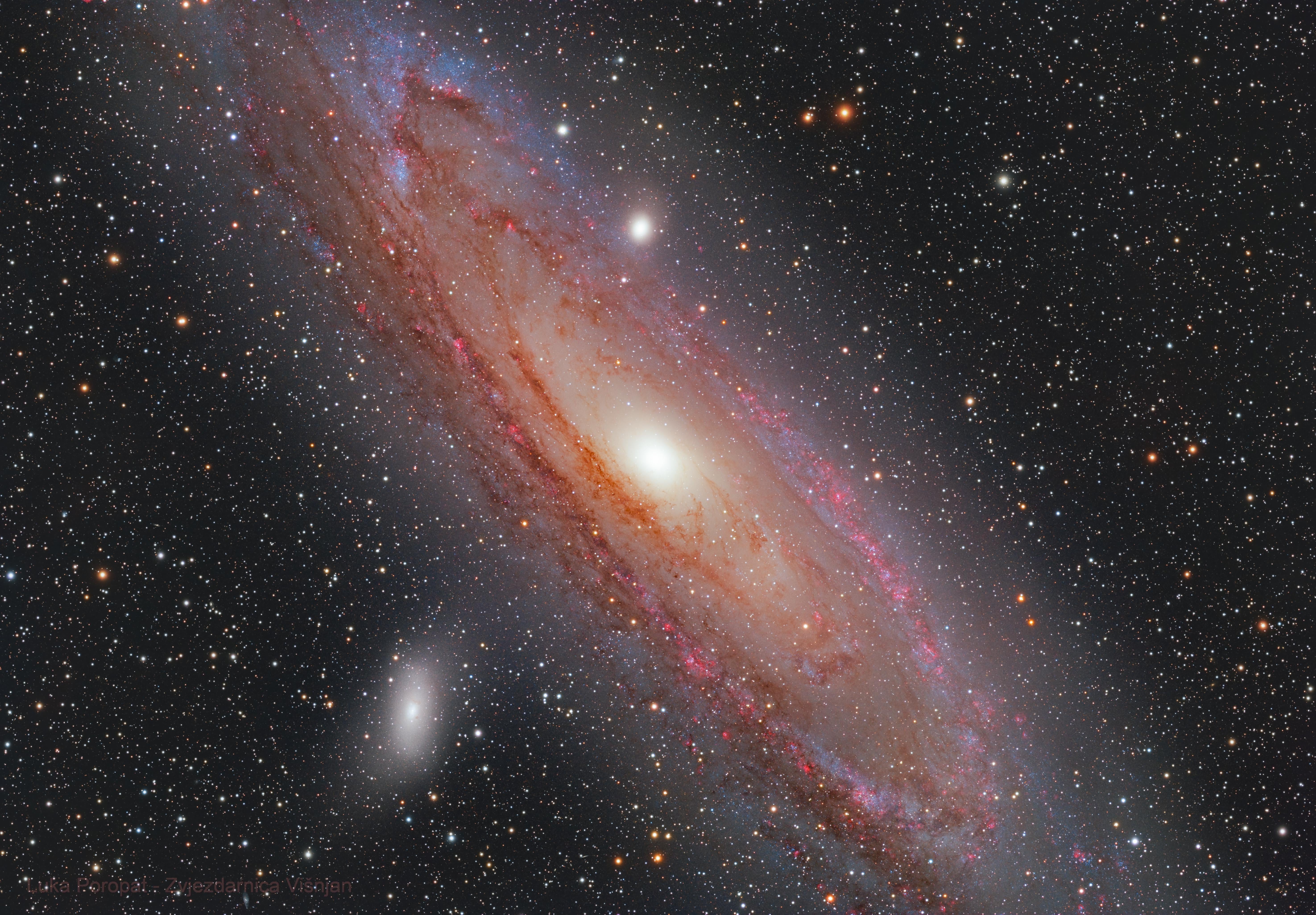
This photo is a deviation from our standard work and is more of a passion project than a duty to the world. Considering that the work of monitoring and detecting dangerous asteroids is related to our large telescope, a smaller telescope with a diameter of 100 mm was used for the purpose of this photo.
The photo was taken in HαRGB with colors (read: visible spectrum + hydrogen) which means that the standard color channels (Red, Green, Blue) are combined with an additional layer recorded through Hydrogen alfa (Hα) filter.
Hα is a very narrow line in the light spectrum at 656,28 nanometarawhich occurs when an electron in a hydrogen atom drops from the third to the second energy level. That transition "products" this characteristic red-pink lightwith which clouds of hydrogen shine in regions where new stars are formed.
In this image, the Hα channel highlights those active star-forming regions along Andromeda’s spiral arms. Combined with the RGB data, the fine structure of gases and dust is revealed that would otherwise remain hidden in ordinary photographs of the visible spectrum.
In total, a little more than 100 hours of exposure during 22 nights under stable atmospheric and weather conditions.
Equipment:
Teleskop: Skywatcher Esprit 100
Astronomical camera: ZWO2600MM (cooled to -10C) + RGB and Ha filters
Mounting: iOptron CEM70
Location: Višnjan Observatory
https://i.redd.it/cyal1t53x11g1.jpeg
Posted by AstroLux23
5 Comments
messier > ronaldier
kakav vrh e, svaka cast!!!!!!
svaka cast na trudu! Fenomenalna fotka.
Wow… Svaka vam čast!
Veliki pozdrav Koradu i ekipi!
Fun fact, Andromeda nam se priblizava i za ohoho godina cemo se sudariti😁