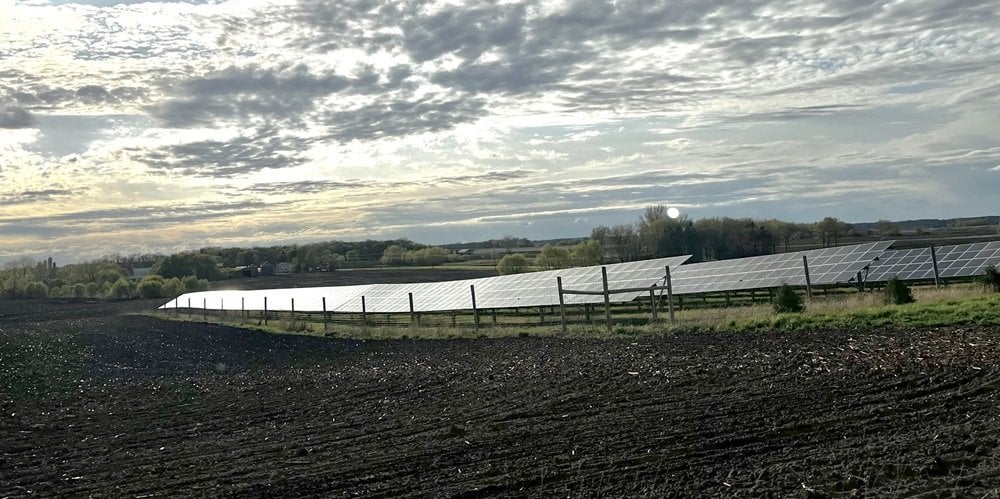
The Center for Rural Affairs (CFRA) recently published an analysis exploring the potential of solar power expansion by 2050 on Midwest farmland. The report, “Sifting through Solar: Land-Use Concerns on Prime Farmland” demonstrates the viability of meeting significant portions of the U.S. renewable energy goals using less than 3% of Midwest farmland. Specifically, the U.S. Department of Energy’s Solar Futures study anticipates that 1,600 GW of solar power will be necessary to supply 40-45% of the nation’s electricity demand by 2050. For the Midwest alone, achieving this would require installing 210 to 420 GW, which would occupy only 1.45% to 2.90% of the region’s farmland. Additionally, the report notes significant economic benefits, such as the creation of 147,000 rural jobs and substantial lease payments to farm owners, with Iowa farmers receiving $73.4 million in 2022 alone.
Despite these potential benefits, challenges remain, particularly with land use policies. The report points to restrictive land designations like “prime farmland” and “corn suitability rating” (CSR) that could hinder solar projects. In Iowa, proposed legislation that would have limited solar installations to lands with a CSR value of 65 or less did not pass; if it had, 65% of the state’s farmland would have been off-limits for solar development. Financial incentives are strong: solar leases can provide significantly higher income compared to traditional crop rents. For example, typical solar lease rates in Iowa and Illinois can range from $750 to $3,000 per acre, dramatically exceeding the average non-irrigated cropland cash rent (which ranges from roughly $58/acre to $450/acre). To maximize both land use efficiency and farm income, strategies such as biodiversity enhancement under solar panels and integrating agrivoltaic practices are recommended, ensuring that the land can still be restored to its original state after the lifecycle of solar projects.
CraftyAdvisor6307 on
Independent farmers always get nickel-and-dimed by the Big Agra buyers they’re forced to sell to, and solar power could offer another source of revenue for their family farm.
But the fascists have convinced them that renewable energy is a communist plot.
acidtalons on
Man imagine what we could do with all the roof area that isn’t being used for anything.
Farm to PV benefits power companies at the cost of land use and often is tied with restrictive policies regard residential/commercial roof top solar.
If farmed want to do it then great but from a policy prespective I don’t think we should be encouraging this over any other form of solar.
According to the Department of Energy, the United States has over 8 billion square meters of rooftops that could be used for solar panel installation, which is more than 1 terawatt of potential solar capacity. A study published in Nature Communications found that the US has enough rooftop space to generate the same amount of solar power as it currently does nationwide. In 2022, rooftop solar generated 1.5% of the country’s electricity, but Environment America estimates that it could potentially provide up to 45%.
[deleted] on
[deleted]
positive_X on
Roof-top individually distributed solar electric panels are the way to go actually .
..
..
.
Know4KnowledgeSake on
Cool. [**Less than 0.2% of farmland could power the entire country**.](https://www.nei.org/news/2015/land-needs-for-wind-solar-dwarf-nuclear-plants) And it isn’t even weather/time-of-day dependent. And it doesn’t require strip-mining in third world countries for precious metals. And any waste takes up less space than a football field for the entire lifetime of the infrastructure; all of it, not just one installation.

6 Comments
The Center for Rural Affairs (CFRA) recently published an analysis exploring the potential of solar power expansion by 2050 on Midwest farmland. The report, “Sifting through Solar: Land-Use Concerns on Prime Farmland” demonstrates the viability of meeting significant portions of the U.S. renewable energy goals using less than 3% of Midwest farmland. Specifically, the U.S. Department of Energy’s Solar Futures study anticipates that 1,600 GW of solar power will be necessary to supply 40-45% of the nation’s electricity demand by 2050. For the Midwest alone, achieving this would require installing 210 to 420 GW, which would occupy only 1.45% to 2.90% of the region’s farmland. Additionally, the report notes significant economic benefits, such as the creation of 147,000 rural jobs and substantial lease payments to farm owners, with Iowa farmers receiving $73.4 million in 2022 alone.
Despite these potential benefits, challenges remain, particularly with land use policies. The report points to restrictive land designations like “prime farmland” and “corn suitability rating” (CSR) that could hinder solar projects. In Iowa, proposed legislation that would have limited solar installations to lands with a CSR value of 65 or less did not pass; if it had, 65% of the state’s farmland would have been off-limits for solar development. Financial incentives are strong: solar leases can provide significantly higher income compared to traditional crop rents. For example, typical solar lease rates in Iowa and Illinois can range from $750 to $3,000 per acre, dramatically exceeding the average non-irrigated cropland cash rent (which ranges from roughly $58/acre to $450/acre). To maximize both land use efficiency and farm income, strategies such as biodiversity enhancement under solar panels and integrating agrivoltaic practices are recommended, ensuring that the land can still be restored to its original state after the lifecycle of solar projects.
Independent farmers always get nickel-and-dimed by the Big Agra buyers they’re forced to sell to, and solar power could offer another source of revenue for their family farm.
But the fascists have convinced them that renewable energy is a communist plot.
Man imagine what we could do with all the roof area that isn’t being used for anything.
Farm to PV benefits power companies at the cost of land use and often is tied with restrictive policies regard residential/commercial roof top solar.
If farmed want to do it then great but from a policy prespective I don’t think we should be encouraging this over any other form of solar.
According to the Department of Energy, the United States has over 8 billion square meters of rooftops that could be used for solar panel installation, which is more than 1 terawatt of potential solar capacity. A study published in Nature Communications found that the US has enough rooftop space to generate the same amount of solar power as it currently does nationwide. In 2022, rooftop solar generated 1.5% of the country’s electricity, but Environment America estimates that it could potentially provide up to 45%.
[deleted]
Roof-top individually distributed solar electric panels are the way to go actually .
..
..
.
Cool. [**Less than 0.2% of farmland could power the entire country**.](https://www.nei.org/news/2015/land-needs-for-wind-solar-dwarf-nuclear-plants) And it isn’t even weather/time-of-day dependent. And it doesn’t require strip-mining in third world countries for precious metals. And any waste takes up less space than a football field for the entire lifetime of the infrastructure; all of it, not just one installation.