Planets form when many rocks floating around crash together. These rocks are moving in mostly random directions, so as they accumulate they hit at different angles and each contribute a bit of spin. The end result of many collisions is a planet, and its spin.
adamwho on
It’s just a relative angular momentum at the time the planet was formed.
Which includes large bodies colliding with them during the planetary formation.
It’s also the same reason why the plants are going around the sun the same direction.
It would be very very weird if they all had the same spin rate.
gyroqx on
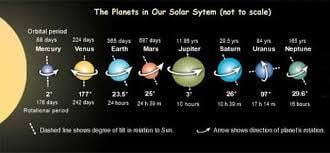
Venus is just built different
5elementGG on
Actually why would jupiter spin so fast? Wouldn’t it make more sense for smaller planet to spin faster ?
BrangdonJ on
They tend to be all the same way because angular momentum is conserved. In the original dust cloud that formed the solar system, parts of it were going clockwise and parts anti-clockwise. Those parts interacted in a way that tended to make opposing rotations cancel. So after a while it was only anti-clockwise. or only clockwise, depending on which was larger at the start. This happens in every plane. You end up with everything rotating in the same direction within a single plane, which becomes the plane of the ecliptic.
Some planets differ because this mechanism isn’t perfect. In some cases it just didn’t cancel perfectly for some bodies. In other cases, it may have cancelled but then something random happened like a collision or close encounter between two bodies. That may be what happened to Uranus. If it happened late enough, the new motion could have persisted with not enough subsequent interactions to bring it back to the average.
SaigonDisko on
That picture resolution looks older than voyager 1.
SunstormGT on
It was just their angular momentum at the moment they were formed. Just like the motion the earth has around the sun.
NombreCurioso1337 on
Short answer: Venus, Uranus, and Neptune have seen some sh-t.
I think the current model suggests that a protoplanetary disk would form near the time of start formation, then the planets clump together and would all be spinning the same direction, but then things start bumping into one another and it gets randomized. So most of a solar system rotates and revolves the same direction and all in a planar disk, but there are outliers who were collided with our tugged out of order.
Theories may have been updated since I studied this all, ten years ago.
NukaColaReaper on
Conservation of angular momentum causes planets to maintain a similar rotational behavior to the others. This is a result of the planets having been created from the Sun when it reached it’s ZAMS, or zero age main sequence part of it’s life.
When the Sun went from a proto-star (baby star) to a main sequence star, establishing something called hydrostatic equilibrium (a balance between nuclear explosions and gravitational collapse), it essentially burped all of the planets out after it with solar winds.
Once these planets all coalesced, they suffered any remaining debris in the solar system that happened to be in their vicinities.
Anything that causes a planet’s rotation to differ from the norm is a result of external stimuli (collisions from other interplanetary bodies). Venus is a good example- the running theory is that it is that it actually entirely flipped (caused by collisions), which would be why the day is longer than the year, and now the planet turns the other direction from all the rest.
And we think Uranus is on it’s side! (Axial tilt gone astray!)
jacksodus on
This is definitely a candidate for r/NeedsMoreJPEG
srona22 on
Does Venus have large collision event in past to have totally different direction in rotation?

14 Comments
Planets form when many rocks floating around crash together. These rocks are moving in mostly random directions, so as they accumulate they hit at different angles and each contribute a bit of spin. The end result of many collisions is a planet, and its spin.
It’s just a relative angular momentum at the time the planet was formed.
Which includes large bodies colliding with them during the planetary formation.
It’s also the same reason why the plants are going around the sun the same direction.
It would be very very weird if they all had the same spin rate.
Venus is just built different
Actually why would jupiter spin so fast? Wouldn’t it make more sense for smaller planet to spin faster ?
They tend to be all the same way because angular momentum is conserved. In the original dust cloud that formed the solar system, parts of it were going clockwise and parts anti-clockwise. Those parts interacted in a way that tended to make opposing rotations cancel. So after a while it was only anti-clockwise. or only clockwise, depending on which was larger at the start. This happens in every plane. You end up with everything rotating in the same direction within a single plane, which becomes the plane of the ecliptic.
Some planets differ because this mechanism isn’t perfect. In some cases it just didn’t cancel perfectly for some bodies. In other cases, it may have cancelled but then something random happened like a collision or close encounter between two bodies. That may be what happened to Uranus. If it happened late enough, the new motion could have persisted with not enough subsequent interactions to bring it back to the average.
That picture resolution looks older than voyager 1.
It was just their angular momentum at the moment they were formed. Just like the motion the earth has around the sun.
Short answer: Venus, Uranus, and Neptune have seen some sh-t.
I think the current model suggests that a protoplanetary disk would form near the time of start formation, then the planets clump together and would all be spinning the same direction, but then things start bumping into one another and it gets randomized. So most of a solar system rotates and revolves the same direction and all in a planar disk, but there are outliers who were collided with our tugged out of order.
Theories may have been updated since I studied this all, ten years ago.
Conservation of angular momentum causes planets to maintain a similar rotational behavior to the others. This is a result of the planets having been created from the Sun when it reached it’s ZAMS, or zero age main sequence part of it’s life.
When the Sun went from a proto-star (baby star) to a main sequence star, establishing something called hydrostatic equilibrium (a balance between nuclear explosions and gravitational collapse), it essentially burped all of the planets out after it with solar winds.
Once these planets all coalesced, they suffered any remaining debris in the solar system that happened to be in their vicinities.
Anything that causes a planet’s rotation to differ from the norm is a result of external stimuli (collisions from other interplanetary bodies). Venus is a good example- the running theory is that it is that it actually entirely flipped (caused by collisions), which would be why the day is longer than the year, and now the planet turns the other direction from all the rest.
And we think Uranus is on it’s side! (Axial tilt gone astray!)
This is definitely a candidate for r/NeedsMoreJPEG
Does Venus have large collision event in past to have totally different direction in rotation?
I’m the General and I want it to spin.
I would like to shoot something up Uranus!!
Rimshot plays.
https://youtu.be/qhJrpzsKEXo
Video of rotations