
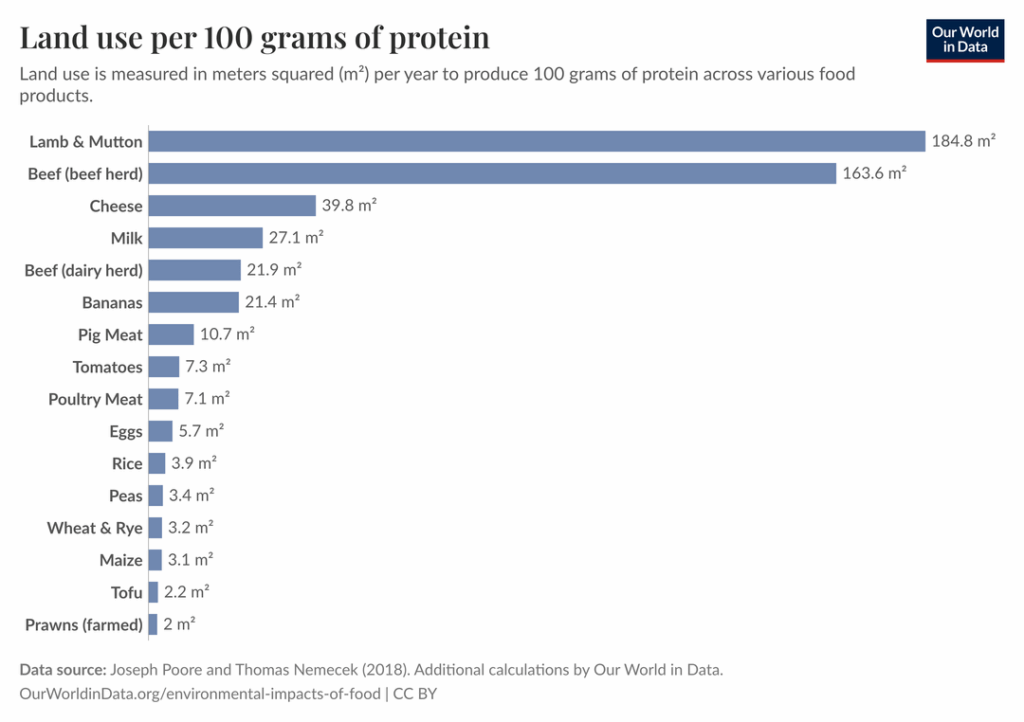
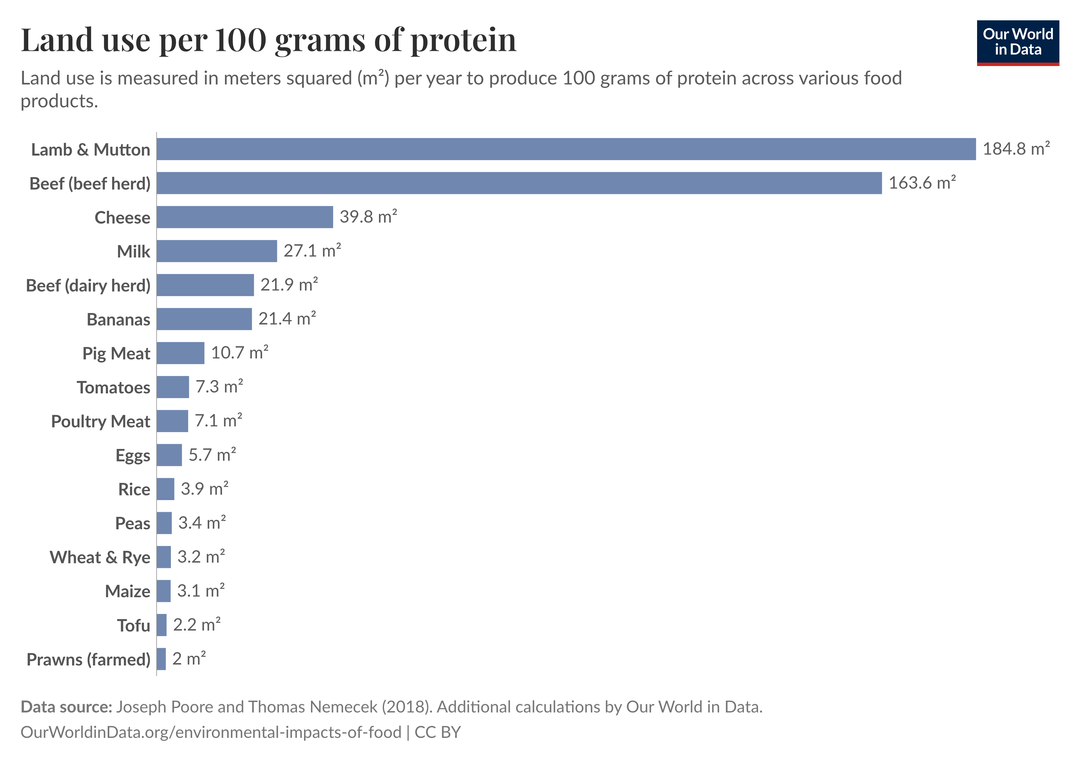
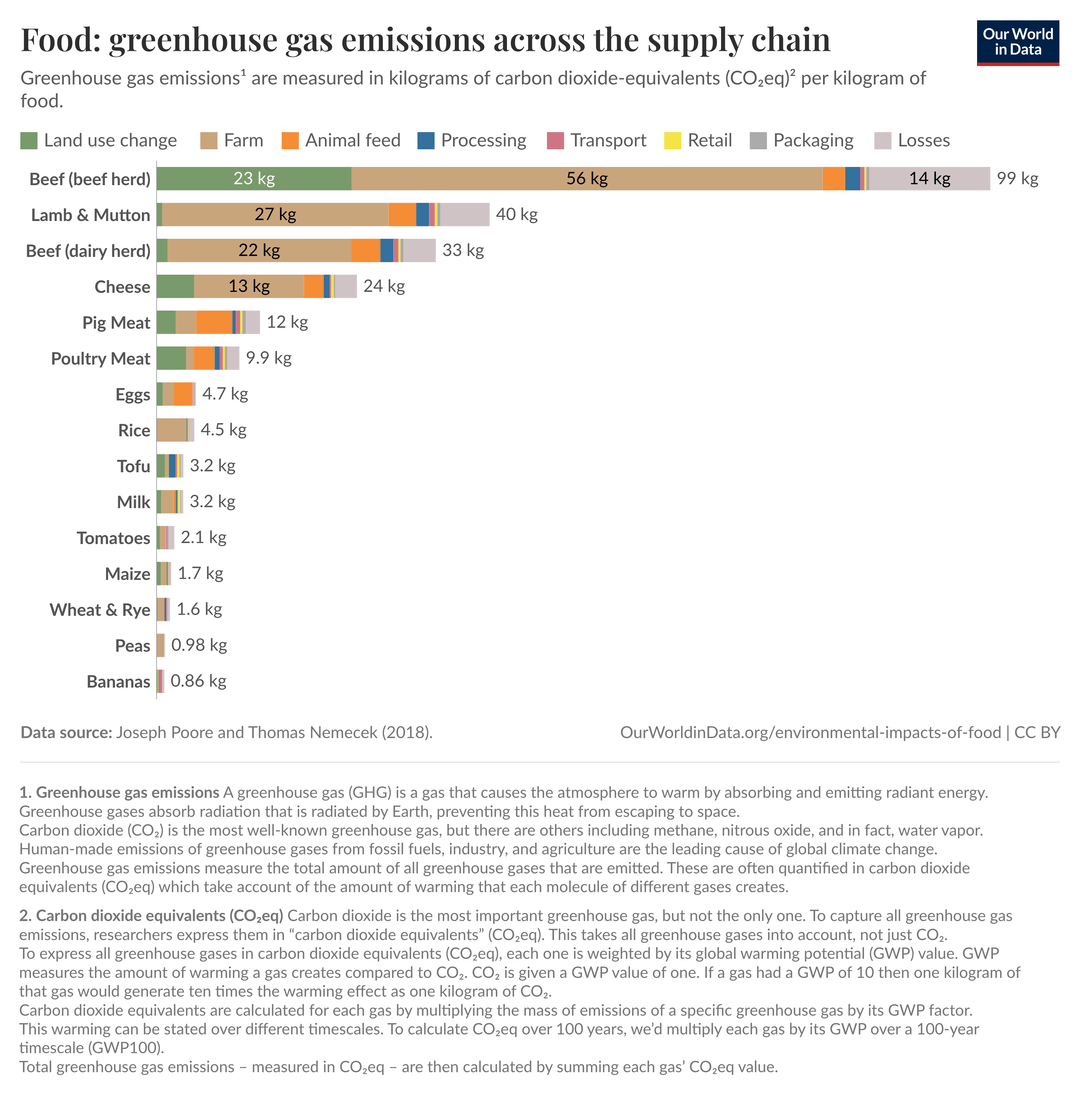
From Our World In Data's excellent web tool – follow that link for original sources and additional options for both the numerator and denominator.
Lots of people in the previous post were commenting "what about per kcal/g of protein/water use" but the data is all there just look at the source!
Posted by space-goats
36 Comments
23 years vegetarian and counting bébé!
What I’m getting from this is that in Australia (I’m assuming that since prawns was used, that’s probably not fair) they call pork “pig meat” and that’s wild.
I’m okay with chicken being poultry meat for whatever reason, but pig meat is unhinged.
Why are Milk and Beef (dairy herd) listed separately? I get there are other sources of milk, but when its not qualified with what is the source, it typically means Cow’s milk.
Notably, a quick google search told me that prawn farms often replace Mangrove forests and are only productive for 3-5 years leaving a destroyed ecosystem behind.
[deleted]
Prawns seems suspicious. Are we counting the land used to create the food for the prawns?
beef emissions seem like a lot relative to other food but as a whole, this is a just a drop in the ocean for worldwide emissions, right?
So basically anything but beef and lamb is an improvement
If only there was a word for pig meat.
It’s been pretty clear for a while now that animal products are terrible for our environment.
Are they triple counting the area for cheese, milk, dairy herd?
ah yes, the great banana-corn-pea diet. what could go wrong
And this shows, as per usual, why people talking about the impact of livestock on the environment love to show beef as an example. Because chicken as an example wouldn’t impress people all that much.
I would be quite interested to see the impact of certain insects in these graphs. I could imagine them ranking lower than rice in terms of CO2-equivalents.
Land Use/Land Change (LU/LC) paints a pretty dismal picture (deserved) for (most/all) meat production. However, there are more refined metrics that, while still show cattle ranching is environmentally problematic, it’s maybe half to a quarter as bad globally as standard LU/LC shows.
That’s because beef can survive by grazing on land that would otherwise be pretty unproductive (from a human if not always wilderness perspective). For example, in New Mexico, USA, there are cattle ranches that even in particularly wet years might have a grazing dyad per ~45 acres (down to 0 cattle at all in the driest year).
That would put the wettest year LU/LC numbers at requiring roughly 2M m^2 per animal (or the ~200 m^ per 100 grams) listed above, and much, much higher in dry/moderately dry years.
However, that land cannot be used for farming; it can’t reasonably be used for other grazing animals, either. It’s also worth remembering that we annihilated most of the other grazing animals local to the area, and without something stamping down and softening that hard clay, there’d be other environmental issues.
I’m not advocating for eating meat, and certainly not beef—from an environmental perspective or a health one—but it’s worth looking at these types of data from the critical view of opportunity cost.
Beef from New Mexico, as well as the cold equivalent places in Alberta, Canada, might be better than the next best option of allowing these lands to go fallow.
Conversely, in Brazil, where land is being changed from highly naturally critical forest (both to the local ecosystem and the global atmosphere), there might be no bigger blight than beef.
Eating ground beef every day yum yum!!
People need to stop with the cows vs the planet nonsense. It’s not the cows. It’s the 24/7 Kuwait tire fire. It’s China. It’s India. It’s Africa.
Edit. [you can see Kuwait graveyard from space](https://www.youtube.com/shorts/wU3Tkj2uY38)
Thank you, the comments on that post were bloody infuriating. “Why doesn’t it include chicken when there’s mutton?” Just click through to the source data you lazy nonce, it’s all there!
“But cattle are grazed on land unsuitable for crops!”. Sure, but you need to look at the whole diet, not individual food items. If the world adopted a plant-based diet, we would reduce global agricultural land use from 4 to 1 billion hectares. Source: https://ourworldindata.org/land-use-diets
I’m curious, why is there such a big difference between milk and cheese? Since cheese is basically just milk with some extra processing steps I figured they’d be similar? Or is the “milk” listed here milk produced only for consumption as milk, and the milk created for use in cheese is being considered separately? Or could it be because sheep and goat milk is also contributing to cheese production (though I assume that is only a small percentage).
A big thing here is how big animals like pigs are stuffed to pens so small they cant move… just standing still feeding and shitting.
This is at glance a load of rubbish and nonsense.
Doesn’t take in consideration where the soy beans are from for tofu, not specificing what country the beef or other sources originate from.
But nice looking grafs!
Why are almonds almost always excluded from these lists? Their environmental impact is off the charts in some categories, like water use.
Getting 100g protein from rice?? Prepare to sit down and eat 23 cups-worth and take in 4800 calories. Including grains here alongside the traditional protein sources misses the point.
so chickens are the future
i feel like mixing up complete and incomplete proteins kinda defeats the purpose here.
Beans and Tofu always wins. 🤣
Sheep often live on land that’s not well suited to much else.
Wow, it’s the same thing from yesterday but somehow an even lazier graphic.
More links to our world in data:
[You want to reduce the carbon footprint of your food? Focus on what you eat, not whether your food is local](https://ourworldindata.org/food-choice-vs-eating-local)
[Environmental footprints of dairy and plant-based milks](https://ourworldindata.org/grapher/environmental-footprint-milks)
[Greenhouse gas emissions per 1000 kilocalories](https://ourworldindata.org/grapher/ghg-kcal-poore)
[Greenhouse gas emissions per 100 grams of protein](https://ourworldindata.org/grapher/ghg-per-protein-poore)
[Land use of foods per 1000 kilocalories](https://ourworldindata.org/grapher/land-use-kcal-poore)
[Land use per 100 grams of protein](https://ourworldindata.org/grapher/land-use-protein-poore)
[If the world adopted a plant-based diet, we would reduce global agricultural land use from 4 to 1 billion hectares](https://ourworldindata.org/land-use-diets)
Really weird chart. Why is banana judged on the amount of m2 for protein ? We don’t eat bananas for protein..
isn’t the land usage for lamb mostly more marginal land?
What a useless chart. This implies that you will only get 100g protein in a year from these sources which is just not close to true.
Keeping animals is more resource intensive than farming, but land use is not mutually exclusive ro raising animals. Not all land can be used for farming either.
Chickens and ducks for example can be raised next to crops and can be beneficial to farms by eating insects and fertilizing the soil. Cattle is sometimes raised by grazing on brush and grasslands that make poor farm land. Sheep and goats can eat dense brush and be raised on rocky, hilly, or mountainous environments that cannot be used for many if not most forms of farming.
Wheat is looking way better here than it probably should. your body can’t use wheat protein to the same degree that it can egg or some of the others. [https://en.wikipedia.org/wiki/Protein_digestibility_corrected_amino_acid_score](https://en.wikipedia.org/wiki/Protein_digestibility_corrected_amino_acid_score)
While there are other environmental impacts to consider besides just climate change, there’s a great resource to help you optimize your climate actions created by a climate scientist and the team at Drawdown: https://drawdown.org/shift
Also, feel free to join us over at /r/ClimateOffensive!
Protein?
Not Calories?
You don’t eat rice, corn, tofu, etc for Protein.
Does the data account for the vegetable protein being harder to assimilate than the animal one?
(It won’t change the conclusion – vegetables are better for the environment as source of proteins compared to meat), but it would make the comparison more accurate.
Source: https://pmc.ncbi.nlm.nih.gov/articles/PMC11171741/