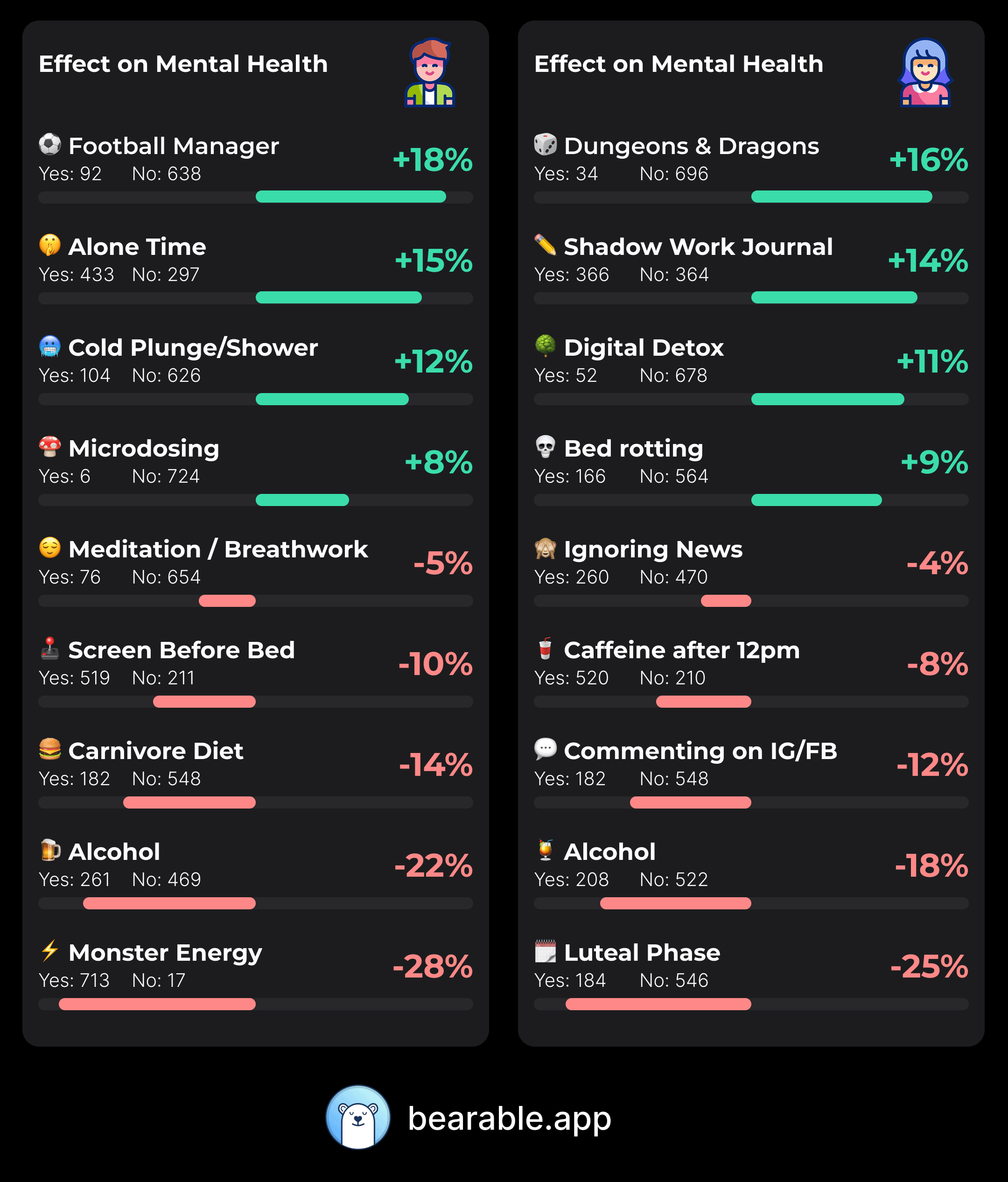
Inspired by some posts I saw on this sub a few years ago, my girlfriend and I spent the past 2 years tracking our general mental health and the effect of different habits.
Posted by Former_Mulberry_

![[OC] 2 years of GF and me tracking mental health and habits. 9 of the most interesting effects.](https://www.byteseu.com/wp-content/uploads/2026/01/be8jl3llsbeg1-1310x1536.png "[OC] 2 years of GF and me tracking mental health and habits. 9 of the most interesting effects.")
Inspired by some posts I saw on this sub a few years ago, my girlfriend and I spent the past 2 years tracking our general mental health and the effect of different habits.
Posted by Former_Mulberry_
33 Comments
Confused abt what these percentages are since all are clearly very high no:yes ratios. Very cool data!
D&D with a good game table is pure nirvana.
Carnivore diet?? Yeah, no wonder that makes you feel worse.
[deleted]
I call this fake. No one have fun playing FM.
Jokes aside, good for you mate!
What do the yesses and noes mean?
Are you sure this isn’t just correlation? I’m more likely to have coffee and energy drinks when I’m stressed or tired
so let me get this straight. meditation worsened your mental health? and bed rotting improved hers?
Football manager is good for your mental health?!
We must be playing it differently.
Does the app do anything to differentiate between “I do X when I feel good/bad” vs “when I do X I feel good/bad”?
Microdosing, cold plunges, carnivore diet. Man you just latch on to anything you see on tiktok huh
can you recommend that app you used to do this? will i improve in some way?
Time to dump Monster energy mate
Really interesting, but I got so many questions how this app (?) works in detail.
Lemme try to break it down into a few questions about the method used here.
First, to see if I understood the basic premise: This is data taken from an app where you log daily routines and actions, together with happiness/mental health ratings. Correct so far?
– Are the activities user defined or given by the app?
– What’s the granularity wrt time? For example, when it says on your screenshot “alcohol – yes 261. no 461”, that means on 261 **days** you selected “I drank alcohol today”, correct?
– What about the happiness ratings? Are they given once a day (probably before going to bed?). Or during the activity?
Sorry, what is bedrotting?
Fun visual. A crime against causal inference though, lol
713 yes and 17 no on monster is extrem mood
No Cardio? No Morning Sunlight?
I’m guessing Football Manager 24 and not Football Manager 26 as I can’t think 26 would be positive for you
Ignoring news is the single best thing anyone can do for their health and sanity, how did it turn bad for you?
I’m curious if you found this helpful! I always thought emotions were so fluid that it’s hard to put specific numbers to them, and when you do it kind of becomes an anchor for your memory telling you “that was a rough patch” or what not.. but at the same time there could be value in that!
Oddly enough I recently found a way to explain why I always felt like those trackers were unhelpful—it’s kind of like quantum physics. Measuring a particle collapses it from a probability cloud into a fixed state. When you rate your day as a “4/10” or mark it as “anxious,” you’re doing the same thing—locking that experience into place. It becomes “the truth” of that day.
But without that record, your memory would stay flexible. You could look back later and think “actually that wasn’t so bad” or notice good parts you forgot about. Your current perspective would naturally reshape how you remember things.
The whole point is supposed to be gaining insight, but I think it might do the opposite—it strips away the ability to reinterpret your own life in a healthier way later on.
My man!
What save are you playing right now?
Interesting app, though people have rightly pointed out these are likely correlations, and it’s unknown if the app is taking into account interaction effects and highly correlated independent variables.
Also, ignore the people that say this data is confusing.
Almost a Monster a day! Some hardcore Monster consumption! I hope you try all the flavours!
Ripper is the best.
I have read OP’s replies and I am still confused how this works..
Data tells me you two are cool af. Get your meditation time back on though!
I have this app, although I don’t use it as frequently as OP. You can check out [r/bearableapp](https://www.reddit.com/r/BearableApp/s/l1nGiAN6pt) if you have any data questions, because I actually forgot about this app until I came across this post.
I use it as an overall mood/physical health tracker. You decide which symptoms you want to track, I tend to focus on how my menstrual cycle and allergies affect me since those both basically determine how effective my ADHD meds will be.
As I understand it, your overall day receives a score and each symptom you track is a percentage of that score. It is awesome for correlations, but the percentages are not scientifically accurate.
OP: I appreciate the post since I personally use the app, but it would be helpful to provide context for others. Perhaps they would appreciate a chart with a full list of symptoms. I’m just a casual data hoarder, not a data scientist…
I don’t understand these metrics. How does one track the carnivore diet as a whole having effects on your mental health? Is this just you tick whether you felt bad on any given day and the app tracks what you did that day? But that wouldn’t really work with alcohol, would it, because on the day you drink, you usually feel good, the bad comes afterwards.
This entire thing looks hella wonky, Imma be real with you 😀
Y’all should break up and chill by yourselves
The comments here are really interesting. While they often seem critical of the personal study, they do actually ask some really good next step questions that OP might consider to further investigate his mental health.
Luteal phase being that awful is real, like everything becomes my enemy even myself 😭
That’s a lot of alcohol “yes”.
Football Manager improved your mental health? You must be kidding.