
![The complete blueprint of the world's first fully synthetic eukaryotic genome — Yeast 2.0 [OC]](https://www.byteseu.com/wp-content/uploads/2026/01/vw2ega24roeg1-1523x1536.png "The complete blueprint of the world’s first fully synthetic eukaryotic genome — Yeast 2.0 [OC]")
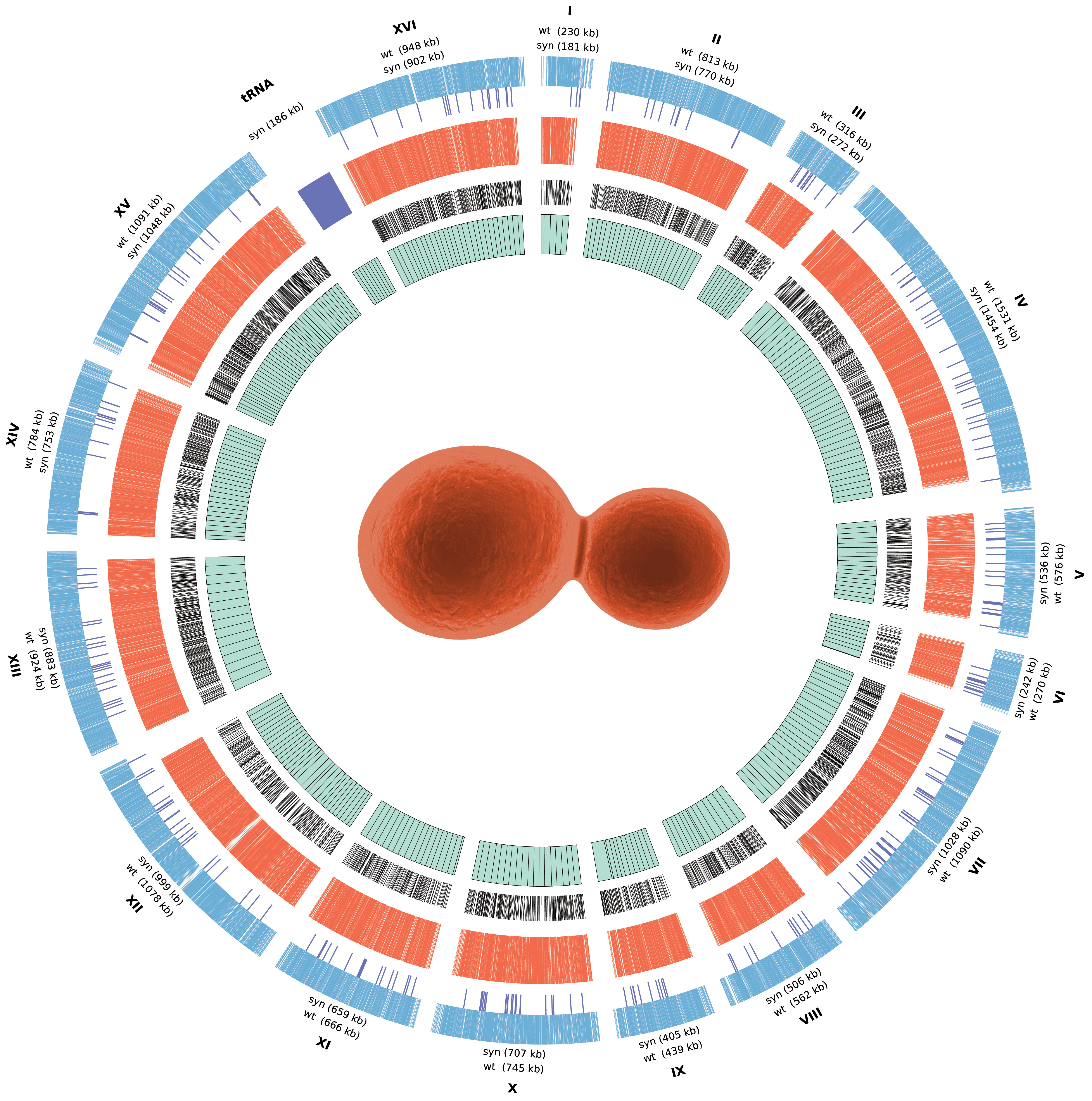
This is graph I made for my Ph.D introduction. It shows the genome map of Saccharomyces cerevisiae — baker's yeast — but not just any yeast. This is Sc2.0, the first complex organism (eukaryote) to have its entire genome rebuilt from scratch by humans.
What am I looking at?
The circular plot shows all 16 chromosomes of yeast arranged like a wheel. Each ring represents a different layer of information:
- Outer ring (light blue): The natural yeast genome — ~12 million base pairs of DNA containing ~6,000 genes
- Second ring (lilac): Transfer RNA genes — the molecular "adapters" that translate genetic code into proteins
- Third ring (orange): The synthetic version — notice it's ~8% smaller. Scientists removed "junk" sequences, introns, and repetitive regions while keeping the yeast fully functional
- Fourth ring (black dots): 3,932 "LoxPsym" sites — molecular "cut here" markers that allow researchers to randomly shuffle the genome on command between those sites (a system called SCRaMbLE)
- Inner ring (green): "Megachunks" — the ~50 kb LEGO-like pieces used to assemble each chromosome
What's the tRNA neochromosome?
The 275 transfer RNA genes scattered across the natural genome were relocated onto a single new artificial chromosome — like consolidating all your app shortcuts into one folder. This is displayed in lilac. This makes the genome more stable.
Why does this matter?
Sc2.0 is essentially a programmable cell. The SCRaMbLE system lets researchers generate millions of genome variants in hours — accelerating evolution that would normally take millennia. Applications include biofuel production, pharmaceutical synthesis, and fundamental research into what makes a genome "work."
This 15-year international effort was completed in 2023 and represents one of the most ambitious synthetic biology projects ever undertaken.
#og
Posted by molecular_data
8 Comments
helped build two out of those chromosomes, ask any questions if you are curious.
Does the scramble system really create diversity? I mean, if the genes are identical, does it really matter if they are reordered?
Is there any population study on synthetic yeast? (and by that I mean is it behaving similarly to natural yeast in a normal environment?)
This is the most unusual and interesting data I’ve seen on r/dataisbeautiful in a long time. And it’s beautiful! Good work, OP
Defragment and Optimise Yeast
Besides writing this post with AI, this is awesome!
I’m stunned.
Science fiction becoming reality.
No parterre tickets available?
Did you keep the original/natural order of genes on each chromosome? And would the SCRaMbLE system start recombination between stretches of DNA between chromosomes? I am wondering how much DNA topology and CRE’s would impact gene regulation