
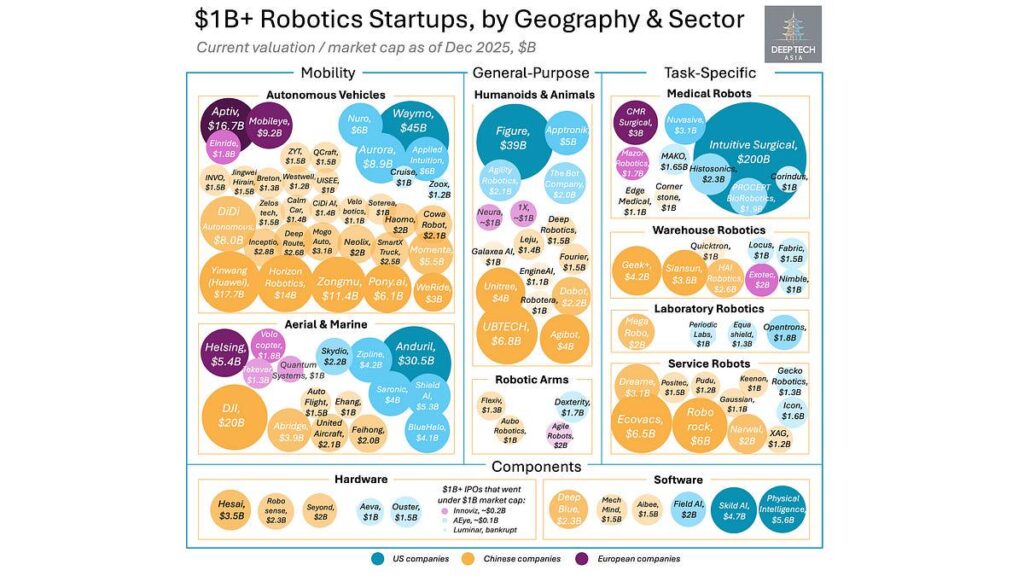
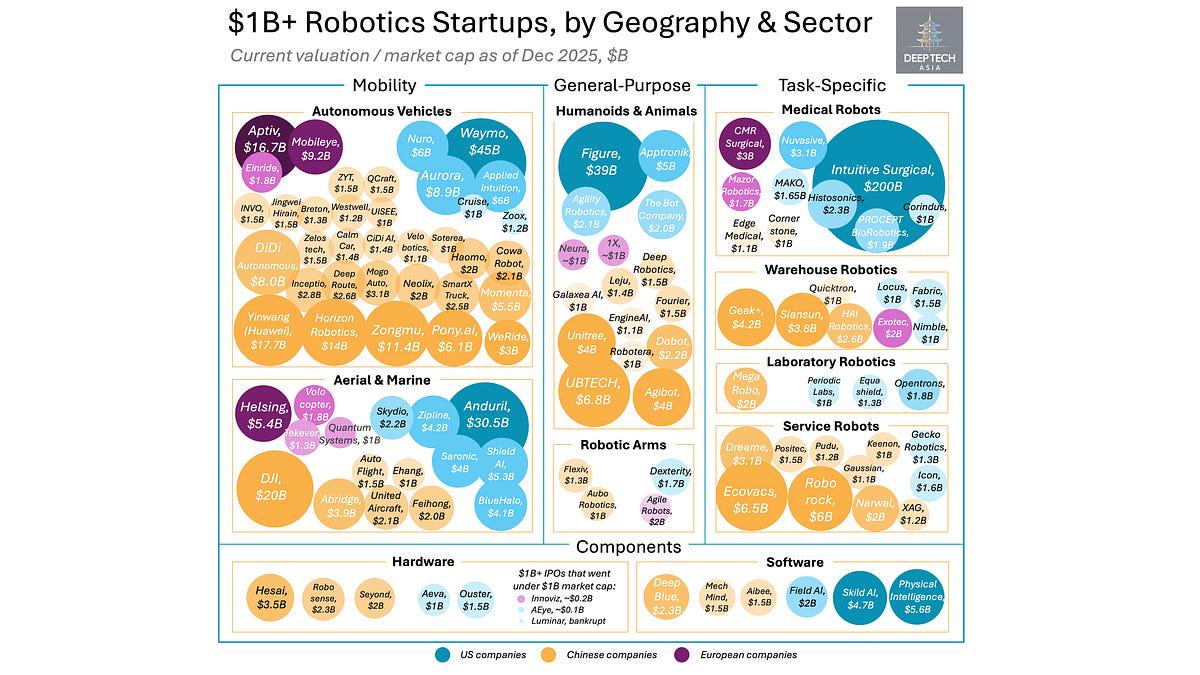
I'm always fascinated by how core fundamental economic facts and realities can't sometimes have deep and profound manifestations. The link below talks about how this will likely be true for robotics over the coming decades.
The key insight here is scalability. Hardware businesses are less scalable than software because you need to procure components, produce and assemble them, and then move physical products across sophisticated supply chains to other parts of the world. Also, deploying robotic solutions at every facility requires high customisation and support from system integrators, which significantly limits scalability.
This means it's unlikely we'll get robotics companies that quickly become huge like Google or Meta. The end result? Robotics won't be dominated by big players, but instead by many smaller/medium-sized enterprises spread out across the world. That has interesting implications. Many people wonder if taxing robotics firms may partially fund UBI, and having the firms smaller may make this easier.
Robotics businesses aren't scalable the way internet/software/AI are, and this means they will probably develop as many smaller companies spread out across the globe, rather than be dominated by a few 'unicorn' giants.
byu/lughnasadh inFuturology
11 Comments
Look at the auto industry. You’re still going to have gigantic players like GM, Toyota, Stellantis, etc
Apple does a pretty damn good job at scaling hardware
Robotics does seem like an industry that would prefer a variety of niche uses rather than a one size fits all solution that software tends to lean towards.
Sufficient capital for R&D with sufficient head start can still dominate if an aggressive IPR strategy is taken.
I think it will be like amazon same day delivery. You open your Tesla App and request a robot to clean your house. A self driving Tesla will deliver and pick up the robot to/from you. Seems pretty scalable to me.
The technical expertise and relevant skills(electronics, pneumatics, PLCs, etc) will likely lead to software and robotics engineers both seeing very high demand. FAANG and their ilk are paying hundreds of thousands per contract, with stock options alongside that, so any robotics group what takes off will need to be competitive with existing market demand. No unicorns, but rather a stable of race horses, all competing
Yet it seems most hardware markets like cars ships truck phones and bikes are also run by a few big players. still allot of small ones exist but this also applies to software.
The mechanics maybe, but the OS and machine learning that makes them do the things no way. There will be 1,2,3 major players in the software space and everyone else will manufacture compatible hardware….kinda like the golden era of PC clones
….. it’s like the automotive industry. Or consumer goods the likes of Samsung produce. Very big companies.
“Hardware businesses are less scalable than software” is a very one-sided view that doesn’t account for the drawbacks. Software is, conversely, fungible. Anyone can write code. There are uncountable startups. The “scalability” you see is countered by a vulnerability to new companies that ALSO have all those advantages of a digital product.
As an illustration, there are free, open-source solutions for literally every software/internet product that exists.
When you say hardware isn’t scalable, that seems contradicted by the *economies of scale*. The truth is, large operations can produce hardware more cheaply. So… they ARE scalable.
Consider the very small number of companies in the world making high-end chips. That’s hardware scalability.
Your premise is false. Hardware is VERY scalable.
It’s matter vs data. Data is infinitely scaleable and instantly transportable across the world, so it works everywhere.
Robots have to deal with matter, physical reality, building, raw materials, delivering… They have to be spread out.
Someone mentioned car companies as an example, that’s a great example, but still shows upper bounds. Even making factories and deliveries all around to diversify, it’s still hard to get the whole world.
Amazon delivery would be the other example, they literally do logistics for the planet, and don’t cover the whole planet. I think that’s another upper bound for “how good can a company get at moving physical stuff around”
Yeah but the tech will get bought out by big guys, and if it doesn’t the big guys will use anti-trust violations to run the small guys out of business.
Capitalism is a machine, and we stopped changing the oil 50 years ago.
It’s a miracle it lasted this long.