
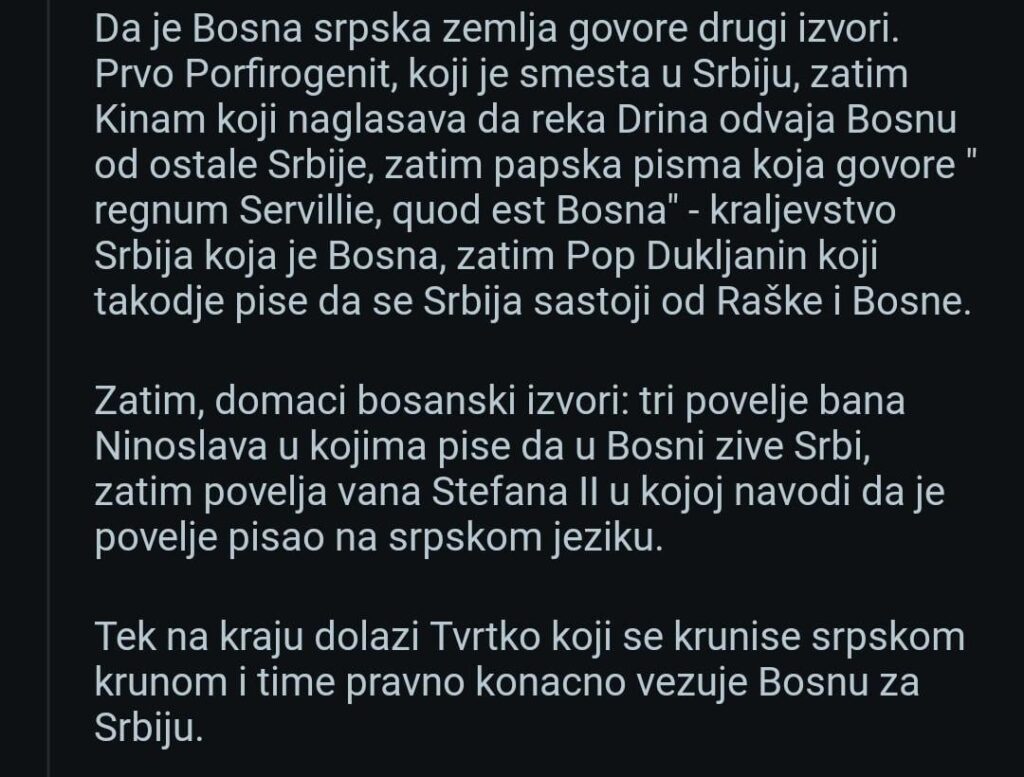
I often debate on forums, and so I see which theses are constantly repeated whenever the story of Serbian Bosnia is brought up. Below are the most common patterns, and my counterarguments.
Porphyrogenite (10th century)
Constantine Porphyrogenitus is quoted:
“That in the baptized Serblia there are inhabited castles… and in the village of Vosona, Katera and Asavich.”
The key thing that is being deliberately ignored is the suggestions:
ἐν τῇ (en tē) = u, unotar
εἰς τὸ (eis to) = prema, ka, do
Porphyrogenite says:
“in Christian Serbia” are these and those cities
“toward the land of Bosnia” are Katera and Asavih
If Bosnia was part of Serbia, he would use the same proposal.
Since “εἰς τὸ” means “to” or “towards”, this means that the cities he lists Κάτερα and Ἀσαβῆχ are Serbian, and located near Bosnia and not in Bosnia.
This is logical, because we are neighbors. If Bosnia was “inside”, he would use the same suggestion as for Serbia.
- Kinam (12th century)
The Byzantine chronicler Kinam writes:
“Bosna is subject to the Archzupan of Serbia, but it is a neighboring nation to the Serbs.”
“Bosnia is not subordinated to the Archbishop of Serbia, but the people are neighbors to the Serbs.”
Your neighbor cannot be who you are.
Drina is the border – Kinam writes as a contemporary and an eyewitness.
👉 Conclusion:
Bosnians = a special people, neighbor to Serbs, not the same.
- Chronicle of Pop Dukljanin
“And Surbia, which is also called Transmontana, he divided into two provinces: one from the great river Drina on the western side as far as Mount Pini, which he also called Bosna; the other, on the other hand, from the same river Drina on the western side as far as Lupia and Lab, which he called Rassa.”
First of all, Surbiam is a strange name, it does not appear anywhere else.
But if Dukljanin is proof that Bosnia is Serbia, then he is the same proof that all of Montenegro and half of Albania (up to Durres) is Red Croatia, which makes no sense.
“from the place of Dalma… to the city of Bambalona, which is now called Dyrrachium, he called Red Croatia…”
Translation:
“from the town of Dalma all the way to the town of Bambalona, which is now called Durrës, he called Red Croatia…”
Second, he himself writes that he is "Surbiam" just a name for the mountains (Transmontana / Zagorje).
For him, it is a geographical term, not an ethnic one.
He calls the people who live there Sclavi (Slavics), not Serbs.
According to Dukljan, Surbiam are mountains (Transmontana), Sclavi is a people, and Bosnia and Raška are countries in those mountains.
Thirdly, Dukljanin did not write the history of the people, but drew the borders as it suited the archbishopric in Bar to gain power over the churches.
- Papal bulls
The quote is used:
“the kingdom of Servilia, which is Bosna”
This translates as:
“Kingdom of Serbia, what is Bosnia”
Problem:
Serbia was never called Servillie in the papal bulls. In the Latin sources of that time, she is Servia, and later Rascia (Raška).
The form Servillia (from Latin servilis – servile, subordinate) is a pejorative administrative term for wider areas under Byzantine rule (servants of Byzantium).
In 1120, the Pope uses this outdated term and immediately specifies it with “quod est Bosna” in order to know which country it is actually about – Bosnia, which was already a separate political entity at that time.
- Ban Matej Ninoslav (1235) – “Serbs are the people of Bosnia and Vlachs are from Dubrovnik”
It is quoted:
“If a Serb believes a Vlach… if a Vlach believes a Serb… and to another Vlach and another Serb, let there be no ism.”
Problem: This is NOT about “us” Serbs
deny it "that Serb" i "that Vlach".
Serbs and Vlachs are: 👉 a third party that trades in Bosnia
For his subjects, Ninoslav clearly says:
“if one of my people commits a crime to stand before me…”
It means:
His people are his people
Serbs and Vlachs are “They”
- Charter of Ban Stjepan II Kotromanić from 1333
Stjepan called his language Serbian?
Quote from the charter.
Therefore, I, Mr. Ban Stefan, put my golden seal, that it is believed – everyone should know the truth. And there are four charters the same: two Latin and two Serbian
Problem:
In all the original charters of Stjepan II Kotromanić, there are them "7" he always signs himself as “Stipan”.
Apart from this charter from 1333, here Stipan suddenly becomes “Stefan”.?
Also all other names for the other Stjepans are always written "Stipan" all the way to Tvrtko I Kotromanić.
It is obvious that the copyists in the Dubrovnik office, making copies for their own needs, “scraped” the name and added the quote about “2 Latins and 2 Serbs” for their own use.
The original certainly didn’t say Stefan, and there aren’t even those famous golden seals that are mentioned in that dubious copy.
- The crown of the company – “The company was only a Serbian king”?
Problem:
The company had:
Serbian crown (as king of Serbia through grandmother Jelisaveta)
i
Bosnian crown (as King of Bosnia through Kotromanić)
This is clearly visible on the seal:
👉 https://commons.wikimedia.org/wiki/File:Pecat_kralja_Tvrtka_I.jpg
Lilies are not a symbol of Nemanjić
The lily is the Bosnian national symbol
Serbian lilies appear only in the 19th century – a pure plagiarism of Bosnian heraldry
https://i.redd.it/h0o5qyweadfg1.jpeg
Posted by Tuzlaq
14 Comments
Sve sto vidis da srbi pisu, pogotovo o Bosni, je cista laz i izmisljotina i ne treba puno ulaziti u te diskusije. Ljudi jednostavno zive u iluzijama
Korišćenje nečega iz davne prošlosti kako bi se opravdao iredentizam u sadašnjici.
[Where have I heard that before?](https://en.wikipedia.org/wiki/Zionism?wprov=sfla1)
Nikad ovo nije napisano ni u jednoj povelji, knjizi niti zvaničnom dokuemntu. Pop Duklanin navodi da Drina dijeli Srbiju i Bosnu.
Stvarno mi nije jasno šta znači tim ljudima kad kažu “Bosna je Srpska”, živiš u pripizdini koja nema asfalta, ali nek je Bosna Srpska zemlja koja je odezata Srbima od Srbomrzaca sa zapada…
I onda se pitaju zašto sa Srbima niko u regionu ne želi da živi.
Umara ovo.
Preporuka za čitanje Tibora Živkovića, jednog od bisera srbijanske medijevistike (koji je, nažalost, veoma mlad preminuo). Posebno njegove analize Porfirogenetovog djela (-> podatak o Bosni potječe iz starijeg, danas izgubljenog latinskog izvora iz druge polovine 9. vijeka). Također i analize “Ljetopisa popa Dukljanina”, za koji je utvrdio i autora, i pravo vrijeme nastanka (kraj 13. i poč. 14. vijeka), dakle za rani srednji vijek beskoristan izvor. To je ozbiljna historiografija i nauka, koja nema nacionalnost.
Srpski narativ da je Bosna srpska država se ne bazira na njihovom ubjeđenju da je to objektivna istoriografska činjenica, nego na emocionalnom doživljaju svog identiteta i prošlosti.
Mnogi Bošnjaci ovo ne razumiju pa pokušavaju da ih istoriografijom i logikom navedu na ono što oni percipiraju kao istinu, nevidjevši da je to krajnje uzaludna rasprava, baš kao i pokušaj dokazivanja da je masakr u Srebrenici genocid.
Stvari funkcionišu tako da postoji jedan opšti nacionalni narativ koji se smatra neupitno istinitim i bilo kakve činjenice i argumenti se tumače u skladu sa tim narativom. Ako zvuče kao da mu odgovaraju oni se ističu, a ako mu ne idu u prilog, tretiraju se kao irelevantni. Ali krajnji cilj je da se odbrani ono što se percipira kao istina a ne da se otkrije stvarna istina. Ovo ne važi samo za Srbe nego za većinu svih ljudi.
Ali ključno je da se razumije da različiti istorijski pogledi **ne predstavljaju nikakav problem suživotu** sami po sebi. Ne postoji nikakav problem u tome da mi srednjovijekovnu Bosnu gledamo kao kolijevku bošnjačkog identiteta i subjektiviteta a da je Srbi istovremeno gledaju kao jednu od srednjovijekovnih srpskih država.
Ovo razilaženje u tumačenju nije uzrok nikakivh problema današnjice, uzroci su politički interesi i aspiracije. Zato ovakve rasprave nemaju nikakvog smisla – čak i da ubijedite sve te sa kojima se raspravljate u vašu verziju istine, to neće promijeniti apsolutno ništa.
A problem i jednih i drugih je predstavljanje današnjih etničkih skupina na srednji vijek u kojem nisu značile ono što danas znače. Al ajd.
Lijepo si to srocio, hvala
it is that time of the day…
[https://www.researchgate.net/publication/377832221_O_pocecima_Bosne_u_ranom_srednjem_vijeku](https://www.researchgate.net/publication/377832221_O_pocecima_Bosne_u_ranom_srednjem_vijeku)
Srbija je bosanska
Eto šta ćemo sad?
Naši susjedi trebaju svatiti da im se i ovo malo Srbije raspada, a domaći Srbi da žive u istoj državi kao i mi…. Ta država je u svi znamo kakvom st(r)anju..
-> [mojposao.ba](http://mojposao.ba)
Ajd daj mi izvor za
Ὅτι ἐν τῇ βαπτισμένῃ Σερβλίᾳ εἰσὶν κάστρα οἰκούμενα… καὶ εἰς τὸ χωρίον Βόσονα, τὸ Κάτερα καὶ τὸ Ἀσαβῆχ
I za
Bosna Serviae archizupano subditur, sed vicina Serviis gens est
Jer pretraga ovih fraza ili njihovih djelova mi daje nula rezultata
Na kraju krajeva, idiotski je ove stvari komentarisati ali ajd da malo zabijem nos jer se danas Njemcem, Italijanom i Francuzom svašta naziva, a sigurno bi kroz istoriju našao drugačije činjenice za to. Hoću reći da se ne može današnjim očima na te stvari gledati.
Zašto je stanovnicima Be i Ha neshvatljivo da su pretci Bošnjaka i Srba (oboje + Hrvata) živeli na prostoru današnje Bosne?