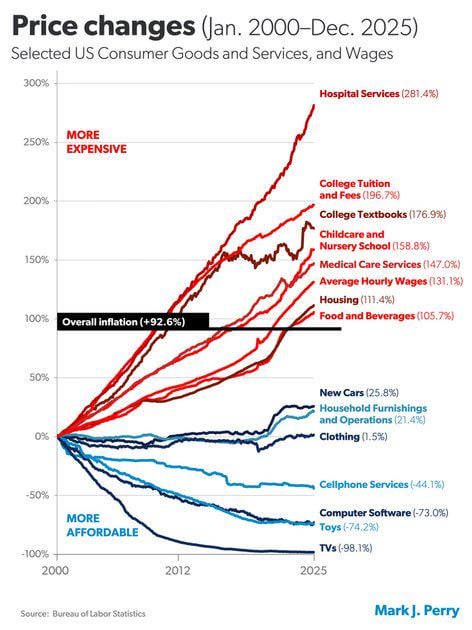
i do not understand how “average hourly wages” is an expense that is bad when it goes up? Was this chart made by someone who hates paying their employees? seems kind like against the whole rest of chart. Like oh no my wages went up, now i can still afford housing, dangit
SarahAlicia on
Basically (with the exception of housing and textbooks) things that can be mass produced with automation got cheaper but things involving a lot of human input became more expensive. Food and beverages can be automated or this could also include dining out i’m not sure if it’s solely grocery prices.
Yossarian_nz on
TVs are only cheap because they’re loss-leaders and the actual profit comes from advertising and selling your data through the built-in “smart” services.
/edit – no idea why this is being downvoted so much, it’s not just my opinion:
In this graph, housing and food and beverages have both increased in less than wages have gone up. Transportation and clothing have gotten cheaper.
turboduck3 on
Everything in the red (excluding the hourly wages) is government subsidized. Coincidence or correlation?
ZebraAthletics on
Right off the bat this article is dumb. “The last 25 years, our money lost 92 % in value due to inflation.” Inflation over that period has been a little under 92%, but that isn’t the same as losing 92% of value, it’s more like losing 45% of value.
vertigostereo on
Doritos are $7+ for a big bag.
Ancardoth on
There seems to be a significant correlation between the price trend of a product or service, and the regulations associated with them.
MidwesternDude2024 on
Who would have thought, labor is expensive.
sourcreamus on
Clothing is non-essential? Not for me
gimmickypuppet on
So glad I live in the timeline where I can afford 10 TVs in my home but fuck having children, right?
LikeMrFantastic on
I’ve seen this several times over the last few years and I STILL call BS on cars. There is NO WAY cars $-$ are less.
EffectiveEconomics on
This is how the system starves it’s most vulnerable. You charge more for what is unavoidable, and you charge less for what’s not selling.
natethegreek on
When you treat everything like it is a free market the only things that will get cheaper are things that have a free market.
With housing and hospital services you cannot just “go without because it is too expensive” but we treat it like we do corn and it leads to things that are not a free market getting very expensive because there is no check for monopoly abuses.

16 Comments
i do not understand how “average hourly wages” is an expense that is bad when it goes up? Was this chart made by someone who hates paying their employees? seems kind like against the whole rest of chart. Like oh no my wages went up, now i can still afford housing, dangit
Basically (with the exception of housing and textbooks) things that can be mass produced with automation got cheaper but things involving a lot of human input became more expensive. Food and beverages can be automated or this could also include dining out i’m not sure if it’s solely grocery prices.
TVs are only cheap because they’re loss-leaders and the actual profit comes from advertising and selling your data through the built-in “smart” services.
/edit – no idea why this is being downvoted so much, it’s not just my opinion:
[https://edition.cnn.com/2023/12/16/business/why-are-tvs-so-cheap](https://edition.cnn.com/2023/12/16/business/why-are-tvs-so-cheap)
This is the difference between manufactured goods and labor intensive services. It has nothing to do with whether or not something is “essential”
This is because of a well known economic phenomena: https://en.wikipedia.org/wiki/Baumol_effect
In this graph, housing and food and beverages have both increased in less than wages have gone up. Transportation and clothing have gotten cheaper.
Everything in the red (excluding the hourly wages) is government subsidized. Coincidence or correlation?
Right off the bat this article is dumb. “The last 25 years, our money lost 92 % in value due to inflation.” Inflation over that period has been a little under 92%, but that isn’t the same as losing 92% of value, it’s more like losing 45% of value.
Doritos are $7+ for a big bag.
There seems to be a significant correlation between the price trend of a product or service, and the regulations associated with them.
Who would have thought, labor is expensive.
Clothing is non-essential? Not for me
So glad I live in the timeline where I can afford 10 TVs in my home but fuck having children, right?
I’ve seen this several times over the last few years and I STILL call BS on cars. There is NO WAY cars $-$ are less.
This is how the system starves it’s most vulnerable. You charge more for what is unavoidable, and you charge less for what’s not selling.
When you treat everything like it is a free market the only things that will get cheaper are things that have a free market.
With housing and hospital services you cannot just “go without because it is too expensive” but we treat it like we do corn and it leads to things that are not a free market getting very expensive because there is no check for monopoly abuses.