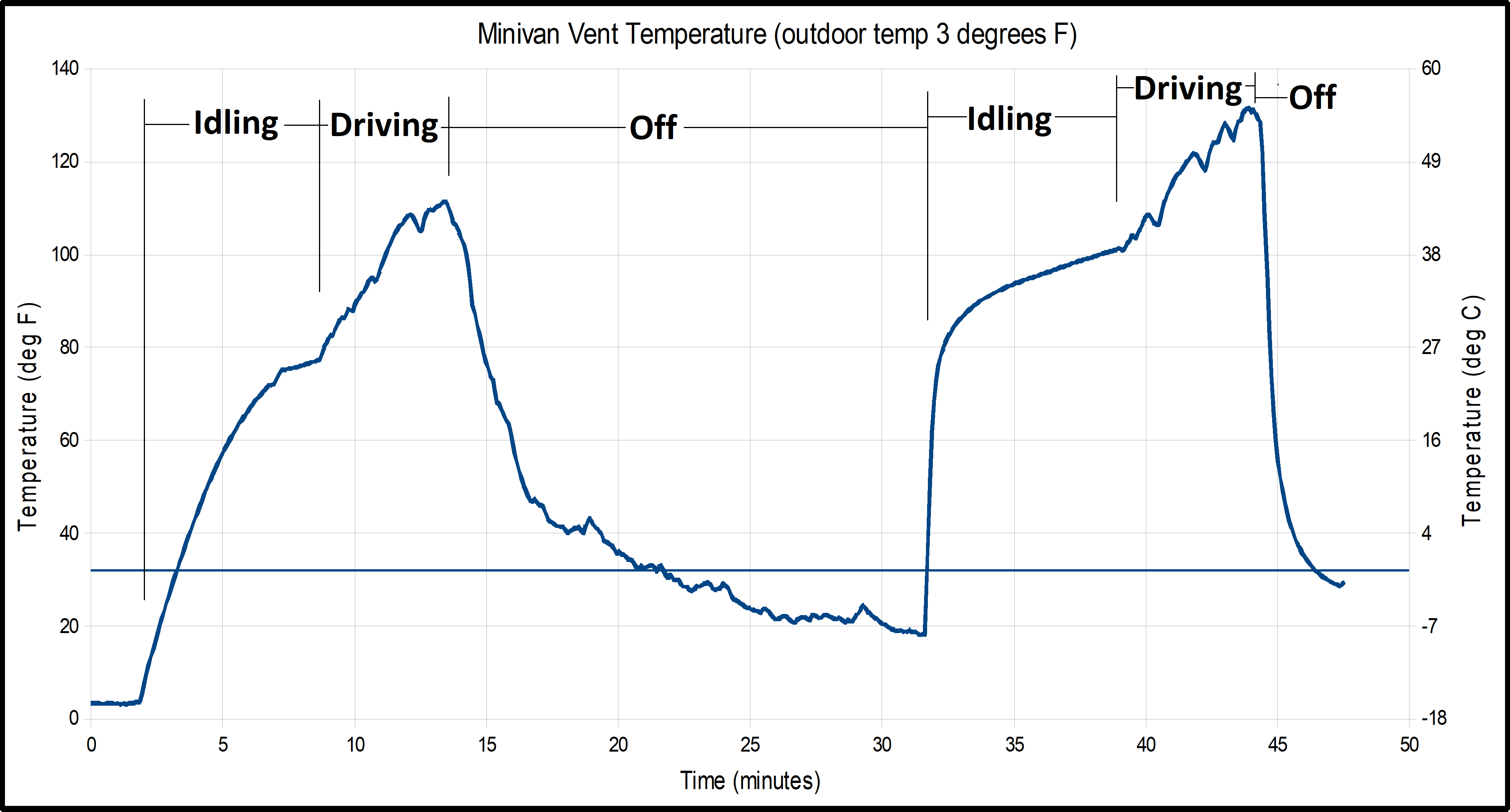
Any idea what might cause the temp to increase in short bursts during the downward trend when it’s off?
timmeh87 on
inb4 everyone comments on how modern cars dont need the engine to be warmed up
but you can actually see from your own data that the engine was still warm after shopping as the temperature slope is nearly infinity. so like realistically the only reasons to eat a sandwich alone in a parking lot is
1) was starving, couldnt wait 10 minutes to drive home
2) avoiding home situation
azucarleta on
Your minivan probably is not even the sort that benefits from being warmed up.
I guess I’m sensitive because I live in a metro area with extreme air quality issues, but hell stop idling vehicles. It’s so 1970s. To me, it looks like having a glass of wine and smoking while pregnant. Soooooo old fashion, like times have changed, and that isn’t adequately responsible anymore.
SuMoto on
I want to see highway speed temps. Then a full throttle acceleration from stop back up to highway speeds.
The heat output after a full throttle session is always a noticeable increase.
Lol. 10 min idling, 5 min driving. Just walk next time.
Btw idling is illegal in Germany. You drive right away.
Asrahn on
Did a double-take before realizing this was in Fahrenheit lol
FormalYeet on
These discussions around idling and warming up a car are always funny to me…
I certainly understand a newer fuel injected car really only needs a few moments to get the oil circulated and fuel ratio set.
However….
I sure as shit turn the shower on and let it get warm before I hop in.
I remote start my car to get the cabin warm before I get in.
Lekstil on
I was always wondering how the heating in a car works. Good to know! Especially that the temperature seems to plateau while idling.
I always wonder if the heat would go up faster if I rev my car while in neutral. Seems like it probably would!
GreyFoxNinjaFan on
Thanks for including Celcius.
PM_YOUR_CENSORD on
Everyone in here complaining about the idling actually live in a climate that plunges below zero to negative double digit temps?
rofl1337waffle on
Why does it seem like it cooled off so much faster the second time it was off?
superrey19 on
Seeing this makes me appreciate my EV. In negative temps I timed how long it takes to get warm air out of the vents: 1 minute 15 seconds.
In similar temps in my previous ice vehicle, I would let it idle for 5 minutes and would only get warm air in the last 5 minutes of my 19 minute commute.
seeker-0 on
Why the hell are you idling for so long?
ticcedtac on
Do none of you own ice scrapers? It takes me about three minutes to leave in the morning when everything is frozen over, are all of you sitting and waiting for 10+ minutes?
CaboJoe on
As your car transitions through different loads and RPMs, the engine controller will switch between different operating states. These states are optimized for different goals like low fuel consumption at idle, more power during acceleration, etc. The schedule for these states are there to meet emissions and economy goals. It’s not unusual to see humps in the temperature profile as the engine transitions through these states and opens and closes valves in the process. It could also be your transmission downshifting causing the rpm’s to jump and thus your water pump moving more or less fluid.
rodeBaksteen on
One of my favorite things about the (new) EVs is preheating the car, so much better than petrol in that regard.
wa27 on
All you people complaining that he warmed up his car for 8 minutes are forgetting the fact that IT’S FUCKIN COLD OUTSIDE
AnnJilliansBrassiere on
These comments are fun, and frustrating to read.
OP has it in the title of the post – “VENT temperature”. Meaning, when the vehicle is running and the heat is blowing, this is the temp measured.
When the vehicle is OFF, obviously, so is the climate control, and no heat blowing through the VENT. The cabin quickly cools down, but the engine is still very warm.
On restart, residual engine heat warms the vents when the climate control, or “blower” is turned back on.
C’mon people. Catch up, mustards.
EDIT – I feel I should add this –
In traditionally built or “ICE” engine-powered vehicles, the heat is provided by the engine coolant. That is why the engine needs to warm up (and it does, to account for metal expansion and proper fit/function of the internal components) to produce heat from the vents. There’s anywhere from 1 to 12 gallons of coolant in it’s circulatory system, and the small radiator in the dashboard gets it’s flow directly from the engine. The age-old test is, start the engine, and at a low blower setting, feel for some warmth coming from the vents. That means the engine’s core is warming up, and the most crucial parts are at a minimum operating temp.
If you’ve been told that a severely cold engine is OK to drive, you are part of the “planned obsolescence” that kills these machines when they could live much longer. No machine designed to run at 230F should be run at full demand cold, or frigid. Metal expands and contracts, lubricants thicken and solidify. An engine should reach at least a temperature where the oil is in “working temperature”, which varies but at least starts at 120-150F. The internal components must heat and expand to proper fit, otherwise “looseness” and metal clash occurs. Bearings get hammered by the looser fit, lubricants cannot flow and provide the “cushion” required. Start a frigid engine and drive away – years of wear happens in minutes.
Also, the “catalyst”, the catalytic converter, the filter used to burn off unburnt fuel and turn harmful exhaust gasses into harmless nitrogen and water – cannot function until it reaches 400F+. The warm-up period richens the burn mixture, allowing for unburnt fuel to “reburn” inside the catalytic converter, bringing it up to an effective temp and filtering the pollutants expelled by the engine. At operating temp, many vehicles really do “filter” the air they breathe.
If you drive a car with a cold engine, it is spewing harmful pollutants that the system cannot filter out. In effect, if you drive a cold car, you hate the environment, trees, air, and all life on Earth. Shame on you.

![Temperature of my minivan vent air during a drive to the grocery store [OC]](https://www.byteseu.com/wp-content/uploads/2026/01/bp15n8zfwpfg1-1536x826.png "Temperature of my minivan vent air during a drive to the grocery store [OC]")
22 Comments
[deleted]
Are you idling longer than driving?
That second idling curve is a thing of beauty
Any idea what might cause the temp to increase in short bursts during the downward trend when it’s off?
inb4 everyone comments on how modern cars dont need the engine to be warmed up
but you can actually see from your own data that the engine was still warm after shopping as the temperature slope is nearly infinity. so like realistically the only reasons to eat a sandwich alone in a parking lot is
1) was starving, couldnt wait 10 minutes to drive home
2) avoiding home situation
Your minivan probably is not even the sort that benefits from being warmed up.
I guess I’m sensitive because I live in a metro area with extreme air quality issues, but hell stop idling vehicles. It’s so 1970s. To me, it looks like having a glass of wine and smoking while pregnant. Soooooo old fashion, like times have changed, and that isn’t adequately responsible anymore.
I want to see highway speed temps. Then a full throttle acceleration from stop back up to highway speeds.
The heat output after a full throttle session is always a noticeable increase.
[https://www.deq.nc.gov/about/divisions/air-quality/motor-vehicles-and-air-quality/idle-reduction/why-idling-harmful](https://www.deq.nc.gov/about/divisions/air-quality/motor-vehicles-and-air-quality/idle-reduction/why-idling-harmful)
Lol. 10 min idling, 5 min driving. Just walk next time.
Btw idling is illegal in Germany. You drive right away.
Did a double-take before realizing this was in Fahrenheit lol
These discussions around idling and warming up a car are always funny to me…
I certainly understand a newer fuel injected car really only needs a few moments to get the oil circulated and fuel ratio set.
However….
I sure as shit turn the shower on and let it get warm before I hop in.
I remote start my car to get the cabin warm before I get in.
I was always wondering how the heating in a car works. Good to know! Especially that the temperature seems to plateau while idling.
I always wonder if the heat would go up faster if I rev my car while in neutral. Seems like it probably would!
Thanks for including Celcius.
Everyone in here complaining about the idling actually live in a climate that plunges below zero to negative double digit temps?
Why does it seem like it cooled off so much faster the second time it was off?
Seeing this makes me appreciate my EV. In negative temps I timed how long it takes to get warm air out of the vents: 1 minute 15 seconds.
In similar temps in my previous ice vehicle, I would let it idle for 5 minutes and would only get warm air in the last 5 minutes of my 19 minute commute.
Why the hell are you idling for so long?
Do none of you own ice scrapers? It takes me about three minutes to leave in the morning when everything is frozen over, are all of you sitting and waiting for 10+ minutes?
As your car transitions through different loads and RPMs, the engine controller will switch between different operating states. These states are optimized for different goals like low fuel consumption at idle, more power during acceleration, etc. The schedule for these states are there to meet emissions and economy goals. It’s not unusual to see humps in the temperature profile as the engine transitions through these states and opens and closes valves in the process. It could also be your transmission downshifting causing the rpm’s to jump and thus your water pump moving more or less fluid.
One of my favorite things about the (new) EVs is preheating the car, so much better than petrol in that regard.
All you people complaining that he warmed up his car for 8 minutes are forgetting the fact that IT’S FUCKIN COLD OUTSIDE
These comments are fun, and frustrating to read.
OP has it in the title of the post – “VENT temperature”. Meaning, when the vehicle is running and the heat is blowing, this is the temp measured.
When the vehicle is OFF, obviously, so is the climate control, and no heat blowing through the VENT. The cabin quickly cools down, but the engine is still very warm.
On restart, residual engine heat warms the vents when the climate control, or “blower” is turned back on.
C’mon people. Catch up, mustards.
EDIT – I feel I should add this –
In traditionally built or “ICE” engine-powered vehicles, the heat is provided by the engine coolant. That is why the engine needs to warm up (and it does, to account for metal expansion and proper fit/function of the internal components) to produce heat from the vents. There’s anywhere from 1 to 12 gallons of coolant in it’s circulatory system, and the small radiator in the dashboard gets it’s flow directly from the engine. The age-old test is, start the engine, and at a low blower setting, feel for some warmth coming from the vents. That means the engine’s core is warming up, and the most crucial parts are at a minimum operating temp.
If you’ve been told that a severely cold engine is OK to drive, you are part of the “planned obsolescence” that kills these machines when they could live much longer. No machine designed to run at 230F should be run at full demand cold, or frigid. Metal expands and contracts, lubricants thicken and solidify. An engine should reach at least a temperature where the oil is in “working temperature”, which varies but at least starts at 120-150F. The internal components must heat and expand to proper fit, otherwise “looseness” and metal clash occurs. Bearings get hammered by the looser fit, lubricants cannot flow and provide the “cushion” required. Start a frigid engine and drive away – years of wear happens in minutes.
Also, the “catalyst”, the catalytic converter, the filter used to burn off unburnt fuel and turn harmful exhaust gasses into harmless nitrogen and water – cannot function until it reaches 400F+. The warm-up period richens the burn mixture, allowing for unburnt fuel to “reburn” inside the catalytic converter, bringing it up to an effective temp and filtering the pollutants expelled by the engine. At operating temp, many vehicles really do “filter” the air they breathe.
If you drive a car with a cold engine, it is spewing harmful pollutants that the system cannot filter out. In effect, if you drive a cold car, you hate the environment, trees, air, and all life on Earth. Shame on you.