**Data Sources:**
– U.S. Department of Labor: Labor Condition Application (LCA) Disclosure Data, FY2024
– USDA Economic Research Service: Rural-Urban Continuum Codes (2013)
– U.S. Census Bureau: TIGER/Line county boundaries
**Sample:**
– 10,614 certified H-1B physicians (SOC 29-1xxx)
– October 2023 – September 2024
– 410 counties with 5+ physicians mapped
**Why This Matters:**
This suggests wage differentials alone cannot overcome non-monetary barriers to rural healthcare access—distance, isolation, spousal employment, and visa constraints may dominate physician location decisions. Price isn’t clearing this market.
**Tools:** Python (pandas, geopandas, matplotlib)
**Full analysis:** Link in bio.
—
*Note: H-1B Labor Condition Applications (LCAs) represent employer filings, not final visa issuances. A small subset may not result in actual employment.*
Rarvyn on
The premium is probably a fair bit larger than $45k for docs overall. The medians you’re quoting are well below typical full time physician pay – even for a fresh graduate right out of residency.
I could probably add 50% to my income if I wanted to move to rural Texas two hours from the nearest big city, but I would rather be near friends and family.
whoareyouguys on
It’s simple – if you make enough money to live somewhere nice, would you be happier living there or somewhere shitty with an extra Porsche in the driveway
Kolt56 on
A physician is not moving to the middle of nowhere for 45K.
They might for double the salary of a saturated HCOL MD.
Say city MD gets 400k, same city MD actually command 1.5x to 2x to move to a rural setting.
Fantastic-Title-2558 on
maybe immigrants don’t want to live in trumpland
onicut on
Unfortunately, they would make more money joining ICE. Why would we want to fund rural hospitals?
PyrrhoTheSkeptic on
If I were a doctor, I would not move to some hellhole for only a $45k increase in salary. Money isn’t the only determinant of quality of life.
Efficient_Tonight_40 on
Just looking at this map you can also see that there’s a lot of blue in those sorts of poorer B and C tier cities which I would imagine also have a hard time attracting doctors. Like are there hordes of American doctors lining up to work in Buffalo, Memphis, Detroit, Birmingham, and Sioux Falls? I doubt it.
Similar case for foreign teachers as well. Many of the largest employers of foreign teachers are majority black and Hispanic inner city school districts which also have a hard time attracting teachers, just for different reasons than rural districts do
maringue on
Not everything is about money. H1B visas go to people from other countries. People from other countries who move to the US like to live in areas that have a community from their home country.
Rural areas almost never have those.
cybercuzco on
So youre telling me someone who values being highly educated doesnt want to live in an area known for poorly educating people?
Sekhmet3 on
If there was a mandatory fee, I would gladly pay $45k a year to move from nowheresville to a major city
Blue_foot on
The concentration graph is totally useless.
Of course more H1B doctors are going to work where there are more people! Duh!
In addition, H1B doctors are typically minorities and want to live somewhere where they feel like part of the community. Where there are specialty grocery stores. Where their kid isn’t going to be the only XXXXX in the entire school.
coconutserg on
I’m sending my wife back to school
kajidourden on
It’s still not worth it for someone who doesn’t want to live in BFE.
scriptingends on
Yes because there’s nothing that makes an educated person want to live in rural America
shyouhei on
Another difference is these rural gigs also give you several months off in addition, so many doctors maintain a second residence in some place worth living in
i_am_voldemort on
The issue is lifestyle.
They’re paying a premium but you’re “one of one” specialist in a rural hospital setting with no backup or peers.
It’s exhausting and unsustainable.
TenderfootGungi on
Living in a rural area is less expensive, but you have to give up a lot. Do you want your kid to play soccer? Sorry, we only have baseball and only for a month or so a year. Want to go swimming in a cooler month? Sorry, no indoor pool. Want to go to a concert, major sporing event, or even a medical specialist? Get ready to drive to the nearest city.
This is not a paradox. This is just weighing the true costs and benefits.
awh290 on
In my system, our providers/employees in more rural areas that are BIPOC regularly deal with blatant discrimination. We aren’t too terribly rural, but a few incidents that come to mind recently:
One guy didn’t even see the provider and asked for a new one based on the last name.
Another question the provider’s intelligence due to their skin color
Some just aren’t happy with any hint of accent and will be rude and leave appointments.
Our system and team is 100% supportive, but who the hell wants to work in a place like that when that’s how your treated semi regularly, while you have the option to not. Providers are in high demand and are already paid pretty damn well. If it were me, I’d want to be where I felt welcome and safe if I had options.
arjomanes on
Yeah I doubt many immigrant doctors would want to live in rural America if they could live in a city or suburb. The towns might be nice enough, but the xenophobia and racism makes it a lot harder.
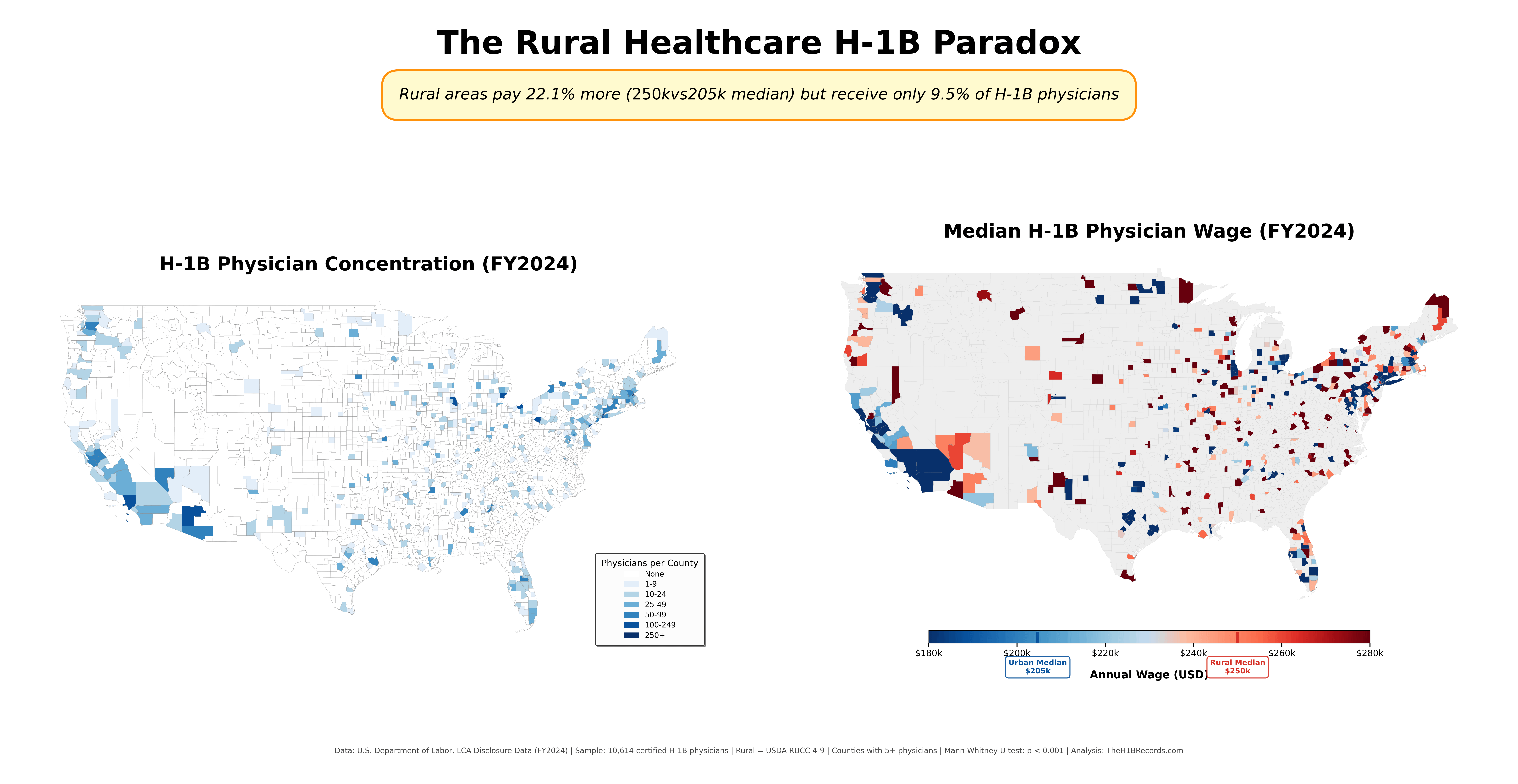

![[OC] Rural areas offer a $45k salary premium for doctors but only attract 1 in 10](https://www.byteseu.com/wp-content/uploads/2026/01/gmq8cf5l2egg1-1536x794.png "[OC] Rural areas offer a $45k salary premium for doctors but only attract 1 in 10")
20 Comments
**[OC] Data & Methodology**
**Data Sources:**
– U.S. Department of Labor: Labor Condition Application (LCA) Disclosure Data, FY2024
– USDA Economic Research Service: Rural-Urban Continuum Codes (2013)
– U.S. Census Bureau: TIGER/Line county boundaries
**Sample:**
– 10,614 certified H-1B physicians (SOC 29-1xxx)
– October 2023 – September 2024
– 410 counties with 5+ physicians mapped
**Key Findings:**
– Rural median: $250,000 (1,006 physicians, 9.5%)
– Urban median: $204,697 (9,608 physicians, 90.5%)
– Wage premium: 22.1% ($45,303 absolute)
– Statistical significance: Mann-Whitney U test, p < 0.001
**Rural Definition:**
USDA Rural-Urban Continuum Codes 4-9 (non-metro counties)
**Why This Matters:**
This suggests wage differentials alone cannot overcome non-monetary barriers to rural healthcare access—distance, isolation, spousal employment, and visa constraints may dominate physician location decisions. Price isn’t clearing this market.
**Tools:** Python (pandas, geopandas, matplotlib)
**Full analysis:** Link in bio.
—
*Note: H-1B Labor Condition Applications (LCAs) represent employer filings, not final visa issuances. A small subset may not result in actual employment.*
The premium is probably a fair bit larger than $45k for docs overall. The medians you’re quoting are well below typical full time physician pay – even for a fresh graduate right out of residency.
I could probably add 50% to my income if I wanted to move to rural Texas two hours from the nearest big city, but I would rather be near friends and family.
It’s simple – if you make enough money to live somewhere nice, would you be happier living there or somewhere shitty with an extra Porsche in the driveway
A physician is not moving to the middle of nowhere for 45K.
They might for double the salary of a saturated HCOL MD.
Say city MD gets 400k, same city MD actually command 1.5x to 2x to move to a rural setting.
maybe immigrants don’t want to live in trumpland
Unfortunately, they would make more money joining ICE. Why would we want to fund rural hospitals?
If I were a doctor, I would not move to some hellhole for only a $45k increase in salary. Money isn’t the only determinant of quality of life.
Just looking at this map you can also see that there’s a lot of blue in those sorts of poorer B and C tier cities which I would imagine also have a hard time attracting doctors. Like are there hordes of American doctors lining up to work in Buffalo, Memphis, Detroit, Birmingham, and Sioux Falls? I doubt it.
Similar case for foreign teachers as well. Many of the largest employers of foreign teachers are majority black and Hispanic inner city school districts which also have a hard time attracting teachers, just for different reasons than rural districts do
Not everything is about money. H1B visas go to people from other countries. People from other countries who move to the US like to live in areas that have a community from their home country.
Rural areas almost never have those.
So youre telling me someone who values being highly educated doesnt want to live in an area known for poorly educating people?
If there was a mandatory fee, I would gladly pay $45k a year to move from nowheresville to a major city
The concentration graph is totally useless.
Of course more H1B doctors are going to work where there are more people! Duh!
In addition, H1B doctors are typically minorities and want to live somewhere where they feel like part of the community. Where there are specialty grocery stores. Where their kid isn’t going to be the only XXXXX in the entire school.
I’m sending my wife back to school
It’s still not worth it for someone who doesn’t want to live in BFE.
Yes because there’s nothing that makes an educated person want to live in rural America
Another difference is these rural gigs also give you several months off in addition, so many doctors maintain a second residence in some place worth living in
The issue is lifestyle.
They’re paying a premium but you’re “one of one” specialist in a rural hospital setting with no backup or peers.
It’s exhausting and unsustainable.
Living in a rural area is less expensive, but you have to give up a lot. Do you want your kid to play soccer? Sorry, we only have baseball and only for a month or so a year. Want to go swimming in a cooler month? Sorry, no indoor pool. Want to go to a concert, major sporing event, or even a medical specialist? Get ready to drive to the nearest city.
This is not a paradox. This is just weighing the true costs and benefits.
In my system, our providers/employees in more rural areas that are BIPOC regularly deal with blatant discrimination. We aren’t too terribly rural, but a few incidents that come to mind recently:
One guy didn’t even see the provider and asked for a new one based on the last name.
Another question the provider’s intelligence due to their skin color
Some just aren’t happy with any hint of accent and will be rude and leave appointments.
Our system and team is 100% supportive, but who the hell wants to work in a place like that when that’s how your treated semi regularly, while you have the option to not. Providers are in high demand and are already paid pretty damn well. If it were me, I’d want to be where I felt welcome and safe if I had options.
Yeah I doubt many immigrant doctors would want to live in rural America if they could live in a city or suburb. The towns might be nice enough, but the xenophobia and racism makes it a lot harder.