I do wonder why, most countries are having the same pattern.
kjuneja on
Japan doesn’t give af. So metal
angry_demon on
World will eventually be cleaner and more peaceful if these stats hold. It is bad for economic growth but we cannot have forever growth. Definition of growth will change.
YoghurtReal1375 on
It’s half economic and half social- people can’t afford kids and are overworked, and at the same time women are freer to realise that traditional motherhood isn’t ideal. Patriarchy is still very strong in lots of these places, and 9-5 plus raising kids is just too much.
sgeeum on
double whammy comin in hot in that many of these countries are very anti immigration
datums on
Without looking it up, see if you can guess what year China’s one child policy started.
>!Wrong. It was 1979.!<
thechemistrychef on
Same story as everywhere else. People are overworked and everything is too expensive to have kids. Governments will do literally anything else to try and raise birthrates but fix those things.
mstpguy on
*The Age of Decay* is a decent book about the long term consequences of population collapse.
As it happens having a population of 50 million isn’t a problem, but a population of 50 million that has to somehow maintain or unbuild the physical and financial infrastructure designed for a population of 80 million is.
ejdlgsngs on
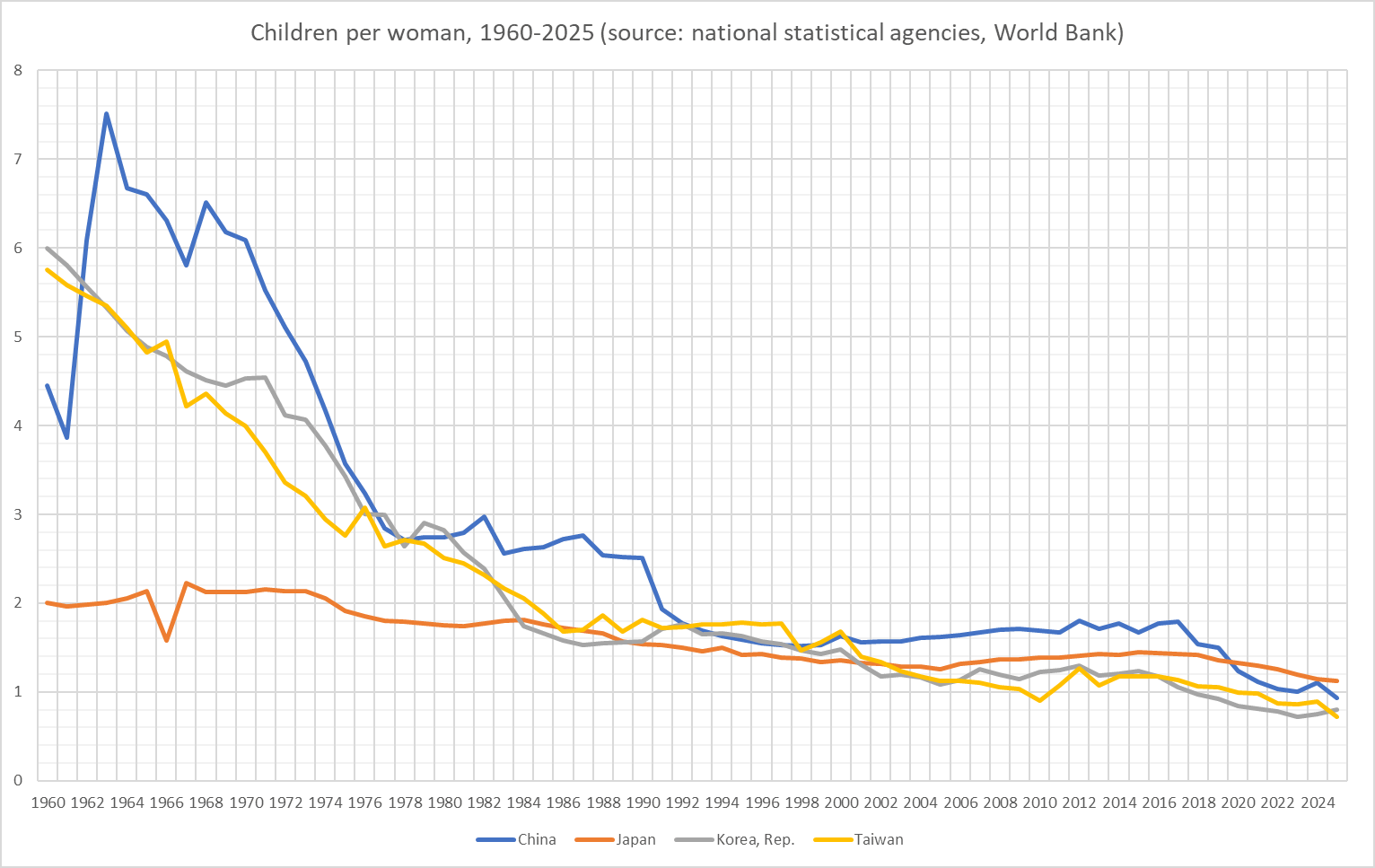
lol. Japan has the highest fertility rate in east Asia now.
Advanced-Bison-99 on
Since ~2015, the decline in fertility rate across Asia has been due to less relationship formation and marriage amongst young people.
For example, married couples in Japan have the same amount of children on average as a married couple since the 1990s.
Yet recently, Japan’s TFR has dropped to 1.0-1.1 births per woman.
BirthGauge on X has some very good graphs detailing exactly how the decline in marriage translates to lower TFR.
Mr_Horizon on
Japan was below replacement even before the pill was introduced?? I had no idea! Such a bad place to be in… or is it better, because their “old people bulge” isn’t as dramatic as in the other countries?
ambientocclusion on
How much is this offset by decreased child mortality?
Edit to answer my own question: infant mortality in China decreased 90% from 1960 to now:
Always very curious to me how these birth rate posts come up all the time but only ever mention East Asia, despite the fact that like half of Europe is experiencing the same. It’s not exactly like people are lining up to immigrate to Moldova or Macedonia either.
Grouchy_Edge632 on
I love how Japan went from lowest to highest fertility rate
RobotBaseball on
its fucking free time. People who are stuck in the corporate grind don’t have free time so they don’t have kids. It doesnt matter if they make 50,000, 500,000, or 5,000,000. It’s about time.
HobartTasmania on
Projections for China don’t look good at the end of the century
Same thing is happening to Japan and some people have even predicted that their economy will collapse by the middle of this century.
ghostoo666 on
the title is already using suggestive language by using the negative word “collapse”, implying that the original numbers were expected and that a loss of them is a detrimental. we could use positive words such as “normalize”, or neutral words such as “decrease”

![[OC] The birthrate collapse of East Asia](https://www.byteseu.com/wp-content/uploads/2026/02/l100yr6yc4ig1-1024x646.png "[OC] The birthrate collapse of East Asia")
17 Comments
Not something new, apparently.
Happening for 40-50 years already.
I do wonder why, most countries are having the same pattern.
Japan doesn’t give af. So metal
World will eventually be cleaner and more peaceful if these stats hold. It is bad for economic growth but we cannot have forever growth. Definition of growth will change.
It’s half economic and half social- people can’t afford kids and are overworked, and at the same time women are freer to realise that traditional motherhood isn’t ideal. Patriarchy is still very strong in lots of these places, and 9-5 plus raising kids is just too much.
double whammy comin in hot in that many of these countries are very anti immigration
Without looking it up, see if you can guess what year China’s one child policy started.
>!Wrong. It was 1979.!<
Same story as everywhere else. People are overworked and everything is too expensive to have kids. Governments will do literally anything else to try and raise birthrates but fix those things.
*The Age of Decay* is a decent book about the long term consequences of population collapse.
As it happens having a population of 50 million isn’t a problem, but a population of 50 million that has to somehow maintain or unbuild the physical and financial infrastructure designed for a population of 80 million is.
lol. Japan has the highest fertility rate in east Asia now.
Since ~2015, the decline in fertility rate across Asia has been due to less relationship formation and marriage amongst young people.
For example, married couples in Japan have the same amount of children on average as a married couple since the 1990s.
Yet recently, Japan’s TFR has dropped to 1.0-1.1 births per woman.
BirthGauge on X has some very good graphs detailing exactly how the decline in marriage translates to lower TFR.
Japan was below replacement even before the pill was introduced?? I had no idea! Such a bad place to be in… or is it better, because their “old people bulge” isn’t as dramatic as in the other countries?
How much is this offset by decreased child mortality?
Edit to answer my own question: infant mortality in China decreased 90% from 1960 to now:
https://www.statista.com/statistics/1042745/china-all-time-infant-mortality-rate/
Always very curious to me how these birth rate posts come up all the time but only ever mention East Asia, despite the fact that like half of Europe is experiencing the same. It’s not exactly like people are lining up to immigrate to Moldova or Macedonia either.
I love how Japan went from lowest to highest fertility rate
its fucking free time. People who are stuck in the corporate grind don’t have free time so they don’t have kids. It doesnt matter if they make 50,000, 500,000, or 5,000,000. It’s about time.
Projections for China don’t look good at the end of the century
https://theconversation.com/chinas-population-is-about-to-shrink-for-the-first-time-since-the-great-famine-struck-60-years-ago-heres-what-it-means-for-the-world-176377
Same thing is happening to Japan and some people have even predicted that their economy will collapse by the middle of this century.
the title is already using suggestive language by using the negative word “collapse”, implying that the original numbers were expected and that a loss of them is a detrimental. we could use positive words such as “normalize”, or neutral words such as “decrease”