*The Economist* is a neoliberal British newsmagazine, while the *Wall Street Journal* is a conservative American financial newspaper. They’re both small compared to the *New York Times*, which has gone from about 4 million subscribers in 2018 to about 12.7 million today.
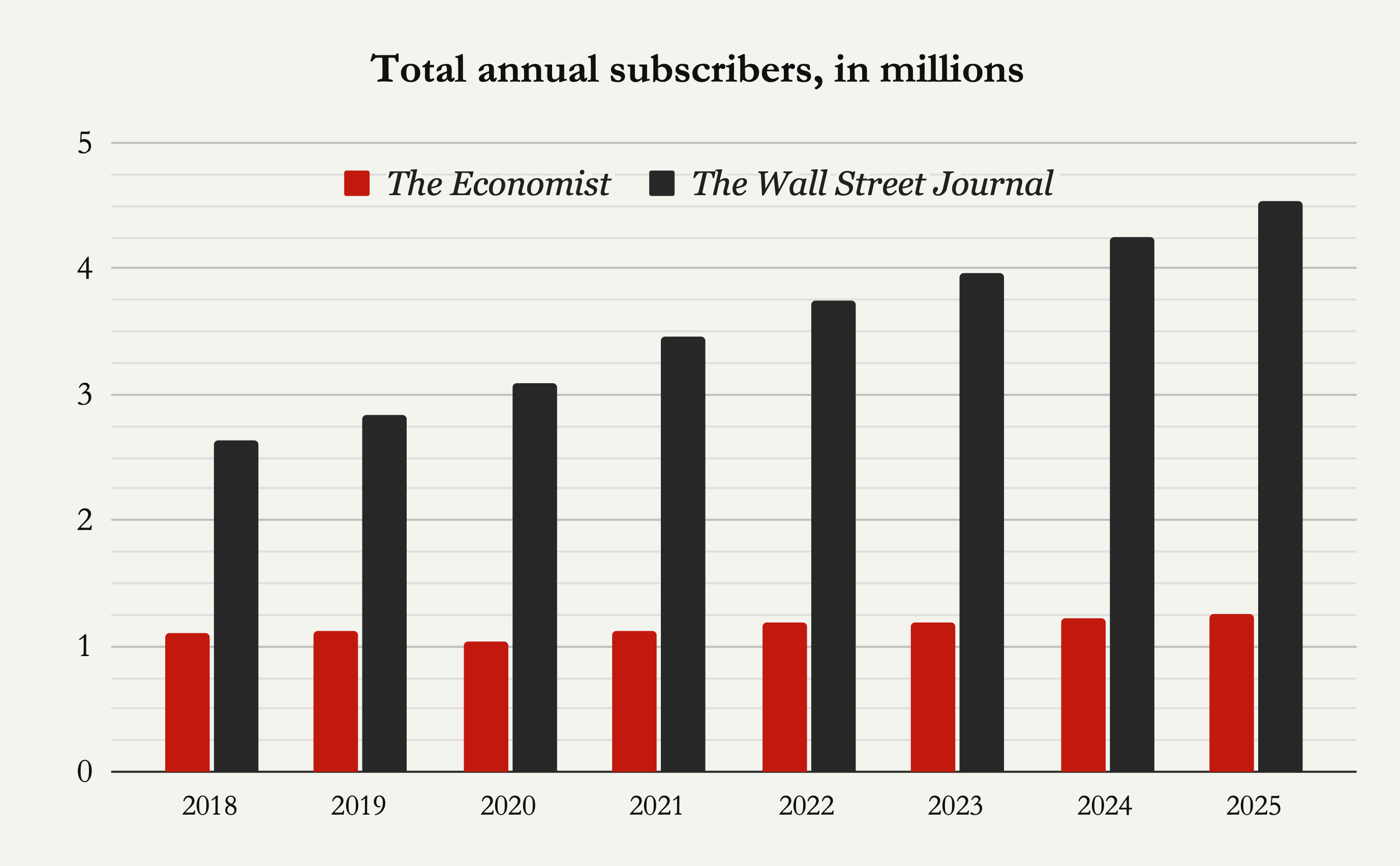
The *WSJ* has nearly doubled its subscribers, but the *Economist* has remained basically flat, going from 1.1 million to 1.25 or so over seven years. But maybe they don’t mind! They famously aim for an narrow, elite, wealthy audience and still make a profit every year. In the 90s their slogan was “*The Economist*: not read by millions each year.”
choco_pi on
It looks like the readership is at a crossroads.
spaceporter on
I subscribed to The Economist for about a decade. It was super cheap for students, and you didn’t need to prove your status every year, so long as you signed up originally with a university address.
I stopped because I bought an iPhone and suddenly had free access to their online journal, but when that ended I no longer felt inclined to sign up for the physical or digital journal.
They may not have thought things through with their digital unveiling, but then no journals/magazines did at the time, and once people get used to the idea of something being free it is very difficult to convince them otherwise.
The same thing happened with several of my weekly newspapers subscriptions.
Now I don’t want to pay for the digital versions, and the physical ones have become exorbitant due to the higher per-subscriber expenses when you are delivering to 1% as many homes in an area.
saveyourtissues on
Feels this is missing Financial Times.
DramaticSimple4315 on
The Economist is harder to read and understand than most of the conservative gibberish coming from the WSJ.
Maybe their digital strategy hasn’t been agressive enough, with additional reporting and analysis on current day events.
For instance, The Atlantic, despite retaining its status as a monthly magazine, transformed itself as a daily editorial provider on its app. It helped in having its subscriber numbers soar.
All in all, they still post a healthy 10% operating margin, so it’s not as if this is a big problem to them.
autobot12349876 on
For context, the WSJ used to be priced at about $37 per month over the past four or five years, at least. They have dropped the price to $4 a month. That would explain a lot of the growth, meanwhile, the economist has maintained no such pricing incentives and still over $200 a year.
Edit I meant $4/ week
jollyadvocate on
Economist cost more than basically anything else.
Worth-Distribution17 on
Data is beautiful = bar chart?
ColdEvenKeeled on
The Economist is great!! I was a subscriber. But I never found time to sit back and read the weekly arrival of news. I had to cancel due to the environmental impact of my unread magazines.
drubus_dong on
Those are very different publications.
IssueEmbarrassed8103 on
I’d get the economist if it wasn’t so expensive
darthnox502 on
The economist has been publishing garbage since the potato famine. Their takes have not improved since they published a breathy article about how happy the world was after letting Hitler have Czechoslovakia. (Seriously, read their coverage of anything with an even slightly critical eye and you’ll wonder if they even have editors).
__violaceous__ on
c ‘;;;;;тити
иv:::::т .
мN .– . b . N-,
,, , ,q q;;×,
Jonesm1 on
Its interesting because the objectives of the publications dont overlie each other, they’re not direct competitors. The Economist is far more international in its in-depth coverage while the WSJ covers, well, Wall Street. I’d be interested in seeing the addition of the Financial Times to the above graphic.
Calling the Economist neo-lib is a bit of a paint-over. It’s strongly pro business and pro free markets, though socially more progressive. It has recently been interesting watching the WSJ trying to walk a tightrope of Republican loyalism while the GOP tries to do lots of things it fundamentally disagrees with.
Slavik81 on
The subscription price for the print edition of The Economist doubled in that time. I’m surprised they’ve grown at all.

![[OC] Subscribers to 'The Wall Street Journal' vs to 'The Economist', 2018-2025](https://www.byteseu.com/wp-content/uploads/2026/02/gmfnecx0y4jg1-1536x950.png "[OC] Subscribers to ‘The Wall Street Journal’ vs to ‘The Economist’, 2018-2025")
16 Comments
Data sources:
[Annual Reports for the Economist from ‘The Economist Group’](https://www.economistgroup.com/results)
Statista – [Number of print and digital subscriptions to the Wall Street Journal from 2018 to 2024](https://www.statista.com/statistics/193788/average-paid-circulation-of-the-wall-street-journal/)
Tools used: Google Sheets
*The Economist* is a neoliberal British newsmagazine, while the *Wall Street Journal* is a conservative American financial newspaper. They’re both small compared to the *New York Times*, which has gone from about 4 million subscribers in 2018 to about 12.7 million today.
The *WSJ* has nearly doubled its subscribers, but the *Economist* has remained basically flat, going from 1.1 million to 1.25 or so over seven years. But maybe they don’t mind! They famously aim for an narrow, elite, wealthy audience and still make a profit every year. In the 90s their slogan was “*The Economist*: not read by millions each year.”
It looks like the readership is at a crossroads.
I subscribed to The Economist for about a decade. It was super cheap for students, and you didn’t need to prove your status every year, so long as you signed up originally with a university address.
I stopped because I bought an iPhone and suddenly had free access to their online journal, but when that ended I no longer felt inclined to sign up for the physical or digital journal.
They may not have thought things through with their digital unveiling, but then no journals/magazines did at the time, and once people get used to the idea of something being free it is very difficult to convince them otherwise.
The same thing happened with several of my weekly newspapers subscriptions.
Now I don’t want to pay for the digital versions, and the physical ones have become exorbitant due to the higher per-subscriber expenses when you are delivering to 1% as many homes in an area.
Feels this is missing Financial Times.
The Economist is harder to read and understand than most of the conservative gibberish coming from the WSJ.
Maybe their digital strategy hasn’t been agressive enough, with additional reporting and analysis on current day events.
For instance, The Atlantic, despite retaining its status as a monthly magazine, transformed itself as a daily editorial provider on its app. It helped in having its subscriber numbers soar.
All in all, they still post a healthy 10% operating margin, so it’s not as if this is a big problem to them.
For context, the WSJ used to be priced at about $37 per month over the past four or five years, at least. They have dropped the price to $4 a month. That would explain a lot of the growth, meanwhile, the economist has maintained no such pricing incentives and still over $200 a year.
Edit I meant $4/ week
Economist cost more than basically anything else.
Data is beautiful = bar chart?
The Economist is great!! I was a subscriber. But I never found time to sit back and read the weekly arrival of news. I had to cancel due to the environmental impact of my unread magazines.
Those are very different publications.
I’d get the economist if it wasn’t so expensive
The economist has been publishing garbage since the potato famine. Their takes have not improved since they published a breathy article about how happy the world was after letting Hitler have Czechoslovakia. (Seriously, read their coverage of anything with an even slightly critical eye and you’ll wonder if they even have editors).
c ‘;;;;;тити
иv:::::т .
мN .– . b . N-,
,, , ,q q;;×,
Its interesting because the objectives of the publications dont overlie each other, they’re not direct competitors. The Economist is far more international in its in-depth coverage while the WSJ covers, well, Wall Street. I’d be interested in seeing the addition of the Financial Times to the above graphic.
Calling the Economist neo-lib is a bit of a paint-over. It’s strongly pro business and pro free markets, though socially more progressive. It has recently been interesting watching the WSJ trying to walk a tightrope of Republican loyalism while the GOP tries to do lots of things it fundamentally disagrees with.
The subscription price for the print edition of The Economist doubled in that time. I’m surprised they’ve grown at all.