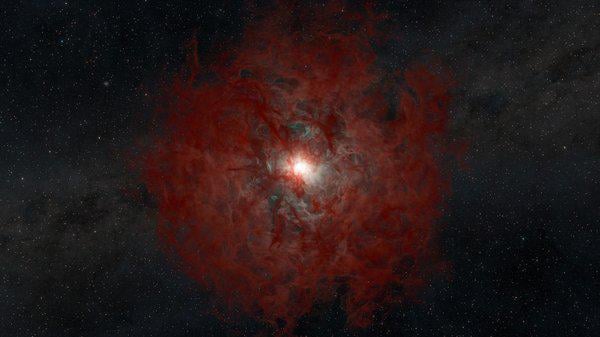
One of the brightest supergiant stars in the Andromeda Galaxy just vanished, skipping its supernova explosion to directly collapse into a black hole in total silence.
https://www.caltech.edu/about/news/the-quiet-formation-of-a-black-hole

One of the brightest supergiant stars in the Andromeda Galaxy just vanished, skipping its supernova explosion to directly collapse into a black hole in total silence.
https://www.caltech.edu/about/news/the-quiet-formation-of-a-black-hole
20 Comments
They do that, apparently. Vanish without a trace.
Unlike my ex who has to make a scene about everything.
Anyone read Pandora’s Star?
My advice: don’t send a starship there to check it out.
Happened 2.2 million years ago.
It should say „millions of years ago“ instead of „just“ if you‘re exact
What sucks here is how the last supernova recorded in Andromeda was in 1885. Now that there was finally one, it turned out to be a failed supernova -talk about Murphy’s law-.
[deleted]
Every comment here is some rubbish pun or joke. This website blows
As prof. David Kipping would say, “it fell all the way in.”
I really recommend Paul Fellows on YouTube for following this sort of stuff. I was just watching a video last night of his where I found out about two kinds of supernova I had never heard of before, including one where the gamma radiation in the core becomes so energetic it starts to split iron atoms apart endothermically, cooling the core and resulting in a core collapse supernova.
No doubt he will do a video on this star in the near future.
To be clear, it happened about 2.5 million years ago. We’re only just seeing it.
All puns and bad jokes aside, the fact that we can monitor a star in another galaxy and know anything about it beyond that it’s a star is mind boggling to me. That thing was so far away that it hurts the brain!
What’s the mechanism for this? Is it just not big enough to go boom?
My sci-fi obscure thoughts: What if every time this happens a new universe forms inside the black hole singularity and it releases a GRB as a Big Bang signature into the universe that it came from? What if the dark matter and energy we observe now is the very black hole that we came from and we are measuring it everywhere?
and why not dyson sphere? What evidence indicates that it is a black hole?
Must’ve been shy. Adding more text for 25 characters.
Based on the article the disappearance seems to have been between 2014 and 2016 and they were just now able to analyze the data and find out the anomaly. I am trying to imagine the breadth of data that must be coming through for us to take this much time in analyzing and confirming this event.
Does anyone here know what kind of technology is used to analyze this type of data?
“Stars are Silently Skipping Their Supernova Stage”
Given that Andromeda is larger than the Milky Way, would we not expect more frequent supernovae than Milky Way?
What I understand is happening is that this star is so massive that there was already a black hole within it, and essentially the star we were seeing was living on borrowed time with it’s nuclear reactions being driven by the same outward pressures that come from quesars. The scales tipped towards the black hole as it grew bigger and absorbed more of the star at once because of how geometry works. It formed inside the star, so it wouldn’t have shined longer like a quesar or galactic super black holes because it was absorbing matter more or less evenly.
Bigger stars burn their fuel faster than smaller ones, so the metaphorical candle was burning at both ends while being propped up by mass falling into the black hole.
I imagine it looked like how a kid imagines a black hole sucking up more and more if one ever formed on Earth, but with the mass to back it up. I don’t know what that says about stars except that there are a lot of interesting thresholds for their ultimate fates.
Is this wrong? I don’t know too much about stellar physics.